QUESTION IMAGE
Question
question 1-10
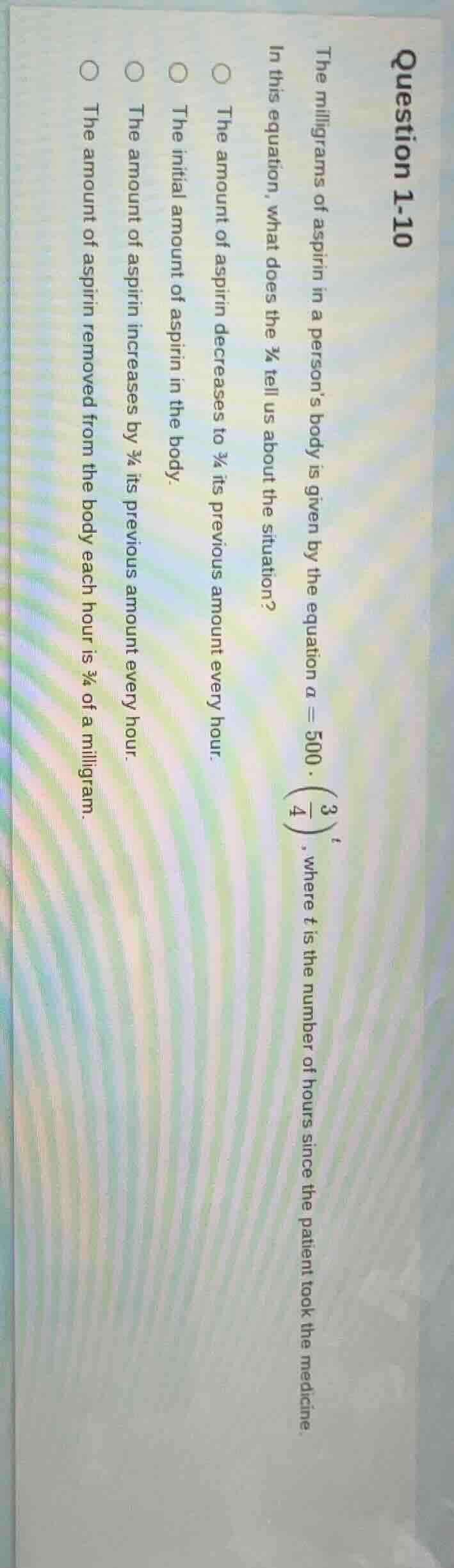
the milligrams of aspirin in a persons body is given by the equation $a = 500 \cdot \left(\frac{3}{4}\
ight)^t$, where $t$ is the number of hours since the patient took the medicine.
in this equation, what does the $\frac{3}{4}$ tell us about the situation?
○ the amount of aspirin decreases to $\frac{3}{4}$ its previous amount every hour.
○ the initial amount of aspirin in the body.
○ the amount of aspirin increases by $\frac{3}{4}$ its previous amount every hour.
○ the amount of aspirin removed from the body each hour is $\frac{3}{4}$ of a milligram.
The given equation is an exponential decay model of the form $a = a_0 \cdot r^t$, where $a_0$ is the initial amount, $r$ is the decay factor, and $t$ is time. Here, $r = \frac{3}{4}$, meaning each hour, the remaining amount of aspirin is $\frac{3}{4}$ of the amount from the previous hour (i.e., it decreases to $\frac{3}{4}$ of its previous amount each hour).

Snap & solve any problem in the app
Get step-by-step solutions on Sovi AI
Photo-based solutions with guided steps
Explore more problems and detailed explanations
The amount of aspirin decreases to ¾ its previous amount every hour.