QUESTION IMAGE
Question
question 1-7
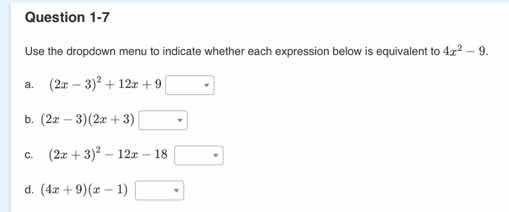
use the dropdown menu to indicate whether each expression below is equivalent to $4x^2 - 9$.
a. $(2x - 3)^2 + 12x + 9$
b. $(2x - 3)(2x + 3)$
c. $(2x + 3)^2 - 12x - 18$
d. $(4x + 9)(x - 1)$
To determine if each expression is equivalent to \(4x^2 - 9\), we can expand or simplify each expression and compare it to \(4x^2 - 9\). Recall that \(4x^2 - 9\) is a difference of squares, which factors as \((2x - 3)(2x + 3)\) (since \(a^2 - b^2 = (a - b)(a + b)\) where \(a = 2x\) and \(b = 3\)).
Part (a): \((2x - 3)^2 + 12x + 9\)
First, expand \((2x - 3)^2\):
\((2x - 3)^2 = (2x)^2 - 2(2x)(3) + 3^2 = 4x^2 - 12x + 9\).
Now add \(12x + 9\) to this result:
\(4x^2 - 12x + 9 + 12x + 9 = 4x^2 + 18\).
This simplifies to \(4x^2 + 18\), which is not equivalent to \(4x^2 - 9\).
Part (b): \((2x - 3)(2x + 3)\)
This is a difference of squares:
\((2x - 3)(2x + 3) = (2x)^2 - 3^2 = 4x^2 - 9\).
This matches \(4x^2 - 9\), so it is equivalent.
Part (c): \((2x + 3)^2 - 12x - 18\)
First, expand \((2x + 3)^2\):
\((2x + 3)^2 = (2x)^2 + 2(2x)(3) + 3^2 = 4x^2 + 12x + 9\).
Now subtract \(12x + 18\) from this result:
\(4x^2 + 12x + 9 - 12x - 18 = 4x^2 - 9\).
This simplifies to \(4x^2 - 9\), so it is equivalent.
Part (d): \((4x + 9)(x - 1)\)
Expand using the distributive property (FOIL):
\((4x + 9)(x - 1) = 4x \cdot x + 4x \cdot (-1) + 9 \cdot x + 9 \cdot (-1)\)
\(= 4x^2 - 4x + 9x - 9\)
\(= 4x^2 + 5x - 9\).
This simplifies to \(4x^2 + 5x - 9\), which is not equivalent to \(4x^2 - 9\).
Final Answers:
a. Not equivalent
b. Equivalent
c. Equivalent
d. Not equivalent
(For the dropdown menus, you would select "No" for (a) and (d), and "Yes" for (b) and (c).)

Snap & solve any problem in the app
Get step-by-step solutions on Sovi AI
Photo-based solutions with guided steps
Explore more problems and detailed explanations
To determine if each expression is equivalent to \(4x^2 - 9\), we can expand or simplify each expression and compare it to \(4x^2 - 9\). Recall that \(4x^2 - 9\) is a difference of squares, which factors as \((2x - 3)(2x + 3)\) (since \(a^2 - b^2 = (a - b)(a + b)\) where \(a = 2x\) and \(b = 3\)).
Part (a): \((2x - 3)^2 + 12x + 9\)
First, expand \((2x - 3)^2\):
\((2x - 3)^2 = (2x)^2 - 2(2x)(3) + 3^2 = 4x^2 - 12x + 9\).
Now add \(12x + 9\) to this result:
\(4x^2 - 12x + 9 + 12x + 9 = 4x^2 + 18\).
This simplifies to \(4x^2 + 18\), which is not equivalent to \(4x^2 - 9\).
Part (b): \((2x - 3)(2x + 3)\)
This is a difference of squares:
\((2x - 3)(2x + 3) = (2x)^2 - 3^2 = 4x^2 - 9\).
This matches \(4x^2 - 9\), so it is equivalent.
Part (c): \((2x + 3)^2 - 12x - 18\)
First, expand \((2x + 3)^2\):
\((2x + 3)^2 = (2x)^2 + 2(2x)(3) + 3^2 = 4x^2 + 12x + 9\).
Now subtract \(12x + 18\) from this result:
\(4x^2 + 12x + 9 - 12x - 18 = 4x^2 - 9\).
This simplifies to \(4x^2 - 9\), so it is equivalent.
Part (d): \((4x + 9)(x - 1)\)
Expand using the distributive property (FOIL):
\((4x + 9)(x - 1) = 4x \cdot x + 4x \cdot (-1) + 9 \cdot x + 9 \cdot (-1)\)
\(= 4x^2 - 4x + 9x - 9\)
\(= 4x^2 + 5x - 9\).
This simplifies to \(4x^2 + 5x - 9\), which is not equivalent to \(4x^2 - 9\).
Final Answers:
a. Not equivalent
b. Equivalent
c. Equivalent
d. Not equivalent
(For the dropdown menus, you would select "No" for (a) and (d), and "Yes" for (b) and (c).)