QUESTION IMAGE
Question
question 10 of 25
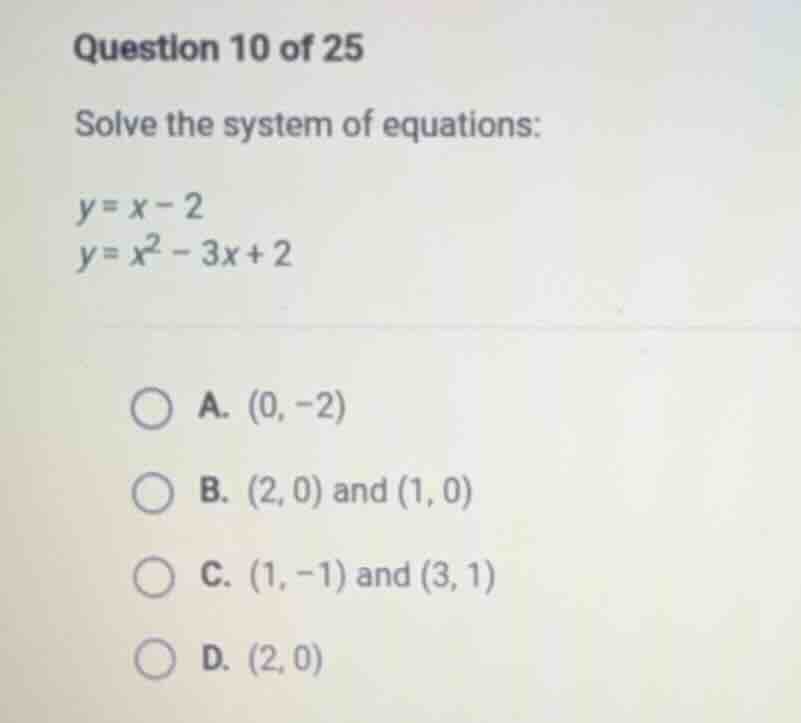
solve the system of equations:
$y = x - 2$
$y = x^2 - 3x + 2$
a. $(0, -2)$
b. $(2, 0)$ and $(1, 0)$
c. $(1, -1)$ and $(3, 1)$
d. $(2, 0)$
Step1: Substitute \( y = x - 2 \) into the quadratic equation
Since both equations are equal to \( y \), we can set them equal to each other: \( x - 2 = x^2 - 3x + 2 \)
Step2: Rearrange into standard quadratic form
Bring all terms to one side: \( x^2 - 3x + 2 - x + 2 = 0 \) simplifies to \( x^2 - 4x + 4 = 0 \)
Step3: Factor the quadratic
The quadratic factors as \( (x - 2)^2 = 0 \)
Step4: Solve for \( x \)
Taking the square root of both sides, we get \( x - 2 = 0 \), so \( x = 2 \)
Step5: Find the corresponding \( y \)-value
Substitute \( x = 2 \) into \( y = x - 2 \): \( y = 2 - 2 = 0 \)
We can also check the other option by substituting into both equations. For option C, take \( (1, -1) \): substitute into \( y = x - 2 \), \( -1 = 1 - 2 \) (true), substitute into \( y = x^2 - 3x + 2 \), \( -1 = 1 - 3 + 2 = 0 \) (false). So only \( (2, 0) \) is a solution? Wait, no, let's re - check the factoring. Wait, \( x^2 - 4x + 4=(x - 2)^2 \), so the only solution for \( x \) is \( x = 2 \), so the solution is \( (2,0) \)? But wait, let's check option C again. For \( (3,1) \): substitute into \( y=x - 2 \), \( 1=3 - 2 \) (true), substitute into \( y=x^2-3x + 2 \), \( 1=9 - 9+2=2 \) (false). Wait, maybe I made a mistake in substitution. Wait, the original equations: \( y=x - 2 \) and \( y=x^2-3x + 2 \). Let's set \( x - 2=x^2-3x + 2 \), then \( x^2-4x + 4 = 0 \), which is \( (x - 2)^2=0 \), so \( x = 2 \), \( y = 0 \). But let's check option C: \( (1,-1) \): \( y=x - 2\Rightarrow-1=1 - 2 \) (correct), \( y=x^2-3x + 2\Rightarrow-1=1 - 3+2=0 \) (incorrect). \( (3,1) \): \( y=x - 2\Rightarrow1=3 - 2 \) (correct), \( y=x^2-3x + 2\Rightarrow1=9 - 9+2=2 \) (incorrect). Wait, but maybe I messed up the equation setup. Wait, the quadratic equation is \( y=x^2-3x + 2 \), let's factor that: \( y=(x - 1)(x - 2) \). And the linear equation is \( y=x - 2 \). So the intersection points are where \( x - 2=(x - 1)(x - 2) \). Then \( (x - 2)-(x - 1)(x - 2)=0 \), \( (x - 2)(1-(x - 1))=0 \), \( (x - 2)(2 - x)=0 \), so \( x - 2=0 \) or \( 2 - x=0 \), both give \( x = 2 \), so \( y=0 \). Wait, but that's only one solution. But the options have C as \( (1,-1) \) and \( (3,1) \). Wait, maybe I made a mistake in the equation. Wait, the quadratic is \( y=x^2-3x + 2 \), let's compute \( y \) when \( x = 1 \): \( y=1 - 3+2=0 \), not - 1. Oh! I see my mistake. When \( x = 1 \), \( y=x^2-3x + 2=1 - 3+2=0 \), not - 1. So for \( (1,-1) \), the \( y \)-value from the quadratic is 0, not - 1, so it's not a solution. For \( (3,1) \): \( y=x^2-3x + 2=9 - 9+2=2 \), not 1. So the only solution is \( (2,0) \). Wait, but let's check the options again. Option B is \( (2,0) \) and \( (1,0) \). Let's check \( (1,0) \): substitute into \( y=x - 2 \), \( 0=1 - 2=-1 \) (false). So \( (1,0) \) is not a solution. So the correct solution is \( (2,0) \), which is option D? Wait, no, option D is \( (2,0) \), option B is \( (2,0) \) and \( (1,0) \), but \( (1,0) \) doesn't satisfy \( y=x - 2 \). Wait, maybe I made a mistake in the equation setup. Wait, the two equations are \( y=x - 2 \) and \( y=x^2-3x + 2 \). Let's graph them mentally: the first is a line with slope 1, y - intercept - 2. The second is a parabola opening upwards with vertex at \( x=\frac{3}{2} \), \( y=(\frac{3}{2})^2-3\times\frac{3}{2}+2=\frac{9}{4}-\frac{9}{2}+2=\frac{9 - 18 + 8}{4}=-\frac{1}{4} \). The line \( y=x - 2 \) intersects the parabola. Let's solve again: \( x - 2=x^2-3x + 2 \), \( x^2-4x + 4 = 0 \), \( (x - 2)^2=0 \), so only \( x = 2 \), \( y = 0 \). So the solution is \( (2,0) \), which is option D…

Snap & solve any problem in the app
Get step-by-step solutions on Sovi AI
Photo-based solutions with guided steps
Explore more problems and detailed explanations
D. (2, 0)