QUESTION IMAGE
Question
question 10
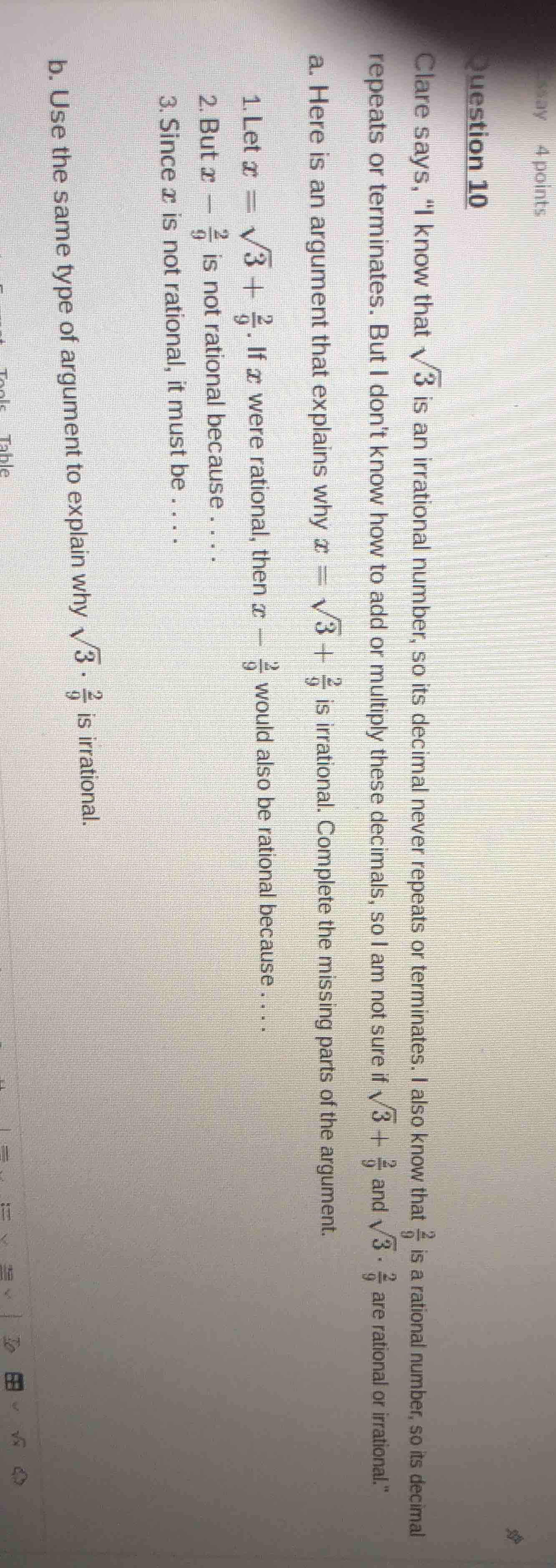
clare says, \i know that \\(\sqrt{3}\\) is an irrational number, so its decimal never repeats or terminates. i also know that \\(\frac{2}{9}\\) is a rational number, so its decimal repeats or terminates. but i dont know how to add or multiply these decimals, so i am not sure if \\(\sqrt{3} + \frac{2}{9}\\) and \\(\sqrt{3} \cdot \frac{2}{9}\\) are rational or irrational.\
a. here is an argument that explains why \\(x = \sqrt{3} + \frac{2}{9}\\) is irrational. complete the missing parts of the argument.
- let \\(x = \sqrt{3} + \frac{2}{9}\\). if \\(x\\) were rational, then \\(x - \frac{2}{9}\\) would also be rational because …
- but \\(x - \frac{2}{9}\\) is not rational because …
- since \\(x\\) is not rational, it must be …
b. use the same type of argument to explain why \\(\sqrt{3} \cdot \frac{2}{9}\\) is irrational.
Part a
Step 1: Recall Rational Number Closure
Rational numbers are closed under subtraction, meaning if \(a\) and \(b\) are rational, then \(a - b\) is rational. Let \(x=\sqrt{3}+\frac{2}{9}\). If \(x\) were rational, and \(\frac{2}{9}\) is rational, then \(x-\frac{2}{9}\) would also be rational because the difference of two rational numbers is rational.
Step 2: Analyze \(x - \frac{2}{9}\)
But \(x-\frac{2}{9}=\sqrt{3}+\frac{2}{9}-\frac{2}{9}=\sqrt{3}\), and \(\sqrt{3}\) is not rational (it's an irrational number, proven by the fact that if \(\sqrt{3}=\frac{p}{q}\) (in lowest terms), then \(p^2 = 3q^2\), implying \(p\) and \(q\) are multiples of 3, a contradiction).
Step 3: Conclude \(x\) is Irrational
Since \(x-\frac{2}{9}=\sqrt{3}\) is not rational, our assumption that \(x\) is rational is false. So \(x = \sqrt{3}+\frac{2}{9}\) must be irrational.
Part b
Step 1: Assume the Product is Rational
Let \(y=\sqrt{3}\cdot\frac{2}{9}\). Assume \(y\) is rational.
Step 2: Use Rational Closure for Division
Rational numbers are closed under division (by non - zero rationals). Since \(\frac{2}{9}\) is non - zero and rational, if \(y\) is rational, then \(y\div\frac{2}{9}=\frac{y}{\frac{2}{9}}=\frac{9y}{2}\) would also be rational. But \(y\div\frac{2}{9}=\sqrt{3}\cdot\frac{2}{9}\div\frac{2}{9}=\sqrt{3}\).
Step 3: Contradiction and Conclusion
We know that \(\sqrt{3}\) is irrational. This contradicts our assumption that \(y\) is rational. So \(\sqrt{3}\cdot\frac{2}{9}\) must be irrational.

Snap & solve any problem in the app
Get step-by-step solutions on Sovi AI
Photo-based solutions with guided steps
Explore more problems and detailed explanations
s:
a.
- The difference of two rational numbers is rational.
- \(x-\frac{2}{9}=\sqrt{3}\)
- \(x=\sqrt{3}+\frac{2}{9}\) is irrational.
b. \(\sqrt{3}\cdot\frac{2}{9}\) is irrational (explanation as above).