QUESTION IMAGE
Question
question 7 of 10
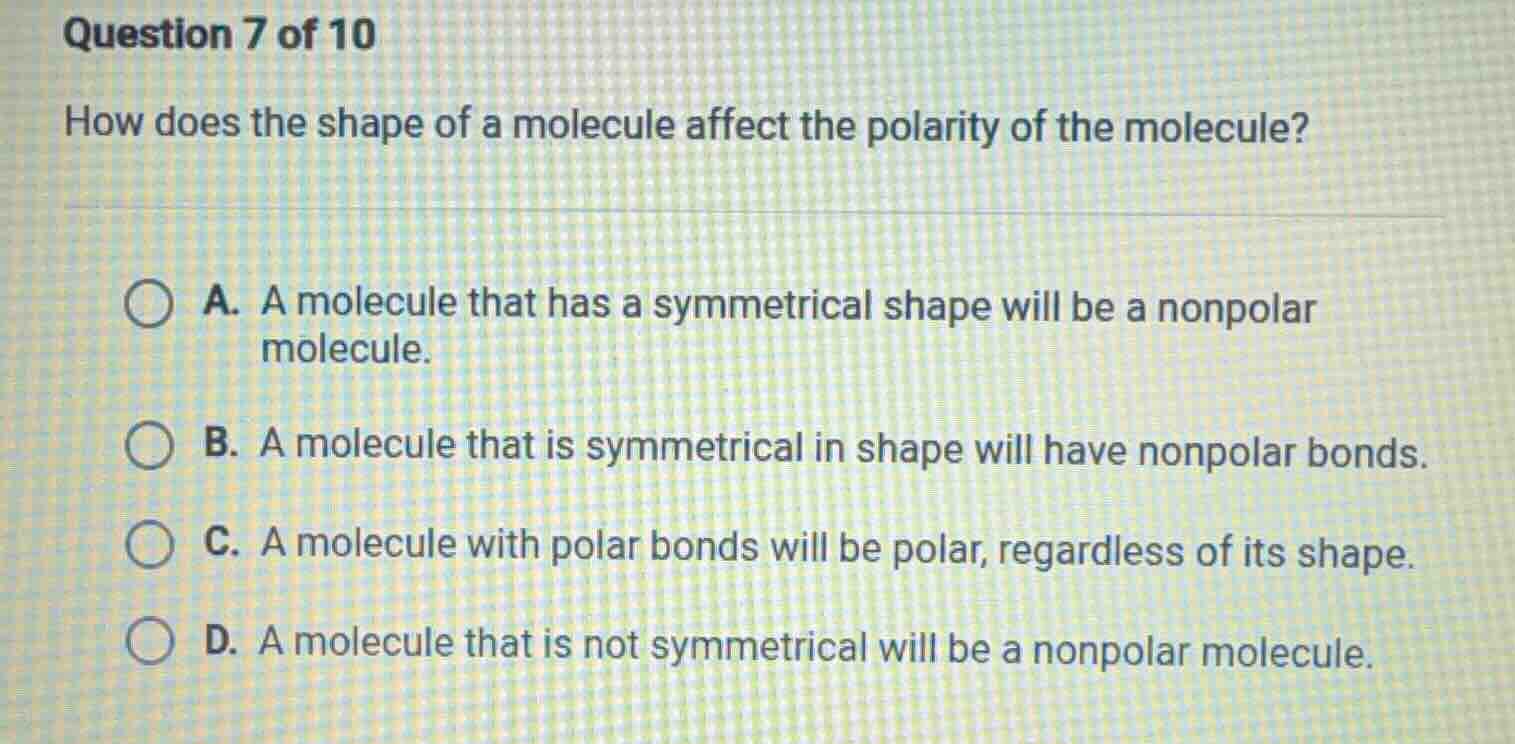
how does the shape of a molecule affect the polarity of the molecule?
a. a molecule that has a symmetrical shape will be a nonpolar
molecule.
b. a molecule that is symmetrical in shape will have nonpolar bonds.
c. a molecule with polar bonds will be polar, regardless of its shape.
d. a molecule that is not symmetrical will be a nonpolar molecule.
Brief Explanations
- Option A: If a molecule has a symmetrical shape, the dipole moments of its polar bonds (if any) tend to cancel out, resulting in a nonpolar molecule. For example, in \( \text{CO}_2 \) (linear and symmetrical), the polar \( \text{C}=\text{O} \) bonds' dipoles cancel, making it nonpolar.
- Option B: Symmetry of the molecule doesn't determine if bonds are nonpolar. A symmetrical molecule can have polar bonds (e.g., \( \text{CO}_2 \) has polar \( \text{C}=\text{O} \) bonds but is symmetrical).
- Option C: A molecule with polar bonds isn't always polar. If the shape is symmetrical, the dipoles can cancel (e.g., \( \text{BF}_3 \) has polar \( \text{B}-\text{F} \) bonds but is nonpolar due to trigonal planar symmetry).
- Option D: A nonsymmetrical molecule with polar bonds will likely be polar (e.g., \( \text{H}_2\text{O} \) is bent and polar), so this is incorrect.

Snap & solve any problem in the app
Get step-by-step solutions on Sovi AI
Photo-based solutions with guided steps
Explore more problems and detailed explanations
A. A molecule that has a symmetrical shape will be a nonpolar molecule.