QUESTION IMAGE
Question
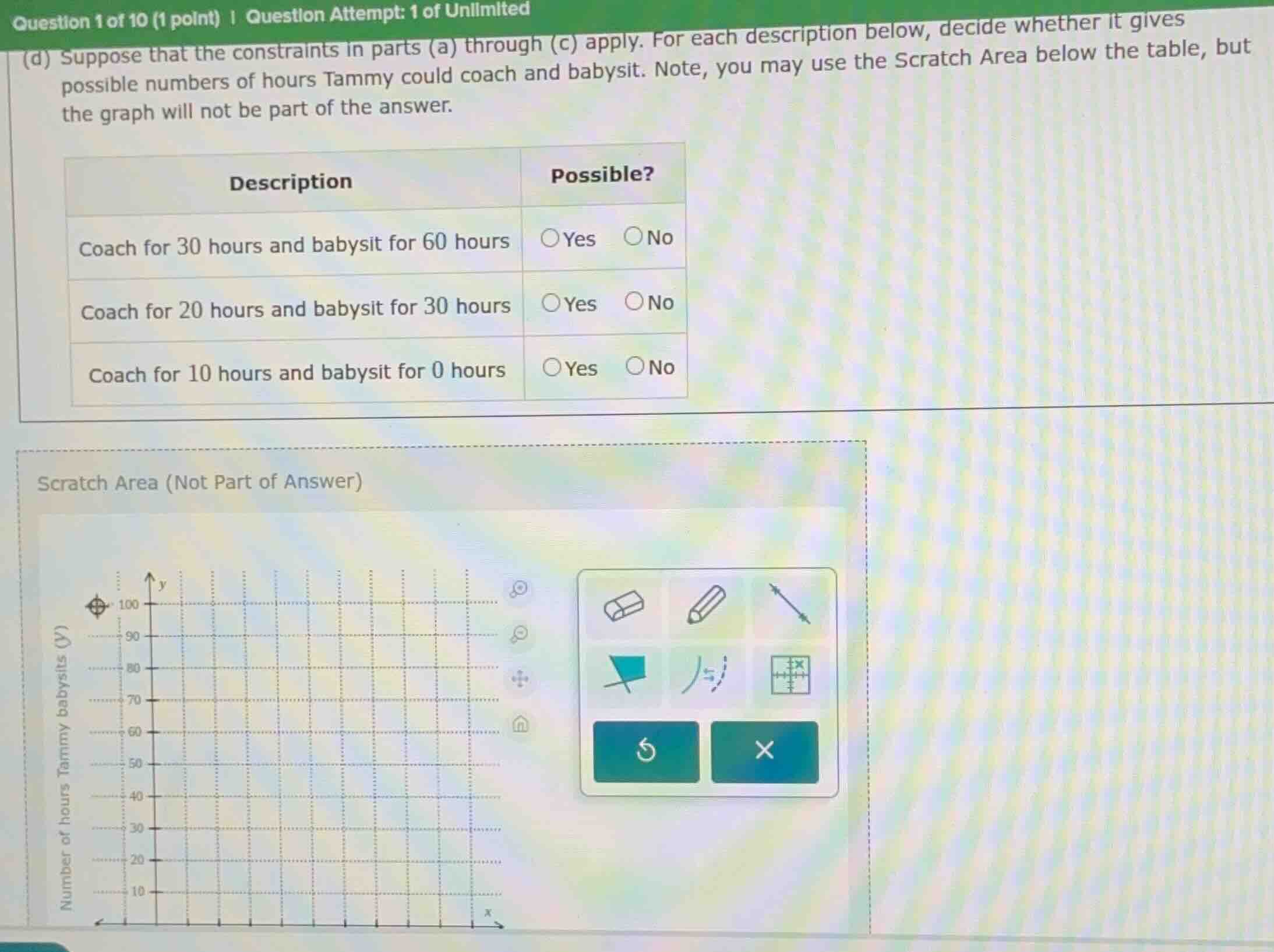
question 1 of 10 (1 point) | question attempt: 1 of unlimited (d) suppose that the constraints in parts (a) through (c) apply. for each description below, decide whether it gives possible numbers of hours tammy could coach and babysit. note, you may use the scratch area below the table, but the graph will not be part of the answer. description possible? coach for 30 hours and babysit for 60 hours ∘yes ∘no coach for 20 hours and babysit for 30 hours ∘yes ∘no coach for 10 hours and babysit for 0 hours ∘yes ∘no scratch area (not part of answer)
To solve this, we assume the constraints from parts (a)-(c) likely include time limits (e.g., total hours, individual limits). Let's analyze each case:
1. Coach for 30 hours, babysit for 60 hours
Assume a constraint like \( x + y \leq \text{total hours} \) (or other linear constraints). If total hours (e.g., from graph, max \( x + y \) or individual limits), 30 + 60 = 90. If max total is less (e.g., 80), this is too much. So likely No.
2. Coach for 20 hours, babysit for 30 hours
20 + 30 = 50. If within total limit (e.g., 80) and individual limits (20 ≤ max coach, 30 ≤ max babysit), this is feasible. So Yes.
3. Coach for 10 hours, babysit for 0 hours
10 + 0 = 10, which is well within any reasonable total limit, and 0 babysit hours is allowed (non - negative). So Yes.
Final Answers:
- Coach for 30 hours and babysit for 60 hours: \(\boldsymbol{\text{No}}\)
- Coach for 20 hours and babysit for 30 hours: \(\boldsymbol{\text{Yes}}\)
- Coach for 10 hours and babysit for 0 hours: \(\boldsymbol{\text{Yes}}\)

Snap & solve any problem in the app
Get step-by-step solutions on Sovi AI
Photo-based solutions with guided steps
Explore more problems and detailed explanations
To solve this, we assume the constraints from parts (a)-(c) likely include time limits (e.g., total hours, individual limits). Let's analyze each case:
1. Coach for 30 hours, babysit for 60 hours
Assume a constraint like \( x + y \leq \text{total hours} \) (or other linear constraints). If total hours (e.g., from graph, max \( x + y \) or individual limits), 30 + 60 = 90. If max total is less (e.g., 80), this is too much. So likely No.
2. Coach for 20 hours, babysit for 30 hours
20 + 30 = 50. If within total limit (e.g., 80) and individual limits (20 ≤ max coach, 30 ≤ max babysit), this is feasible. So Yes.
3. Coach for 10 hours, babysit for 0 hours
10 + 0 = 10, which is well within any reasonable total limit, and 0 babysit hours is allowed (non - negative). So Yes.
Final Answers:
- Coach for 30 hours and babysit for 60 hours: \(\boldsymbol{\text{No}}\)
- Coach for 20 hours and babysit for 30 hours: \(\boldsymbol{\text{Yes}}\)
- Coach for 10 hours and babysit for 0 hours: \(\boldsymbol{\text{Yes}}\)