QUESTION IMAGE
Question
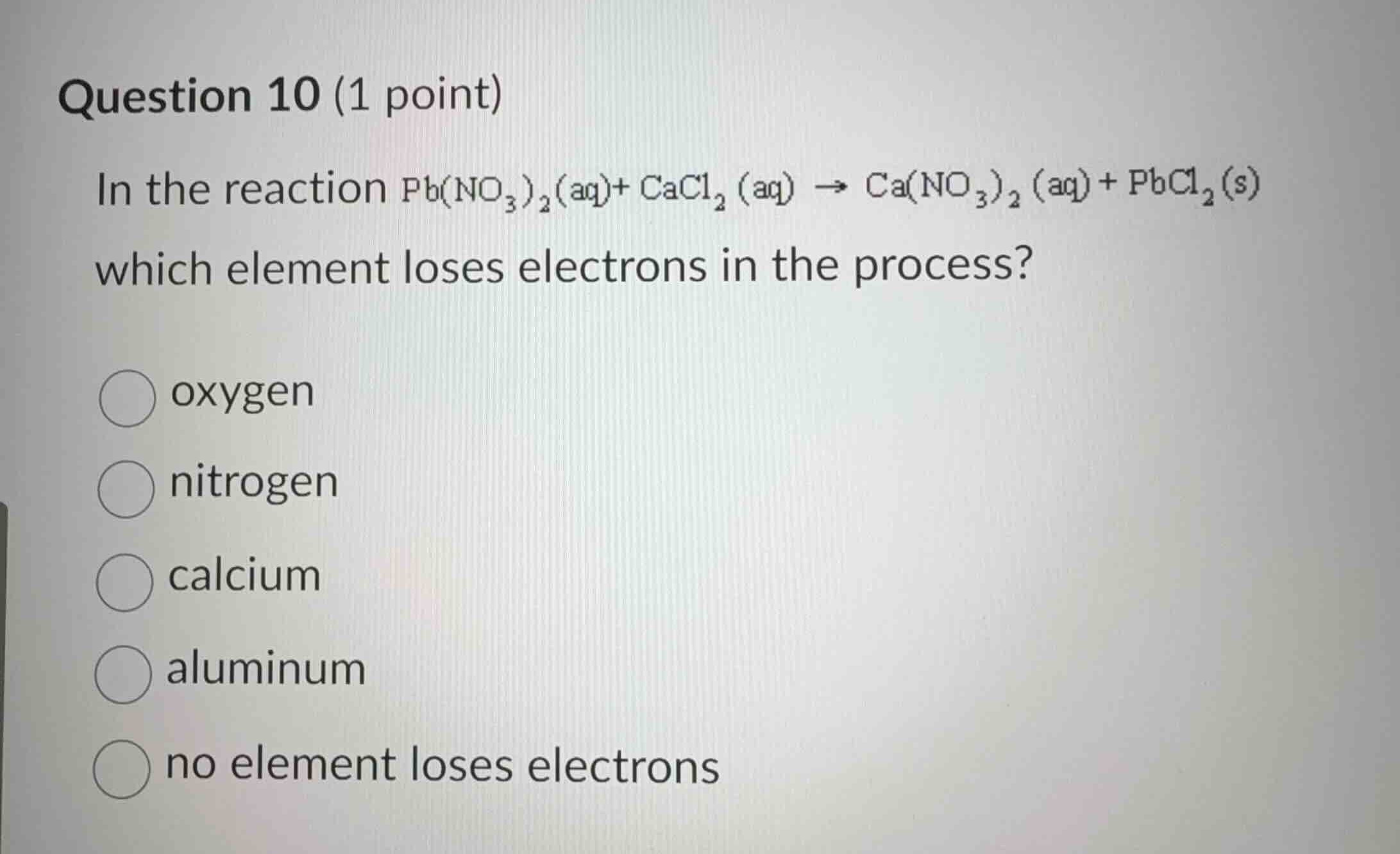
question 10 (1 point)
in the reaction $\ce{pb(no_{3})_{2}(aq) + cacl_{2}(aq) \
ightarrow ca(no_{3})_{2}(aq) + pbcl_{2}(s)}$ which element loses electrons in the process?
\\(\circ\\) oxygen
\\(\circ\\) nitrogen
\\(\circ\\) calcium
\\(\circ\\) aluminum
\\(\circ\\) no element loses electrons
First, we analyze the reaction \( \text{Pb(NO}_3\text{)}_2\text{(aq)} + \text{CaCl}_2\text{(aq)}
ightarrow \text{Ca(NO}_3\text{)}_2\text{(aq)} + \text{PbCl}_2\text{(s)} \). This is a double - displacement reaction (also called a metathesis reaction), not a redox reaction. In a redox reaction, there is a transfer of electrons (change in oxidation states). Let's check the oxidation states of each element:
- For \( \text{Pb} \) in \( \text{Pb(NO}_3\text{)}_2 \): The nitrate ion (\( \text{NO}_3^- \)) has a charge of - 1. Let the oxidation state of \( \text{Pb} \) be \( x \). Then \( x+2\times(- 1)=0\), so \( x = + 2 \). In \( \text{PbCl}_2 \), the chloride ion (\( \text{Cl}^- \)) has a charge of - 1. Let the oxidation state of \( \text{Pb} \) be \( y \). Then \( y + 2\times(-1)=0\), so \( y=+2 \).
- For \( \text{Ca} \) in \( \text{CaCl}_2 \): The chloride ion has a charge of - 1. Let the oxidation state of \( \text{Ca} \) be \( z \). Then \( z+2\times(-1) = 0\), so \( z = + 2 \). In \( \text{Ca(NO}_3\text{)}_2 \), the nitrate ion has a charge of - 1. Let the oxidation state of \( \text{Ca} \) be \( w \). Then \( w+2\times(-1)=0\), so \( w = + 2 \).
- For \( \text{N} \) in \( \text{NO}_3^- \): Let the oxidation state of \( \text{N} \) be \( a \). Oxygen has an oxidation state of - 2. So \( a+3\times(-2)=-1\), \( a = + 5 \) in both \( \text{Pb(NO}_3\text{)}_2 \) and \( \text{Ca(NO}_3\text{)}_2 \).
- For \( \text{O} \) in \( \text{NO}_3^- \): The oxidation state of \( \text{O} \) is - 2 in all cases.
- For \( \text{Cl} \) in \( \text{CaCl}_2 \): The oxidation state of \( \text{Cl} \) is - 1, and in \( \text{PbCl}_2 \) it is also - 1.
Since there is no change in the oxidation states of any of the elements (no element is oxidized or reduced), no element loses electrons.

Snap & solve any problem in the app
Get step-by-step solutions on Sovi AI
Photo-based solutions with guided steps
Explore more problems and detailed explanations
no element loses electrons