QUESTION IMAGE
Question
question 1 of 10 < >
policies
current attempt in progress
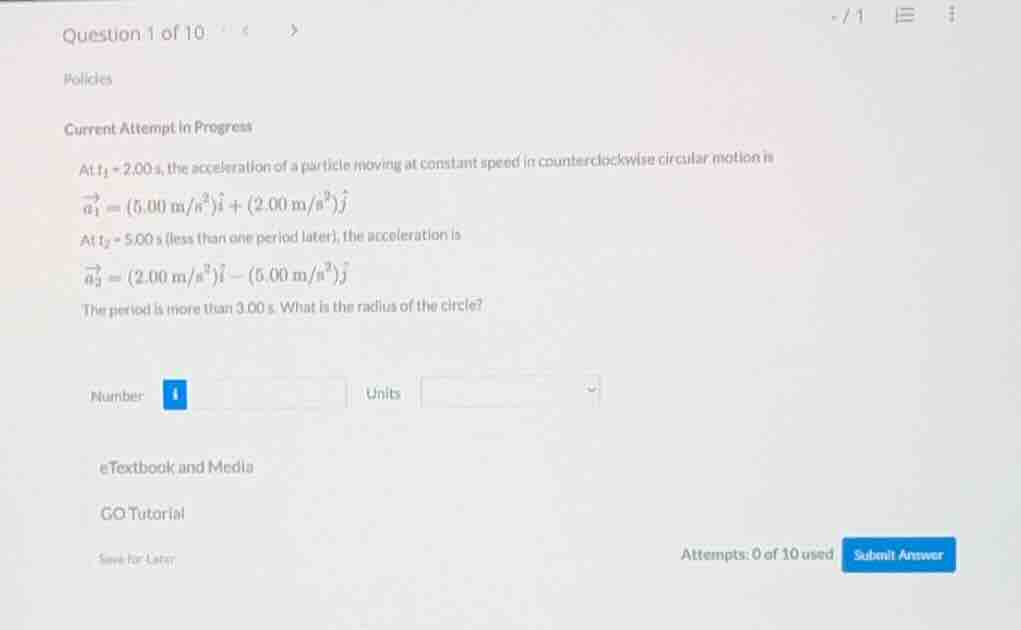
at $t_1 = 2.00$ s, the acceleration of a particle moving at constant speed in counterclockwise circular motion is
$\vec{a}_1 = (5.00\\ \text{m/s}^2)\hat{i} + (2.00\\ \text{m/s}^2)\hat{j}$
at $t_2 = 5.00$ s (less than one period later), the acceleration is
$\vec{a}_2 = (2.00\\ \text{m/s}^2)\hat{i} - (5.00\\ \text{m/s}^2)\hat{j}$
the period is more than 3.00 s. what is the radius of the circle?
number
units
etextbook and media
go tutorial
save for later
attempts: 0 of 10 used submit answer
Step1: Find magnitudes of accelerations
The centripetal acceleration magnitude is constant for uniform circular motion. For $\vec{a}_1$:
$$|\vec{a}_1| = \sqrt{(5.00)^2 + (2.00)^2} = \sqrt{25 + 4} = \sqrt{29} \, \text{m/s}^2$$
For $\vec{a}_2$:
$$|\vec{a}_2| = \sqrt{(2.00)^2 + (-5.00)^2} = \sqrt{4 + 25} = \sqrt{29} \, \text{m/s}^2$$
Step2: Find angle between accelerations
Use the dot product formula $\vec{a}_1 \cdot \vec{a}_2 = |\vec{a}_1||\vec{a}_2|\cos\theta$.
$$\vec{a}_1 \cdot \vec{a}_2 = (5.00)(2.00) + (2.00)(-5.00) = 10 - 10 = 0$$
So $\cos\theta = 0$, meaning $\theta = 90^\circ = \frac{\pi}{2}$ radians.
Step3: Calculate angular speed $\omega$
Time elapsed $\Delta t = t_2 - t_1 = 5.00 - 2.00 = 3.00$ s. For counterclockwise motion, $\theta = \omega\Delta t$, so:
$$\omega = \frac{\theta}{\Delta t} = \frac{\pi/2}{3.00} = \frac{\pi}{6} \, \text{rad/s}$$
Step4: Relate to radius $r$
Centripetal acceleration $a = \omega^2 r$, so solve for $r$:
$$r = \frac{a}{\omega^2}$$
Substitute $a = \sqrt{29}$ and $\omega = \frac{\pi}{6}$:
$$r = \frac{\sqrt{29}}{(\pi/6)^2} = \frac{36\sqrt{29}}{\pi^2}$$
Step5: Compute numerical value
$$\sqrt{29} \approx 5.385, \pi^2 \approx 9.8696$$
$$r \approx \frac{36 \times 5.385}{9.8696} \approx \frac{193.86}{9.8696} \approx 19.64 \, \text{m}$$

Snap & solve any problem in the app
Get step-by-step solutions on Sovi AI
Photo-based solutions with guided steps
Explore more problems and detailed explanations
19.64
Units: meters (m)