QUESTION IMAGE
Question
question 1 of 10
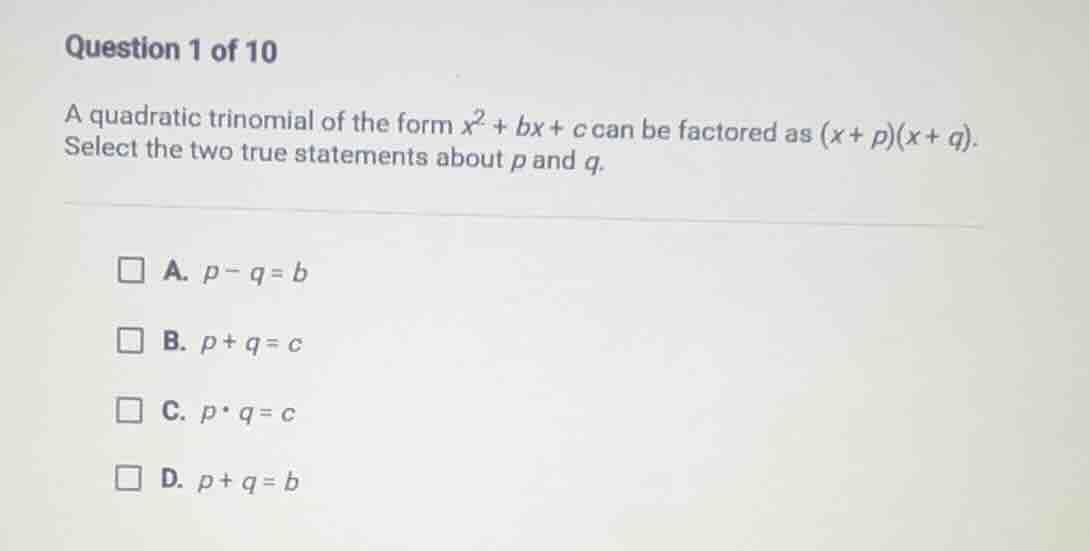
a quadratic trinomial of the form ( x^2 + bx + c ) can be factored as ( (x + p)(x + q) ).
select the two true statements about ( p ) and ( q ).
a. ( p - q = b )
b. ( p + q = c )
c. ( p cdot q = c )
d. ( p + q = b )
Step1: Expand the factored form
We start by expanding \((x + p)(x + q)\) using the distributive property (FOIL method).
\[
$$\begin{align*}
(x + p)(x + q)&=x\cdot x+x\cdot q + p\cdot x + p\cdot q\\
&=x^{2}+(p + q)x+pq
\end{align*}$$
\]
Step2: Compare with the standard form
The standard form of the quadratic trinomial is \(x^{2}+bx + c\). When we compare the expanded form \(x^{2}+(p + q)x+pq\) with \(x^{2}+bx + c\), we can see that:
- The coefficient of \(x\) in the expanded form is \(p + q\), and in the standard form it is \(b\). So, \(p + q=b\).
- The constant term in the expanded form is \(pq\) (which is \(p\cdot q\)), and in the standard form it is \(c\). So, \(p\cdot q = c\).

Snap & solve any problem in the app
Get step-by-step solutions on Sovi AI
Photo-based solutions with guided steps
Explore more problems and detailed explanations
C. \(p\cdot q = c\)
D. \(p + q = b\)