QUESTION IMAGE
Question
question 7 of 10
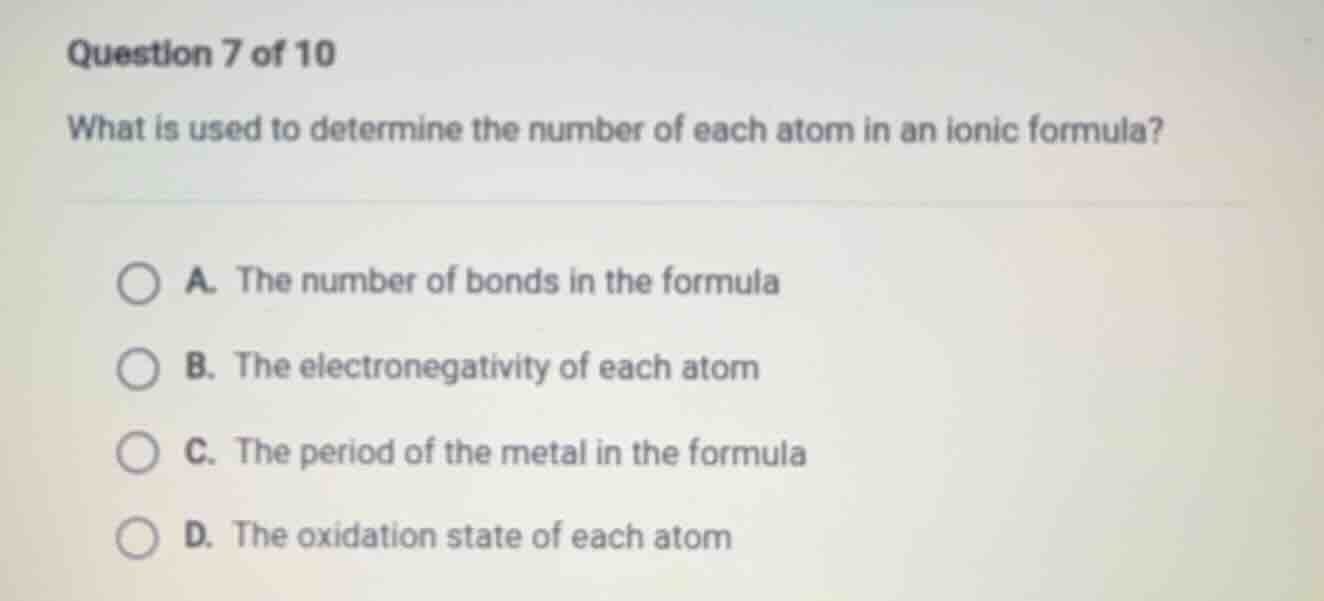
what is used to determine the number of each atom in an ionic formula?
a. the number of bonds in the formula
b. the electronegativity of each atom
c. the period of the metal in the formula
d. the oxidation state of each atom
Brief Explanations
To determine the number of each atom in an ionic formula, we analyze each option:
- Option A: Ionic compounds involve ionic bonds (electron transfer), not covalent - like bond counting. So bond number is irrelevant.
- Option B: Electronegativity determines bond type (ionic/covalent) or polarity, not atom counts in ionic formulas.
- Option C: The period of a metal (row in periodic table) relates to electron shells, not atom counts in ionic formulas.
- Option D: Oxidation state (charge of ion) is used. In an ionic formula, the total positive charge equals total negative charge (charge balance). Using oxidation states, we find the ratio of ions (and thus atoms) to satisfy charge neutrality. For example, in $\ce{Al2O3}$, $\ce{Al}$ has +3 oxidation state, $\ce{O}$ has - 2. To balance charges ($2\times( + 3)+3\times( - 2)=0$), we get the ratio 2:3 for $\ce{Al}$ and $\ce{O}$.

Snap & solve any problem in the app
Get step-by-step solutions on Sovi AI
Photo-based solutions with guided steps
Explore more problems and detailed explanations
D. The oxidation state of each atom