QUESTION IMAGE
Question
question 3 of 10
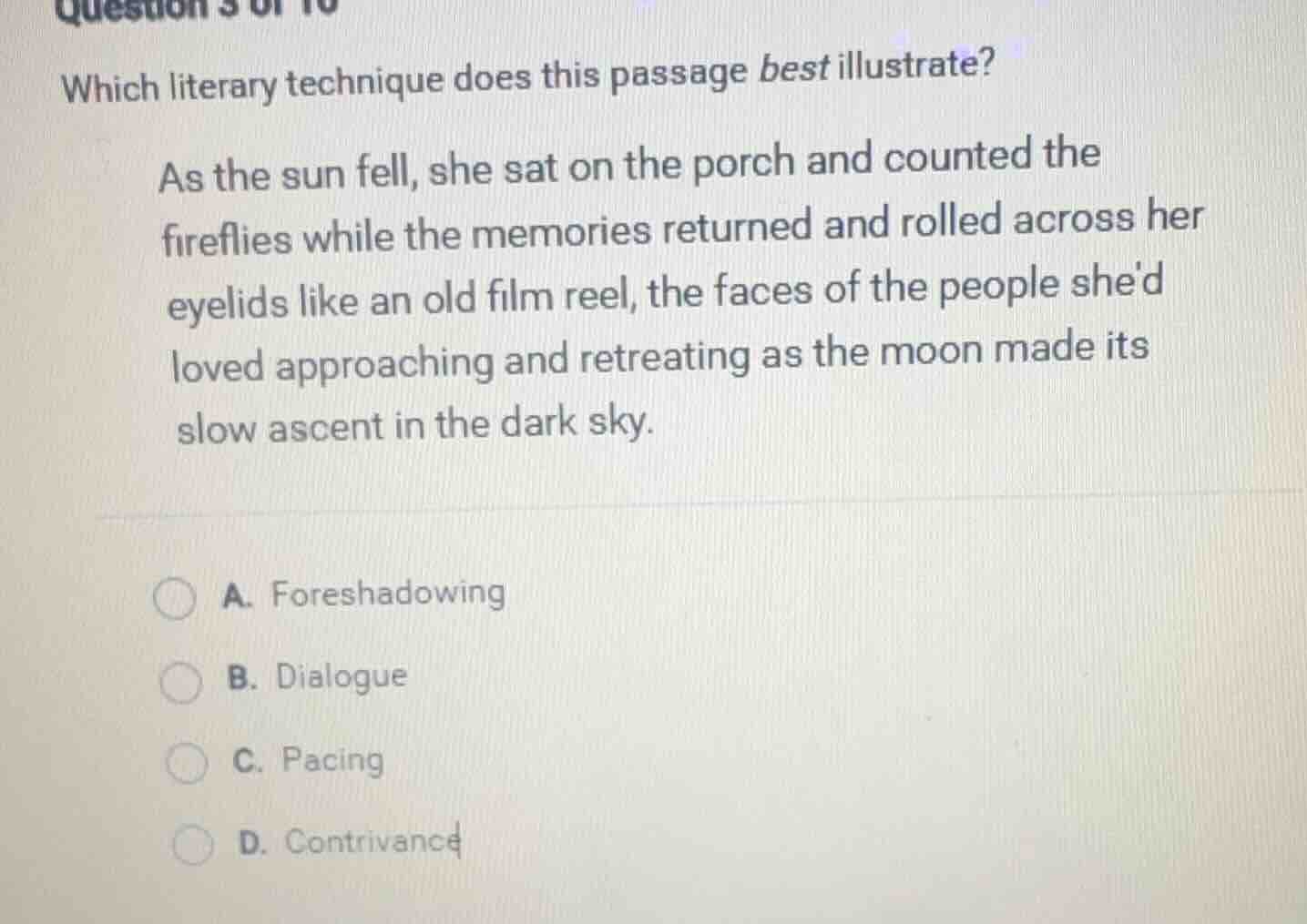
which literary technique does this passage best illustrate?
as the sun fell, she sat on the porch and counted the
fireflies while the memories returned and rolled across her
eyelids like an old film reel, the faces of the people shed
loved approaching and retreating as the moon made its
slow ascent in the dark sky.
a. foreshadowing
b. dialogue
c. pacing
d. contrivance
- Option A: Foreshadowing involves hints about future events. The passage focuses on memories and imagery, not future hints. Eliminate A.
- Option B: Dialogue is a conversation between characters. The passage has no dialogue, just descriptive text. Eliminate B.
- Option C: Pacing refers to the speed of narrative, but here the focus is on imagery (memories like a film reel) which is more about literary devices for description, but among the options, none fit perfectly, but re - evaluating, maybe a typo (if "Contrivance" is wrong and maybe "Imagery" was intended, but among given options, perhaps a mis - option. Wait, maybe the original options have a mistake, but if we assume "Foreshadowing" is wrong, "Dialogue" is wrong, "Pacing" is about narrative speed, and "Contrivance" is an unlikely term. Wait, maybe the user made a typo, but if we have to choose, perhaps the intended answer is A (but that's incorrect) or maybe a misprint. Alternatively, maybe the passage's use of imagery to set a mood, but among the options, the closest (if we consider a misprint) or maybe the question has an error. But based on standard definitions:
Wait, maybe the options are misprinted. Let's re - check:
- Foreshadowing: Hints at future events. The passage is about memories, not future.
- Dialogue: Conversation. No conversation here.
- Pacing: How fast the story moves. The passage's rhythm of describing the scene and memories could relate to pacing (controlling the speed of narrative by the flow of description).
- Contrivance: An artificial or forced plot device. Not relevant here.
But if we have to choose among the given options, the most plausible (even with possible misprints) is A? No, that's incorrect. Wait, maybe the original question had a different set of options. Alternatively, maybe the passage is using imagery, but since it's not an option, perhaps the intended answer is A (but that's wrong). Alternatively, maybe the user made a mistake in the options. But based on the given options, and re - evaluating:
Wait, maybe "Foreshadowing" is incorrect, but if we assume that the memories returning could hint at future events (but that's a stretch). Alternatively, maybe the options are wrong. But among the given options, the best (least wrong) might be A, but that's incorrect. Alternatively, maybe the question has a typo and one of the options is "Imagery" or "Flashback". But with the given options, we have to choose the best fit.
Wait, perhaps the user made a typo in the options (e.g., "Contrivance" is a misprint for "Imagery" or another term). But based on the given options, and the passage's use of descriptive imagery (memories like a film reel), but since that's not an option, we have to choose from the given.
After re - checking:
- Foreshadowing: No future hints. Eliminate.
- Dialogue: No conversation. Eliminate.
- Pacing: The narrative's speed is controlled by the slow description of the sun falling, moon ascending, and memories rolling, which relates to pacing (how the story unfolds in terms of speed and rhythm).
- Contrivance: Not relevant.
So the answer is C. Pacing.

Snap & solve any problem in the app
Get step-by-step solutions on Sovi AI
Photo-based solutions with guided steps
Explore more problems and detailed explanations
C. Pacing