QUESTION IMAGE
Question
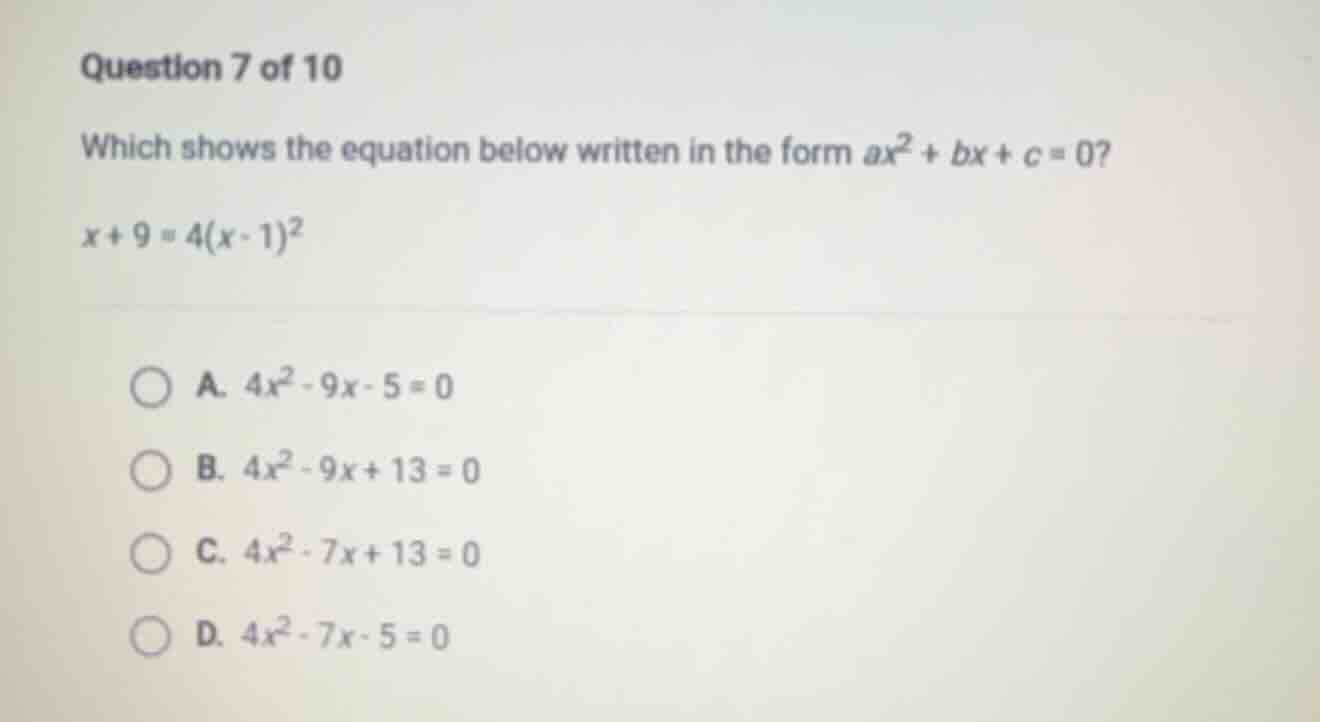
question 7 of 10
which shows the equation below written in the form $ax^2 + bx + c = 0$?
$x + 9 = 4(x - 1)^2$
a. $4x^2 - 9x - 5 = 0$
b. $4x^2 - 9x + 13 = 0$
c. $4x^2 - 7x + 13 = 0$
d. $4x^2 - 7x - 5 = 0$
Step1: Expand the right - hand side
We know that \((a - b)^2=a^{2}-2ab + b^{2}\). For \((x - 1)^2\), we have \((x - 1)^2=x^{2}-2x + 1\). Then \(4(x - 1)^2=4(x^{2}-2x + 1)\).
Using the distributive property \(a(b + c)=ab+ac\), we get \(4(x^{2}-2x + 1)=4x^{2}-8x + 4\).
Step2: Rewrite the original equation
The original equation is \(x + 9=4(x - 1)^2\). Substitute the expanded form of the right - hand side into the equation:
\(x + 9=4x^{2}-8x + 4\)
Step3: Move all terms to one side
Subtract \(x\) and \(9\) from both sides to get \(0 = 4x^{2}-8x + 4-x - 9\).
Step4: Combine like terms
Combine the \(x\) terms: \(-8x-x=-9x\), and combine the constant terms: \(4 - 9=-5\).
So the equation in the form \(ax^{2}+bx + c = 0\) is \(4x^{2}-9x - 5=0\).

Snap & solve any problem in the app
Get step-by-step solutions on Sovi AI
Photo-based solutions with guided steps
Explore more problems and detailed explanations
A. \(4x^{2}-9x - 5=0\)