QUESTION IMAGE
Question
question 11 (3 points)
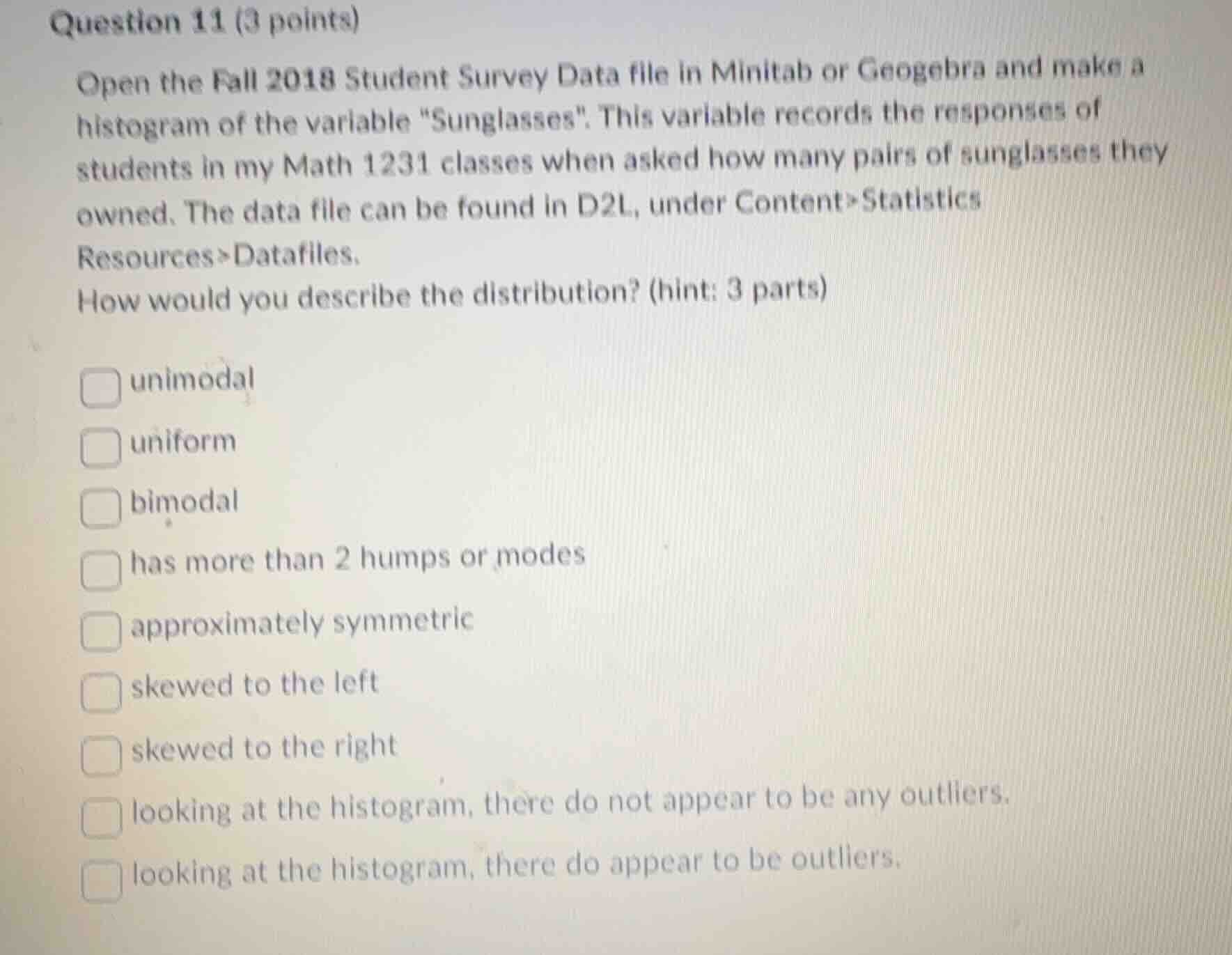
open the fall 2018 student survey data file in minitab or geogebra and make a histogram of the variable \sunglasses\. this variable records the responses of students in my math 1231 classes when asked how many pairs of sunglasses they owned. the data file can be found in d2l, under content>statistics resources>datafiles.
how would you describe the distribution? (hint: 3 parts)
□ unimodal
□ uniform
□ bimodal
□ has more than 2 humps or modes
□ approximately symmetric
□ skewed to the left
□ skewed to the right
□ looking at the histogram, there do not appear to be any outliers.
□ looking at the histogram, there do appear to be outliers.
To describe the distribution of the "Sunglasses" variable (number of sunglasses owned by students), we analyze the histogram's key features:
- Modality: Typically, the number of sunglasses owned by students has one main peak (unimodal) as most students own a moderate number, with fewer at extreme ends.
- Symmetry/Skewness: Since having very few sunglasses is less common and having many is also less common but the tail of "many" is longer, the distribution is skewed to the right (right - skewed).
- Outliers: Usually, there are no extreme outliers as the data represents a reasonable range of sunglasses ownership (e.g., 0 - a few dozen, with most in a smaller range), so "looking at the histogram, there do not appear to be any outliers" is appropriate.

Snap & solve any problem in the app
Get step-by-step solutions on Sovi AI
Photo-based solutions with guided steps
Explore more problems and detailed explanations
- unimodal
- skewed to the right
- looking at the histogram, there do not appear to be any outliers.