QUESTION IMAGE
Question
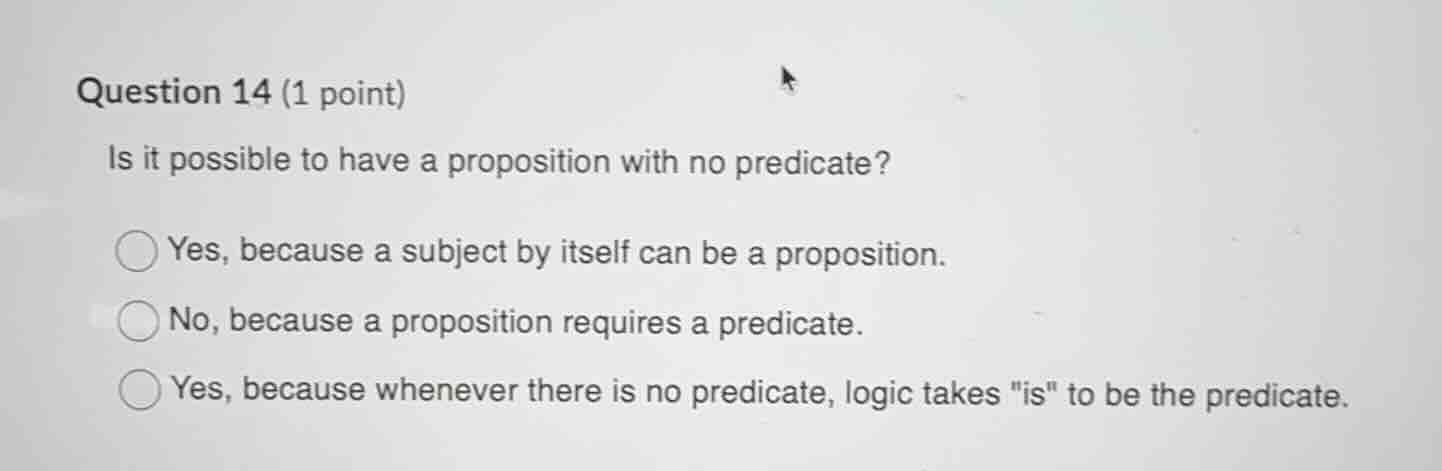
question 14 (1 point)
is it possible to have a proposition with no predicate?
yes, because a subject by itself can be a proposition.
no, because a proposition requires a predicate.
yes, because whenever there is no predicate, logic takes \is\ to be the predicate.
A proposition in logic (and in the context of sentence structure for propositions) consists of a subject and a predicate, where the predicate attributes something to the subject. A subject alone cannot be a proposition as it doesn't make a claim or assertion. Also, logic does not automatically insert "is" as a predicate in the absence of an explicit or implicit predicate. A proposition needs a predicate to assert or deny something about the subject. So the correct reasoning is that a proposition requires a predicate, so the answer is the option stating "No, because a proposition requires a predicate."

Snap & solve any problem in the app
Get step-by-step solutions on Sovi AI
Photo-based solutions with guided steps
Explore more problems and detailed explanations
B. No, because a proposition requires a predicate.