QUESTION IMAGE
Question
question 8 of 15
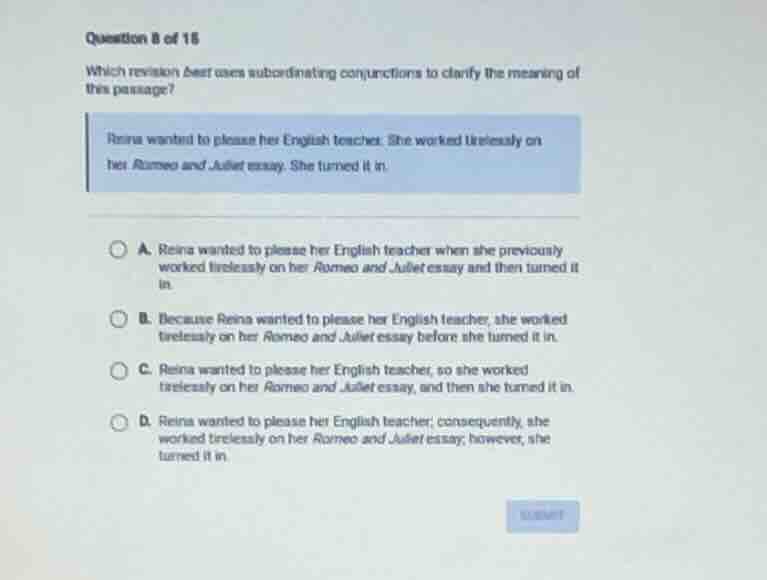
which revision best uses subordinating conjunctions to clarify the meaning of this passage?
reina wanted to please her english teacher. she worked tirelessly on her romeo and juliet essay. she turned it in.
a. reina wanted to please her english teacher when she previously worked tirelessly on her romeo and juliet essay and then turned it in.
b. because reina wanted to please her english teacher, she worked tirelessly on her romeo and juliet essay before she turned it in.
c. reina wanted to please her english teacher, so she worked tirelessly on her romeo and juliet essay, and then she turned it in.
d. reina wanted to please her english teacher; consequently, she worked tirelessly on her romeo and juliet essay; however, she turned it in.
A subordinating conjunction shows a dependent relationship between clauses. "Because" is a subordinating conjunction that clearly links Reina's motivation (pleasing her teacher) to her actions (working tirelessly on the essay and submitting it), clarifying the cause-effect meaning of the original passage. Option A uses "when" which misrepresents the timing relationship. Option C adds no subordinating conjunction to clarify the connection. Option D uses conjunctive adverbs ("consequently," "however") instead of subordinating conjunctions, and "however" introduces an unnecessary contrast not present in the original text.

Snap & solve any problem in the app
Get step-by-step solutions on Sovi AI
Photo-based solutions with guided steps
Explore more problems and detailed explanations
B. Because Reina wanted to please her English teacher, she worked tirelessly on her Romeo and Juliet essay before she turned it in.