QUESTION IMAGE
Question
question 16
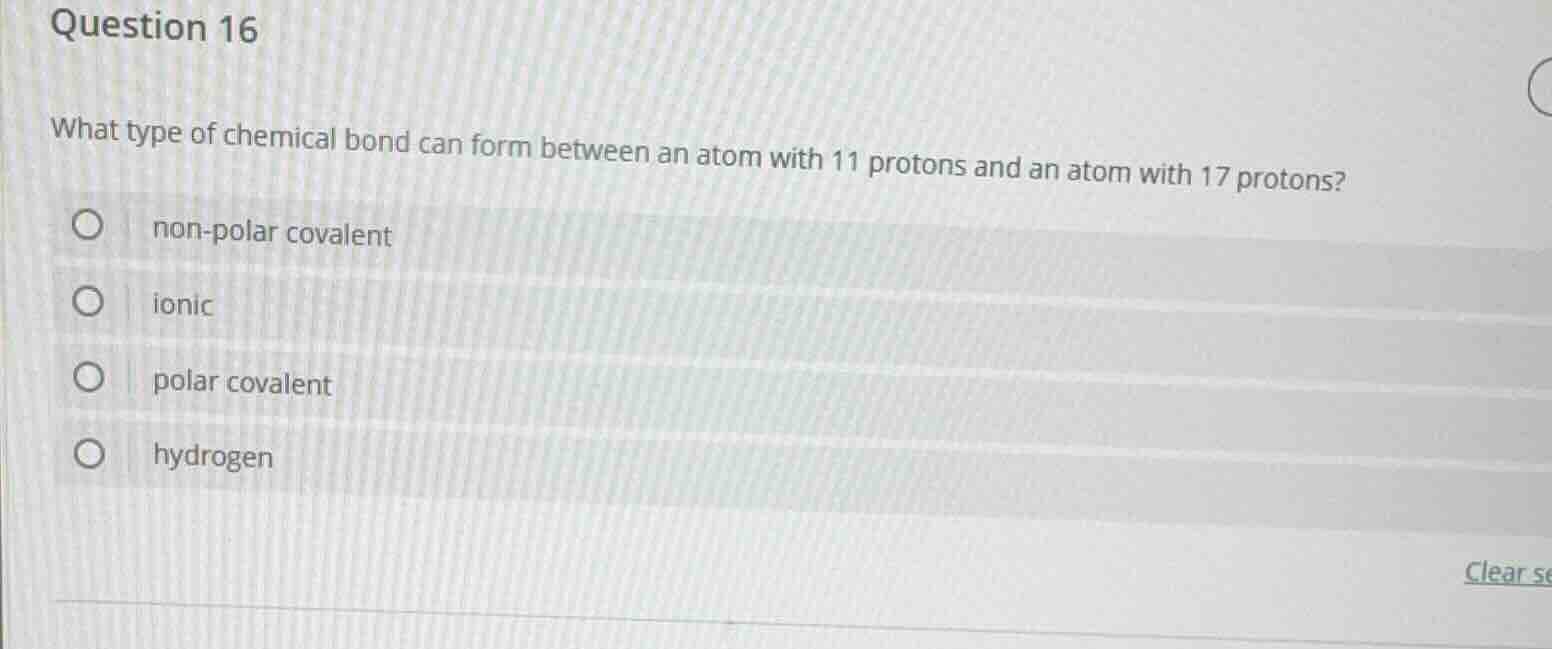
what type of chemical bond can form between an atom with 11 protons and an atom with 17 protons?
non - polar covalent
ionic
polar covalent
hydrogen
Brief Explanations
- First, determine the elements: An atom with 11 protons is sodium (Na), and an atom with 17 protons is chlorine (Cl).
- Sodium is a metal (alkali metal) and chlorine is a non - metal (halogen).
- Metals and non - metals typically form ionic bonds by transferring electrons (sodium loses an electron to become \(Na^+\), chlorine gains an electron to become \(Cl^-\), and they are held together by electrostatic attraction).
- Non - polar covalent bonds form between atoms of the same element or atoms with similar electronegativities sharing electrons equally, which is not the case here.
- Polar covalent bonds form between non - metals with different electronegativities sharing electrons unequally, but the large electronegativity difference between Na and Cl (and the metal - non - metal nature) leads to ionic, not polar covalent, bonding.
- Hydrogen bonds are intermolecular forces, not chemical bonds between these two atoms.

Snap & solve any problem in the app
Get step-by-step solutions on Sovi AI
Photo-based solutions with guided steps
Explore more problems and detailed explanations
B. ionic