QUESTION IMAGE
Question
question 18 of 30
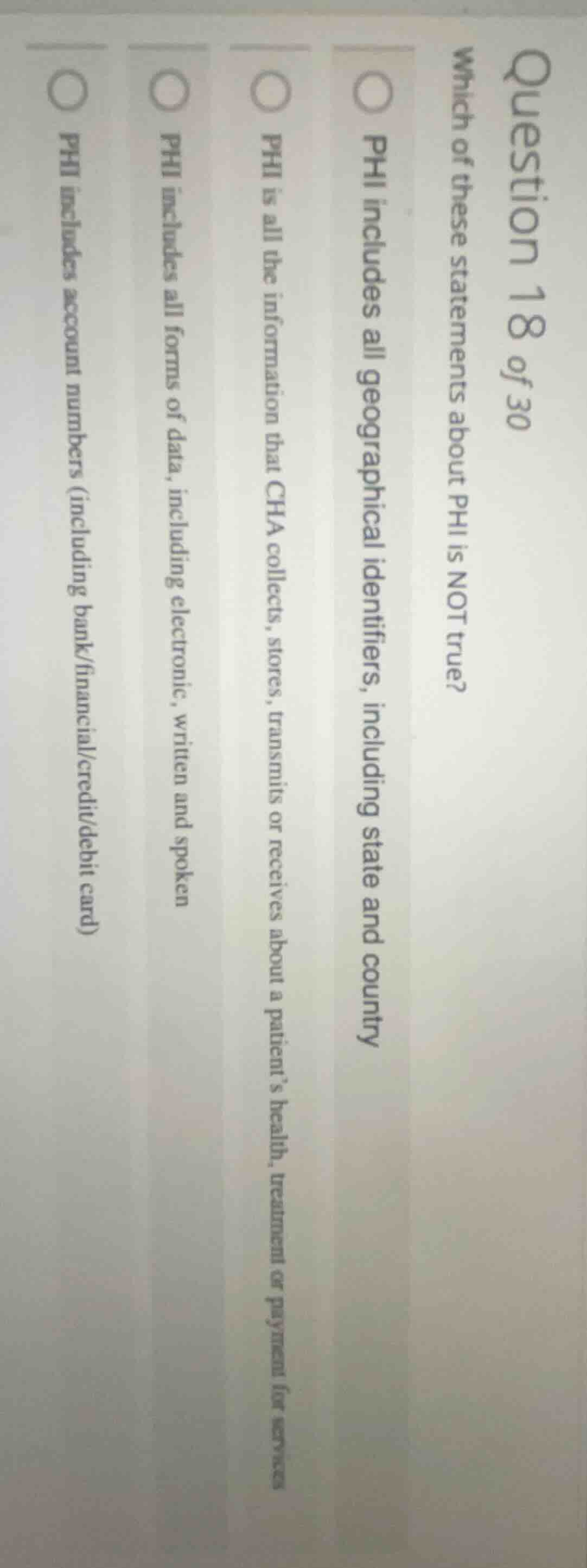
which of these statements about phi is not true?
○ phi includes all geographical identifiers, including state and country
○ phi is all the information that cha collects, stores, transmits or receives about a patient’s health, treatment or payment for services
○ phi includes all forms of data, including electronic, written and spoken
○ phi includes account numbers (including bank/financial/credit/debit card)
To determine the false statement about Protected Health Information (PHI):
- PHI does include geographical identifiers (like state, county) related to a patient's health context.
- PHI includes all health - related info (health, treatment, payment) that a covered entity (like CHA) collects, stores, transmits, or receives.
- PHI includes all forms of data (electronic, written, spoken) related to health.
- However, account numbers (bank/financial/credit/debit card) are considered financial information, and while PHI can include payment - related info, the statement "PHI includes account numbers (including bank/financial/credit/debit card)" is misleading. Account numbers for financial transactions not directly tied to health - care payment (or when not part of health - related identification) are not PHI. But among the options, the third option (PHI is all the information that CHA collects, stores, transmits or receives about a patient’s health, treatment or payment for services) is incorrect. Wait, no—let's re - evaluate. Wait, the option "PHI is all the information that CHA collects, stores, transmits or receives about a patient’s health, treatment or payment for services" is actually a correct description of PHI. Wait, no, let's check the options again. Wait, the first option: "PHI includes all geographical identifiers, including state and county" – correct, as geographical info related to health (like where a patient received care) is PHI. Second option: "PHI includes all forms of data, including electronic, written and spoken" – correct, as PHI can be in any format. Third option: "PHI is all the information that CHA collects, stores, transmits or receives about a patient’s health, treatment or payment for services" – this is a correct definition of PHI (Protected Health Information is individually identifiable health information that a covered entity creates, receives, maintains, or transmits). Fourth option: "PHI includes account numbers (including bank/financial/credit/debit card)" – Account numbers for financial transactions not related to health care (or when not used to identify a patient in health - care context) are not PHI. But the third option is incorrect? Wait, no, maybe I messed up. Wait, the question is which statement is NOT true. Let's recall: PHI is individually identifiable health information. The statement "PHI is all the information that CHA collects, stores, transmits or receives about a patient’s health, treatment or payment for services" is incorrect because it implies that all such information is PHI, but actually, only the information that can be used to identify the patient is PHI. For example, if CHA collects a patient's health info but it's de - identified (no identifiers), it's not PHI. So the third option is the false one.

Snap & solve any problem in the app
Get step-by-step solutions on Sovi AI
Photo-based solutions with guided steps
Explore more problems and detailed explanations
The third option: "PHI is all the information that CHA collects, stores, transmits or receives about a patient’s health, treatment or payment for services" (assuming the options are ordered as: 1. PHI includes all geographical identifiers, including state and county; 2. PHI includes all forms of data, including electronic, written and spoken; 3. PHI is all the information that CHA collects, stores, transmits or receives about a patient’s health, treatment or payment for services; 4. PHI includes account numbers (including bank/financial/credit/debit card))