QUESTION IMAGE
Question
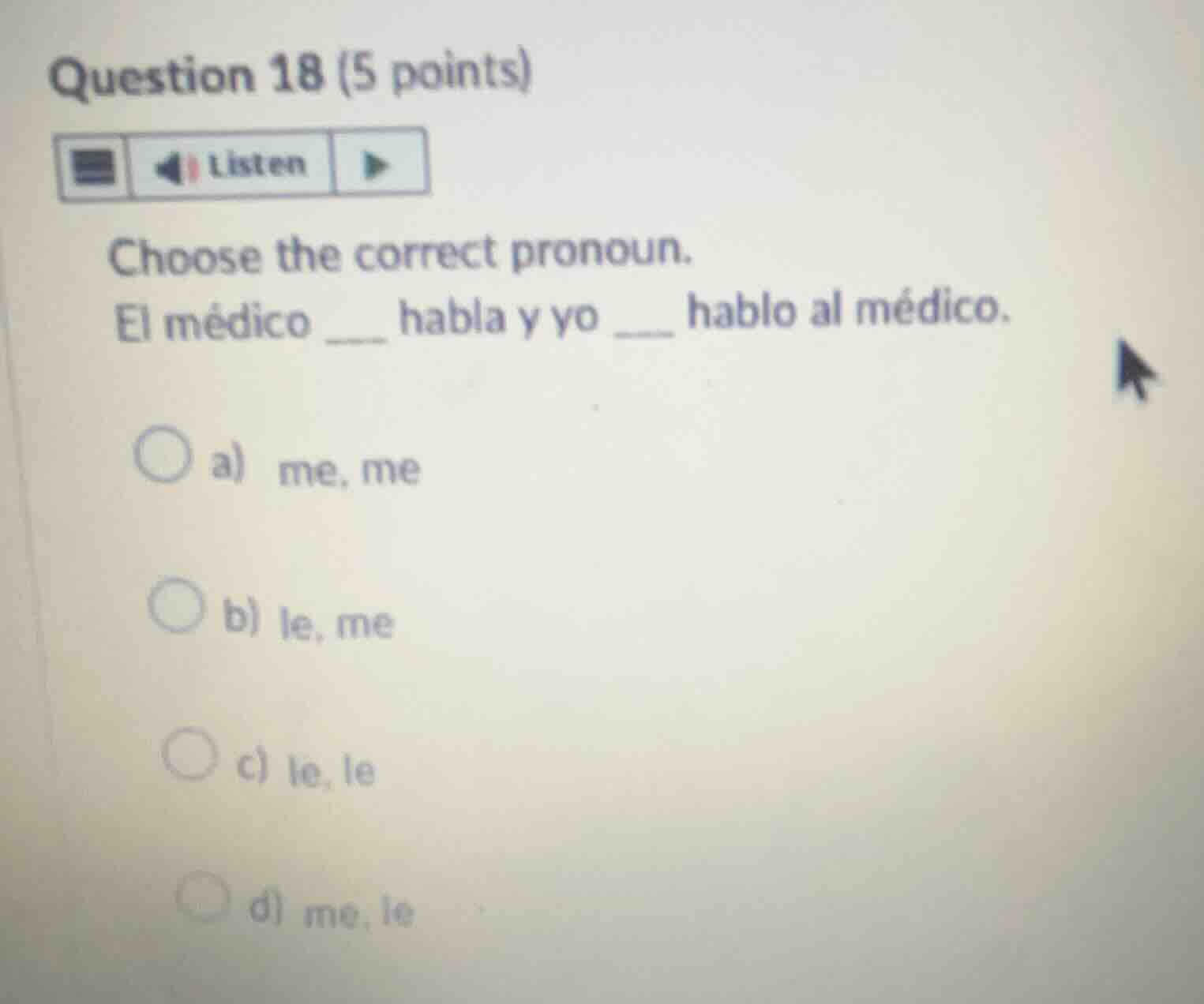
question 18 (5 points)
listen
choose the correct pronoun.
el médico _ habla y yo _ hablo al médico.
a) me, me
b) le, me
c) le, le
d) me, le
To solve this, we analyze the Spanish pronoun usage. In "El médico _ habla", the indirect object (the one being spoken to) is "yo" (me), but wait, no—wait, "hablar a" (to speak to) uses indirect object pronouns. Wait, first part: "El médico _ habla" – the subject is el médico, the verb is habla (he speaks), and the indirect object is who he speaks to. Wait, no, maybe better: "hablar a alguien" (to speak to someone). So "El médico me habla" would be "The doctor speaks to me", but wait, no—wait, "le" is for him/her/you (formal). Wait, no, let's parse each part. First blank: "El médico _ habla" – the action is the doctor speaking to whom? If the second part is "yo _ hablo al médico" (I speak to the doctor). So "hablar a" (to) takes indirect object pronouns. For "yo hablo al médico", the indirect object pronoun for "al médico" (the doctor, masculine singular) is "le"? No, wait, "hablar a" – the indirect object pronoun for the person you speak to. Wait, "yo le hablo al médico" – no, wait, "al médico" is the prepositional phrase, but the indirect object pronoun would be "le" (for him, the doctor). Wait, no, maybe I got it reversed. Let's take the first clause: "El médico _ habla" – the doctor speaks to me? Or the doctor speaks to him? Wait, no, the second clause is "yo _ hablo al médico" – I speak to the doctor. So for "yo hablo al médico", the indirect object pronoun (since "hablar a" is a verb with indirect object) would be "le" (for the doctor, masculine singular). Wait, no, "me" is for first person. Wait, no, let's recall: indirect object pronouns in Spanish: me (to me), te (to you, informal), le (to him/her/you formal), nos (to us), os (to you all, informal), les (to them/you all formal).
First part: "El médico _ habla" – the doctor speaks to me? Or the doctor speaks to him? Wait, the second part is "yo _ hablo al médico" – I speak to the doctor. So let's check each option:
Option d: "me, le" – first blank: "El médico me habla" (the doctor speaks to me), second blank: "yo le hablo al médico" (I speak to the doctor (le = to him, the doctor)). Wait, that makes sense. Wait, no, wait the original sentence: "El médico _ habla y yo _ hablo al médico." So first part: doctor speaks to me (me), second part: I speak to the doctor (le). So "El médico me habla" (doctor speaks to me) and "yo le hablo al médico" (I speak to the doctor). So the correct pronouns are "me" (first blank, doctor speaks to me) and "le" (second blank, I speak to the doctor (le = to him, the doctor)). Wait, but let's check the options. Option d is "me, le". Wait, but let's re-examine. Wait, maybe I mixed up. Let's take each option:
Option a: me, me – first: doctor speaks to me; second: I speak to me (me) al médico? No, that doesn't make sense.
Option b: le, me – first: doctor speaks to him (le); second: I speak to me (me) al médico? No.
Option c: le, le – first: doctor speaks to him; second: I speak to him (le) al médico? No, "al médico" is the doctor, so "le" would be correct for the doctor, but the first part would be doctor speaks to him, which doesn't connect to the second part.
Option d: me, le – first: doctor speaks to me (me); second: I speak to the doctor (le, since the doctor is masculine singular, le is the indirect object pronoun for him). So "El médico me habla" (the doctor speaks to me) and "yo le hablo al médico" (I speak to the doctor). That makes sense. Wait, but let's confirm. In Spanish, when you have "hablar a" (to speak to), the indirect object pronoun is used. So "yo le hablo al médico" – "le" is the indirect object pronoun for…

Snap & solve any problem in the app
Get step-by-step solutions on Sovi AI
Photo-based solutions with guided steps
Explore more problems and detailed explanations
d) me, le