QUESTION IMAGE
Question
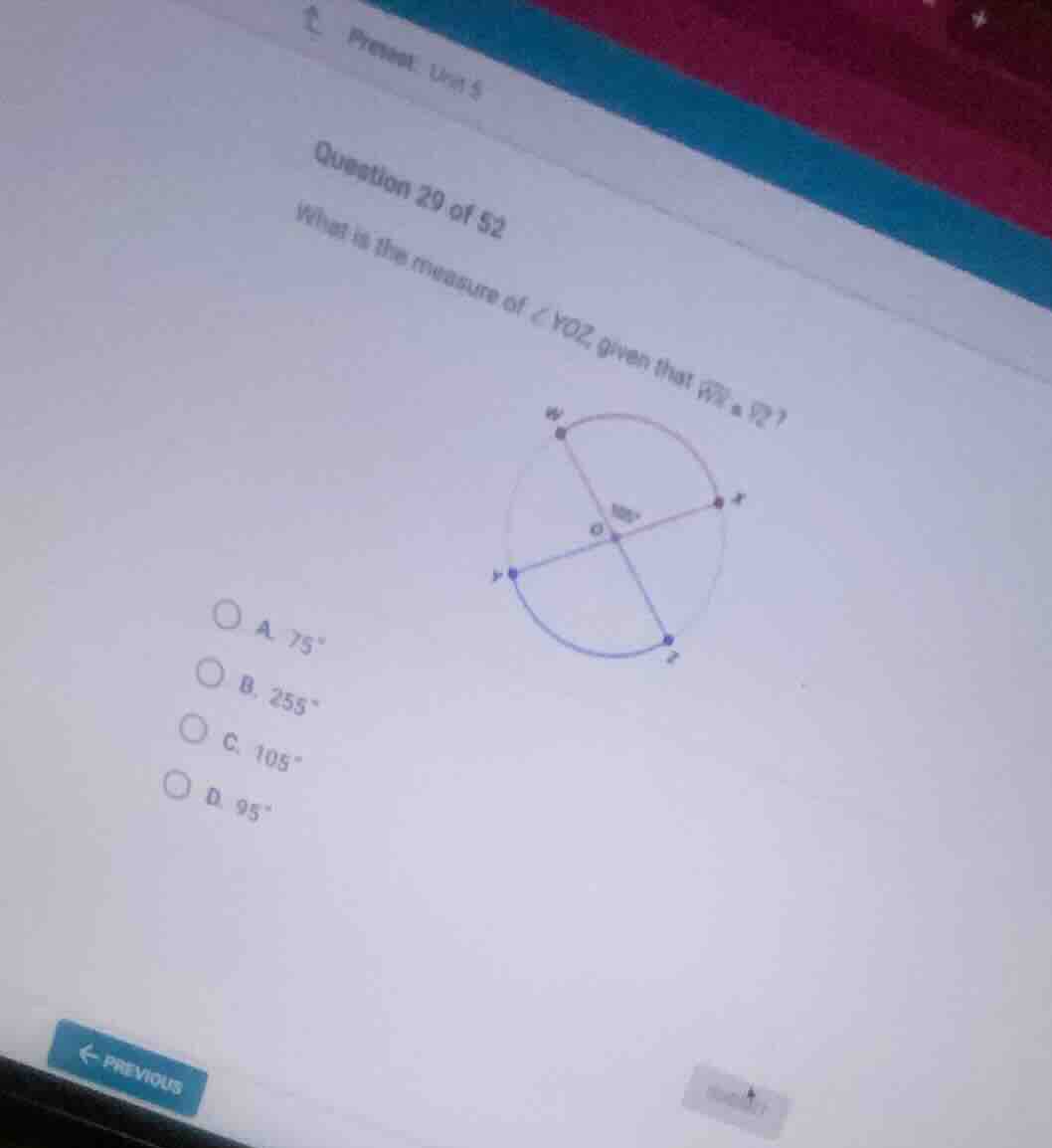
question 20 of 52 what is the measure of ∠yoz given that \\(\overarc{wz} \cong \overarc{xz}\\)? a. \\(75^\circ\\) b. \\(253^\circ\\) c. \\(108^\circ\\) d. \\(95^\circ\\)
Step1: Analyze the circle and angles
We know that the sum of angles around a point (center of the circle) is \(360^\circ\), and a straight angle is \(180^\circ\). From the diagram, we can see that \(\angle WOX = 105^\circ\), and \(\angle WOY\) and \(\angle XOZ\) are straight angles (so \(180^\circ\) each)? Wait, actually, looking at the circle, the arcs \(WX\) and \(YZ\) are equal? Wait, the problem says \(\widehat{WX}\cong\widehat{YZ}\). So the central angles corresponding to these arcs are equal. Wait, first, let's find the angle \(\angle WOY\) or \(\angle XOZ\). Wait, the angle \(\angle WOX = 105^\circ\), so the angle adjacent to it (forming a straight line) would be \(180^\circ - 105^\circ=75^\circ\)? Wait, no, maybe better to think about the total around the center. Wait, the sum of angles around point \(O\) is \(360^\circ\). But we have two vertical angles? Wait, maybe the diagram has \(W\), \(Y\) on one side, \(X\), \(Z\) on the other? Wait, the problem is about \(\angle YOZ\). Let's assume that \(\angle WOX = 105^\circ\), and since \(\widehat{WX}\cong\widehat{YZ}\), the central angle \(\angle YOZ\) is related. Wait, maybe the angle between \(W\) and \(X\) is \(105^\circ\), and the angle between \(Y\) and \(Z\) is equal? Wait, no, let's re - examine.
Wait, the key is that in a circle, the measure of a central angle is equal to the measure of its arc. Also, the sum of angles around a point is \(360^\circ\), and a straight line (diameter) forms a \(180^\circ\) angle. Let's assume that \(WX\) and \(YZ\) are arcs, and \(\angle WOX\) is the central angle for arc \(WX\), so \(\angle YOZ\) is the central angle for arc \(YZ\). But also, the angle between \(W\) and \(Y\) (or \(X\) and \(Z\)): Wait, maybe the angle \(\angle WOX = 105^\circ\), and the angle \(\angle WOY\) is \(90^\circ\)? No, that might not be right. Wait, another approach: the sum of \(\angle WOX\) and \(\angle XOZ\) and \(\angle ZOY\) and \(\angle YOW\) is \(360^\circ\). But if \(WX\) and \(YZ\) are equal arcs, their central angles are equal. Wait, maybe the angle \(\angle WOX = 105^\circ\), so the angle \(\angle YOZ\) is \(105^\circ\)? No, the options have \(105^\circ\) as option C? Wait, no, the options are A. \(75^\circ\), B. \(255^\circ\), C. \(105^\circ\), D. \(95^\circ\). Wait, maybe I made a mistake. Wait, the angle \(\angle WOX = 105^\circ\), and since \(\widehat{WX}\cong\widehat{YZ}\), then \(\angle YOZ=\angle WOX = 105^\circ\)? But let's check the straight line. Wait, if we have a diameter, the angle on a straight line is \(180^\circ\). Wait, maybe the angle between \(W\) and \(Y\) is \(90^\circ\)? No, the problem says \(\widehat{WX}\cong\widehat{YZ}\). So the central angle for \(WX\) is \(105^\circ\), so the central angle for \(YZ\) is also \(105^\circ\), so \(\angle YOZ = 105^\circ\).
Step2: Confirm the answer
Looking at the options, option C is \(105^\circ\), which matches our calculation.

Snap & solve any problem in the app
Get step-by-step solutions on Sovi AI
Photo-based solutions with guided steps
Explore more problems and detailed explanations
C. \(105^\circ\)