QUESTION IMAGE
Question
question 25
10 pts
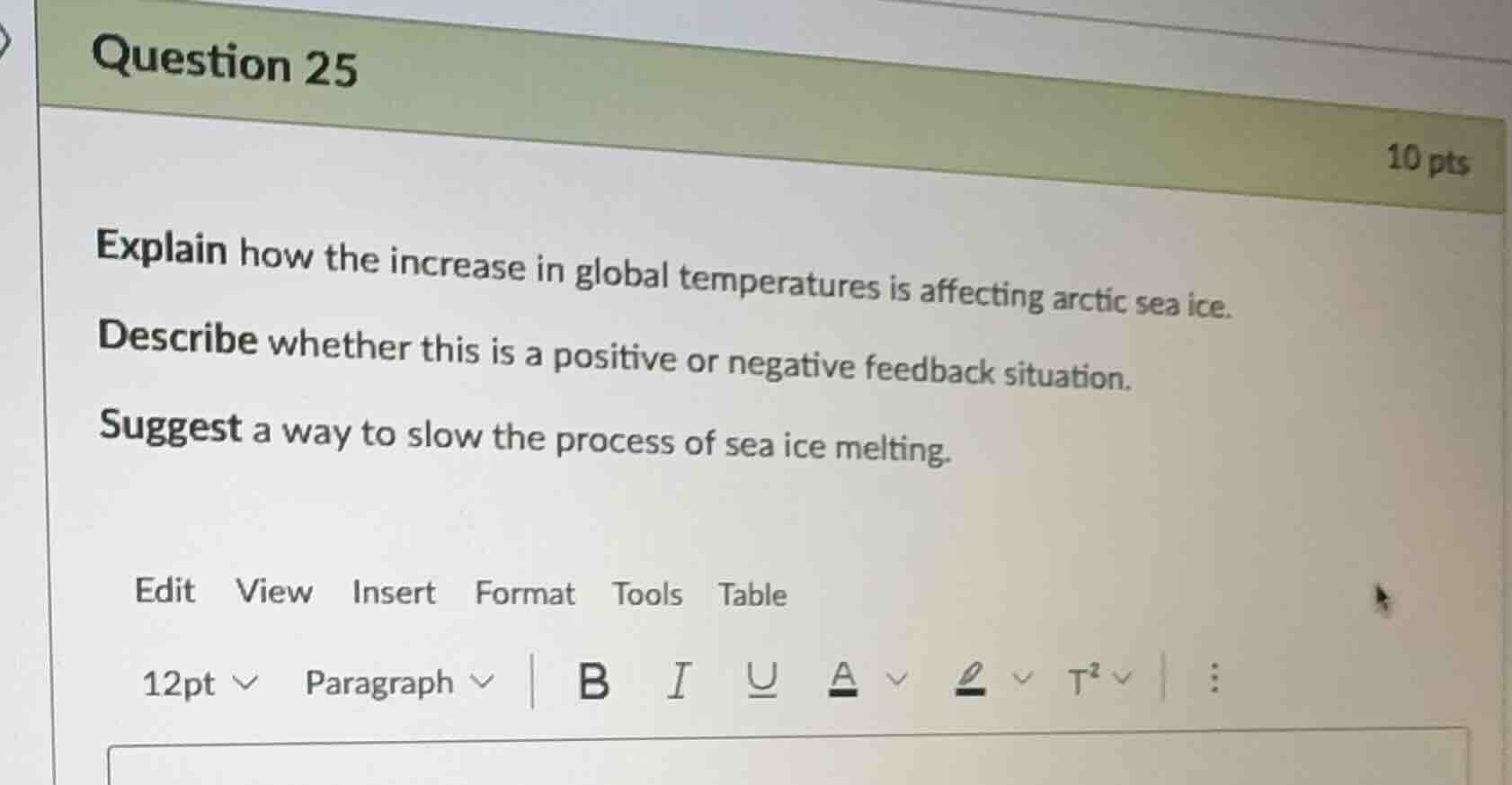
explain how the increase in global temperatures is affecting arctic sea ice.
describe whether this is a positive or negative feedback situation.
suggest a way to slow the process of sea ice melting.
Brief Explanations
- Effect on Arctic Sea Ice: Global temperature rise causes Arctic sea ice to melt at an accelerated rate. Warmer air and ocean temperatures lead to more ice melting in summer and less ice forming in winter, reducing the overall extent and thickness of Arctic sea ice.
- Feedback Situation: This is a positive feedback loop. As ice melts, more dark ocean water is exposed (ice is highly reflective, while water absorbs more heat). The exposed water absorbs more solar radiation, warming the ocean further, which causes more ice to melt, and the cycle continues, amplifying the initial temperature increase.
- Slowing the Process: To slow sea ice melting, we can reduce greenhouse gas emissions (e.g., transitioning to renewable energy sources like solar and wind, improving energy efficiency) to mitigate global warming. Also, protecting and restoring carbon sinks (like forests) can help remove excess CO₂ from the atmosphere, reducing the rate of temperature increase.

Snap & solve any problem in the app
Get step-by-step solutions on Sovi AI
Photo-based solutions with guided steps
Explore more problems and detailed explanations
- Effect on Arctic Sea Ice: Global warming increases air and ocean temperatures, causing Arctic sea ice to melt faster (more summer melting, less winter formation, reduced extent/thickness).
- Feedback: Positive feedback—melting ice exposes dark ocean water, which absorbs more heat, warming the ocean further and accelerating ice melt.
- Slowing the Process: Reduce greenhouse gas emissions (e.g., use renewable energy, improve energy efficiency) and protect carbon sinks (e.g., forests) to mitigate global warming.