QUESTION IMAGE
Question
question 28 of 29
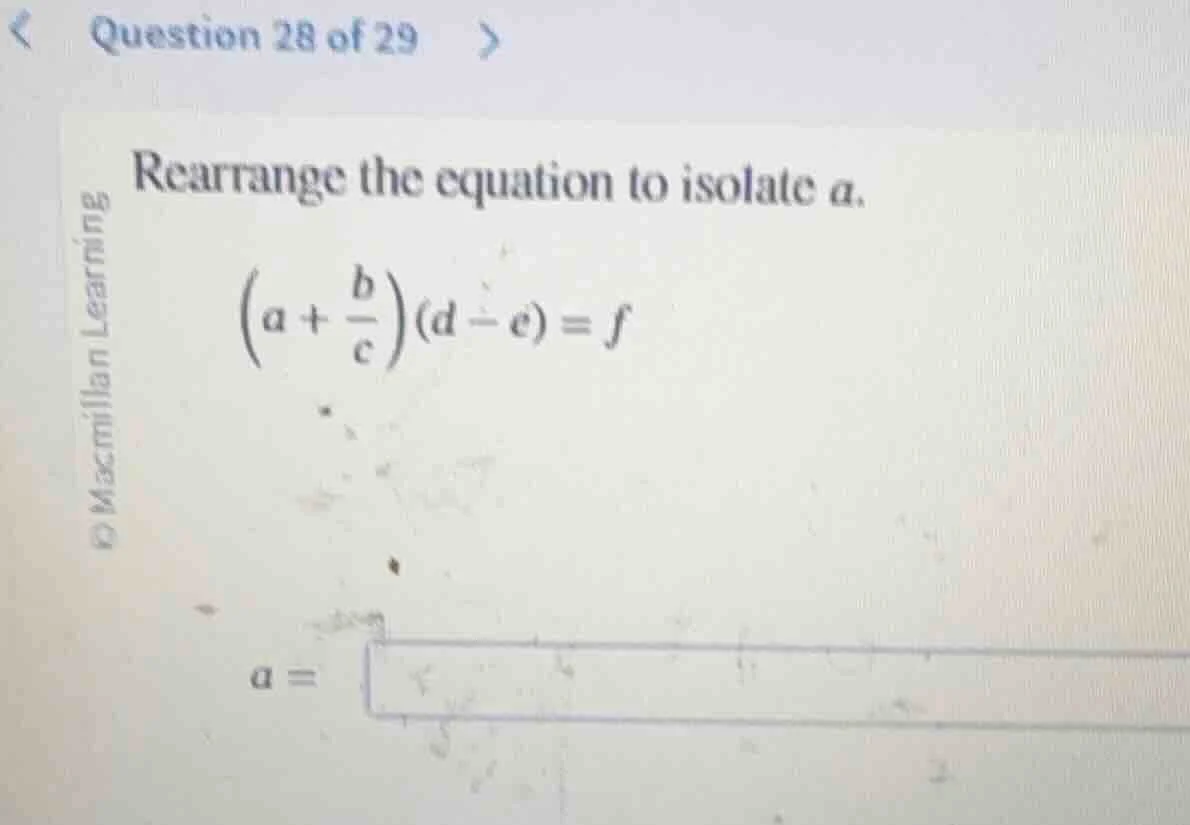
rearrange the equation to isolate a.
\\(\left(a + \frac{b}{c}\
ight)(d - e) = f\\)
\\(a = \\)
Step1: Divide both sides by \(d - e\) (assuming \(d - e
eq 0\))
\(\frac{(a + \frac{b}{c})(d - e)}{d - e} = \frac{f}{d - e}\)
Simplifies to: \(a + \frac{b}{c} = \frac{f}{d - e}\)
Step2: Subtract \(\frac{b}{c}\) from both sides
\(a + \frac{b}{c} - \frac{b}{c} = \frac{f}{d - e} - \frac{b}{c}\)
Simplifies to: \(a = \frac{f}{d - e} - \frac{b}{c}\)
(We can also combine the fractions: \(a = \frac{fc - b(d - e)}{c(d - e)}\) or \(a = \frac{fc - bd + be}{c(d - e)}\), but the form from step 2 is also correct as an isolated form for \(a\))

Snap & solve any problem in the app
Get step-by-step solutions on Sovi AI
Photo-based solutions with guided steps
Explore more problems and detailed explanations
\(a = \frac{f}{d - e} - \frac{b}{c}\) (or equivalent combined fraction form)