QUESTION IMAGE
Question
question 29 of 49
other structure.
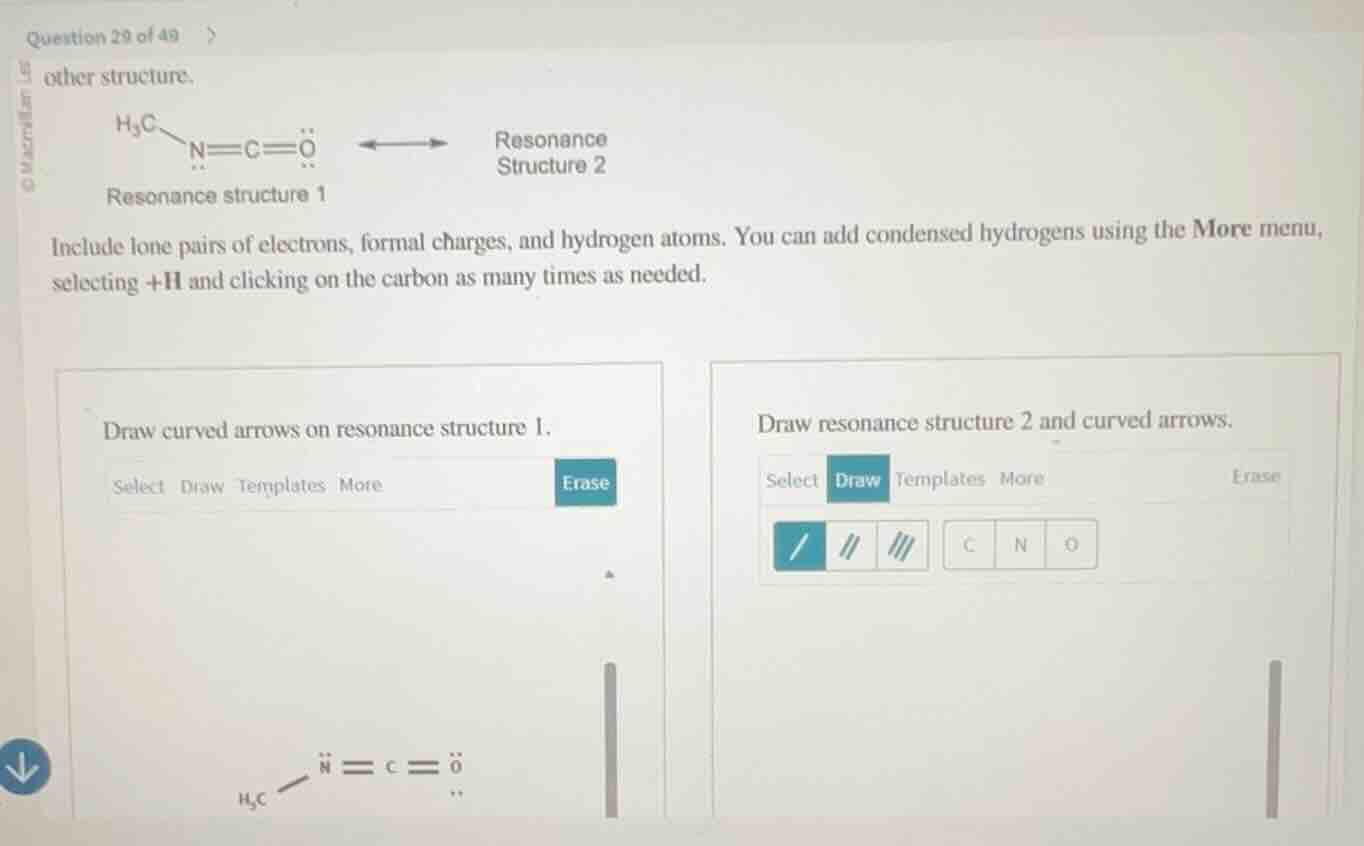
resonance structure 1: h₃c - n = c = o (with lone pairs on o)
resonance structure 2
include lone pairs of electrons, formal charges, and hydrogen atoms. you can add condensed hydrogens using the more menu, selecting +h and clicking on the carbon as many times as needed.
draw curved arrows on resonance structure 1.
select draw templates more erase
draw resonance structure 2 and curved arrows.
select draw templates more erase
Step1: Identify electron movement
Curved arrow from O lone pair to form N-C double bond, and arrow from N-C double bond to N lone pair.
Step2: Draw resonance structure 2
Rearrange bonds: $H_3C-\overset{+}{N}\equiv C-\overset{-}{O}:$ (with 3 lone pairs on O, 1 lone pair on N)
Step3: Add curved arrows to structure1
- Curved arrow from one of O's lone pairs to the C-O bond (converting single to double bond).
- Curved arrow from the N-C double bond to the N atom (converting double to single bond, adding a lone pair to N).

Snap & solve any problem in the app
Get step-by-step solutions on Sovi AI
Photo-based solutions with guided steps
Explore more problems and detailed explanations
Curved arrows on Resonance Structure 1:
- A curved arrow originating from one of the lone pairs on the oxygen atom, pointing towards the carbon-oxygen bond (to form a double bond).
- A curved arrow originating from the nitrogen-carbon double bond, pointing towards the nitrogen atom (to convert the double bond to a single bond and add a lone pair to nitrogen).
Resonance Structure 2:
$H_3C-\overset{+}{N}\equiv C-\overset{-}{O}:$
(The nitrogen has a +1 formal charge and one lone pair, the oxygen has a -1 formal charge and three lone pairs, and there is a triple bond between carbon and nitrogen, single bond between carbon and oxygen.)
Curved arrows for Structure 2 (to show back-resonance):
- A curved arrow from one of the lone pairs on the negatively charged oxygen, pointing towards the carbon-oxygen bond.
- A curved arrow from the carbon-nitrogen triple bond, pointing towards the positively charged nitrogen.