QUESTION IMAGE
Question
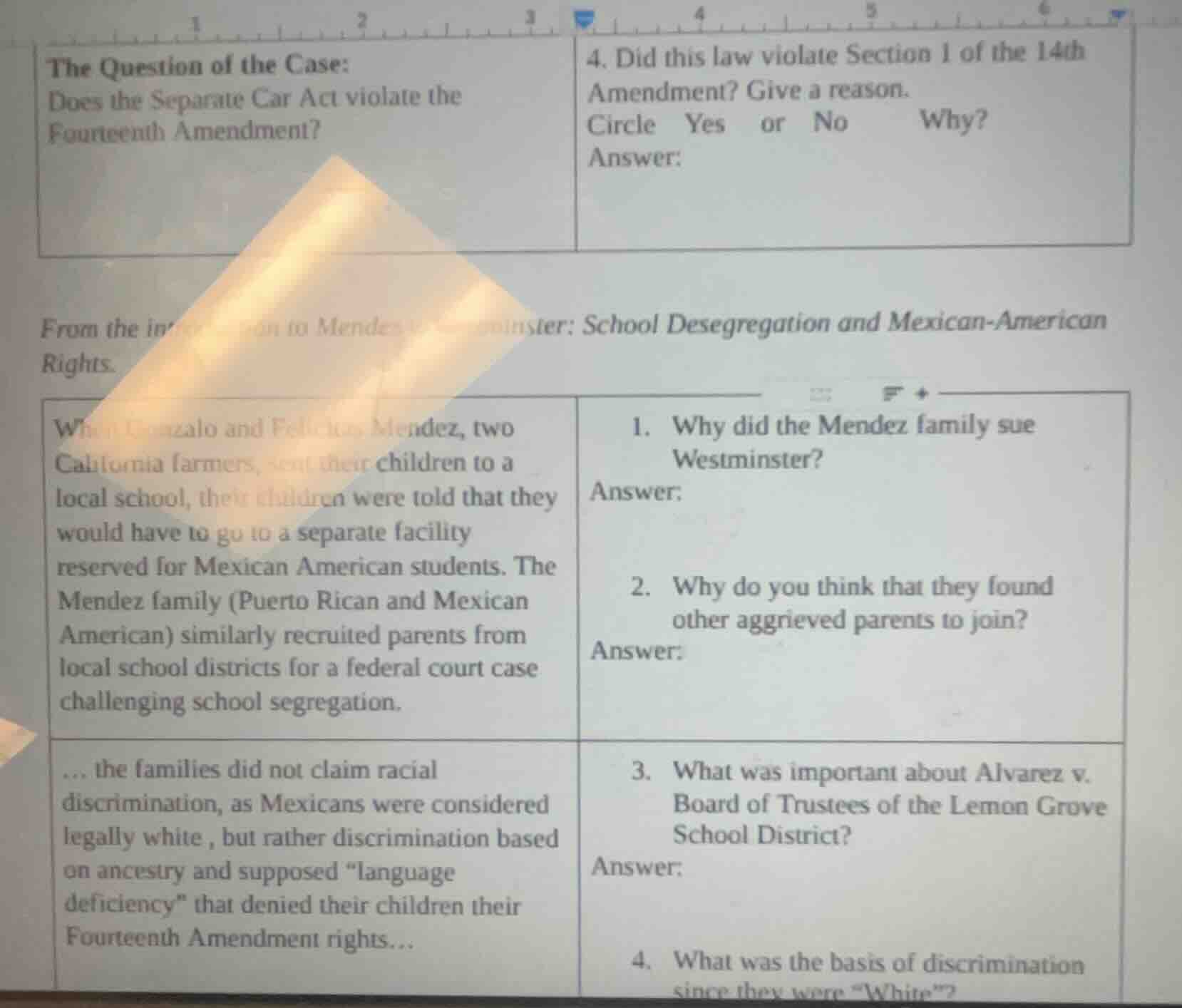
the question of the case:
does the separate car act violate the
fourteenth amendment?
- did this law violate section 1 of the 14th
amendment? give a reason.
circle yes or no why?
answer:
from the introduction to mendes v. westminster: school desegregation and mexican-american
rights.
when gonzalo and felicitas mendez, two
california farmers, sent their children to a
local school, their children were told that they
would have to go to a separate facility
reserved for mexican american students. the
mendez family (puerto rican and mexican
american) similarly recruited parents from
local school districts for a federal court case
challenging school segregation.
- why did the mendez family sue
westminster?
answer:
- why do you think that they found
other aggrieved parents to join?
answer:
... the families did not claim racial
discrimination, as mexicans were considered
legally white, but rather discrimination based
on ancestry and supposed \language
deficiency\ that denied their children their
fourteenth amendment rights...
- what was important about alvarez v.
board of trustees of the lemon grove
school district?
answer:
- what was the basis of discrimination
since they were \white\?
- The Mendez family was denied access to a local school and forced to send their children to a segregated facility for Mexican American students, so they sued to challenge this school segregation.
- Recruiting other aggrieved parents strengthened their legal case by showing the segregation was a widespread issue affecting multiple families, not just their own.
- Alvarez v. Board of Trustees of the Lemon Grove School District was one of the first successful school desegregation cases in the U.S., setting a precedent for challenging segregation of Mexican American students.
- The discrimination was based on ancestry and the false claim of "language deficiency," even though Mexican Americans were legally classified as white.
- (Top question) Yes, the law violated Section 1 of the 14th Amendment. Section 1 guarantees equal protection under the law, and the Separate Car Act (and similar segregation laws like the school segregation here) created unequal, segregated facilities that denied equal protection to marginalized groups.

Snap & solve any problem in the app
Get step-by-step solutions on Sovi AI
Photo-based solutions with guided steps
Explore more problems and detailed explanations
- Their children were barred from a local school and forced to attend a segregated facility for Mexican American students, so they sued to challenge this segregation.
- To show the segregation was a widespread problem, strengthening their legal challenge.
- It was an early successful school desegregation case that set a precedent for challenging segregation of Mexican American students.
- Discrimination was based on ancestry and the false claim of "language deficiency."
- Yes. The law denied equal protection under the law guaranteed by Section 1 of the 14th Amendment by enforcing segregated, unequal facilities.