QUESTION IMAGE
Question
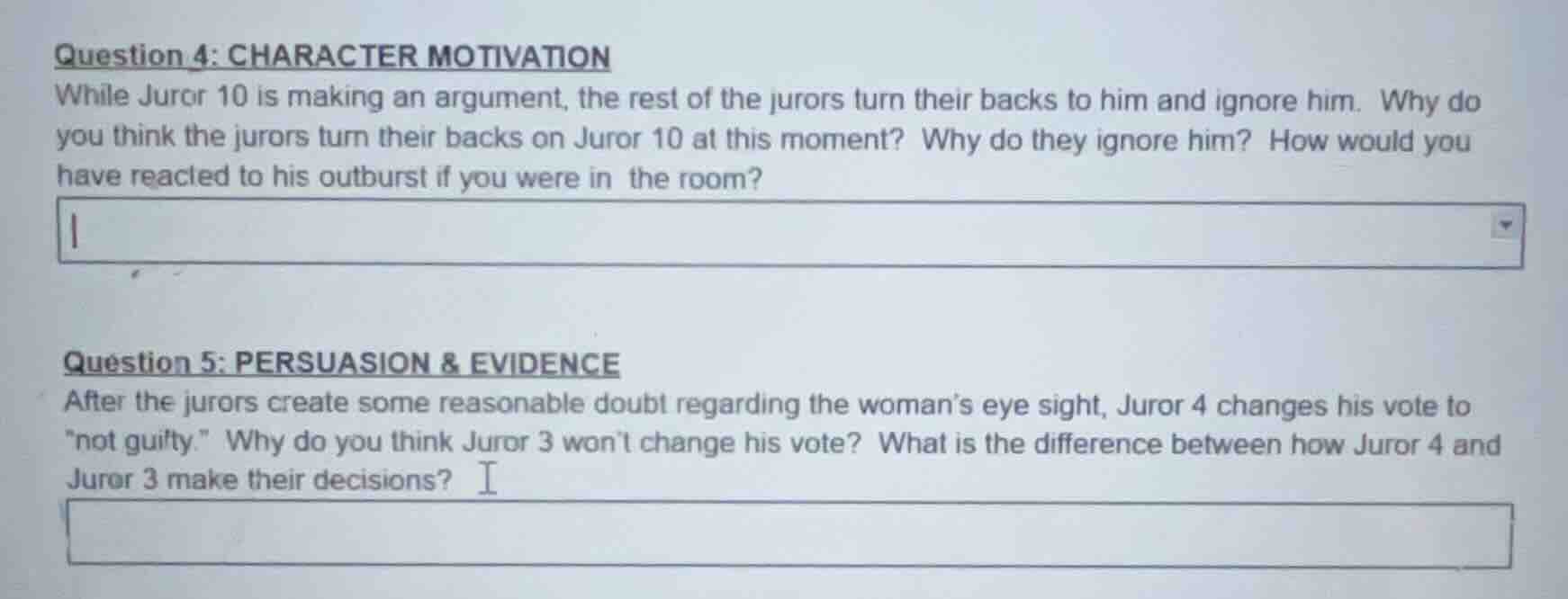
question 4: character motivation
while juror 10 is making an argument, the rest of the jurors turn their backs to him and ignore him. why do you think the jurors turn their backs on juror 10 at this moment? why do they ignore him? how would you have reacted to his outburst if you were in the room?
question 5: persuasion & evidence
after the jurors create some reasonable doubt regarding the womans eye sight, juror 4 changes his vote to
ot guilty.\ why do you think juror 3 wont change his vote? what is the difference between how juror 4 and juror 3 make their decisions?
Brief Explanations
For Question 4:
- Jurors turn their backs on Juror 10 because his argument is rooted in overt, offensive prejudice against the defendant's marginalized background, not logical evidence. They use this silent act to condemn his bigotry and signal that his biased views are unacceptable and unworthy of engagement.
- They ignore him to refuse platforming his discriminatory rhetoric, maintain focus on the trial's actual evidence, and show collective rejection of his unfair, non-factual reasoning.
- If in the room, a reasonable reaction would be to join the group in turning away to reject his prejudice, or to directly state that his biased comments are irrelevant to evaluating the defendant's guilt and demand he stick to evidence-based arguments.
For Question 5:
- Juror 3 refuses to change his vote because his decision is driven by personal anger and resentment, stemming from his strained relationship with his own son, which he projects onto the defendant. He cannot separate his personal feelings from the trial facts.
- Juror 4 makes decisions based on logical evaluation of evidence; he changes his vote when reasonable doubt about the witness's testimony is proven. Juror 3 makes decisions based on personal emotion and bias, prioritizing his own grudges over objective analysis of the trial's facts.

Snap & solve any problem in the app
Get step-by-step solutions on Sovi AI
Photo-based solutions with guided steps
Explore more problems and detailed explanations
Question 4:
- The jurors turn their backs to condemn Juror 10's overtly prejudiced, non-evidence-based argument and signal his bigotry is unacceptable.
- They ignore him to refuse amplifying his discriminatory rhetoric and refocus on the trial's factual evidence.
- I would either join the group in turning away to reject his bias, or directly state his prejudiced comments are irrelevant and demand he stick to evidence.
Question 5:
- Juror 3 won't change his vote because his decision is fueled by personal anger/resentment toward his own son, which he projects onto the defendant, overriding objective evidence.
- Juror 4 decides based on logical, evidence-based analysis (changing his vote when reasonable doubt is proven), while Juror 3 decides based on personal emotion and bias, prioritizing his own grudges over factual trial details.