QUESTION IMAGE
Question
question
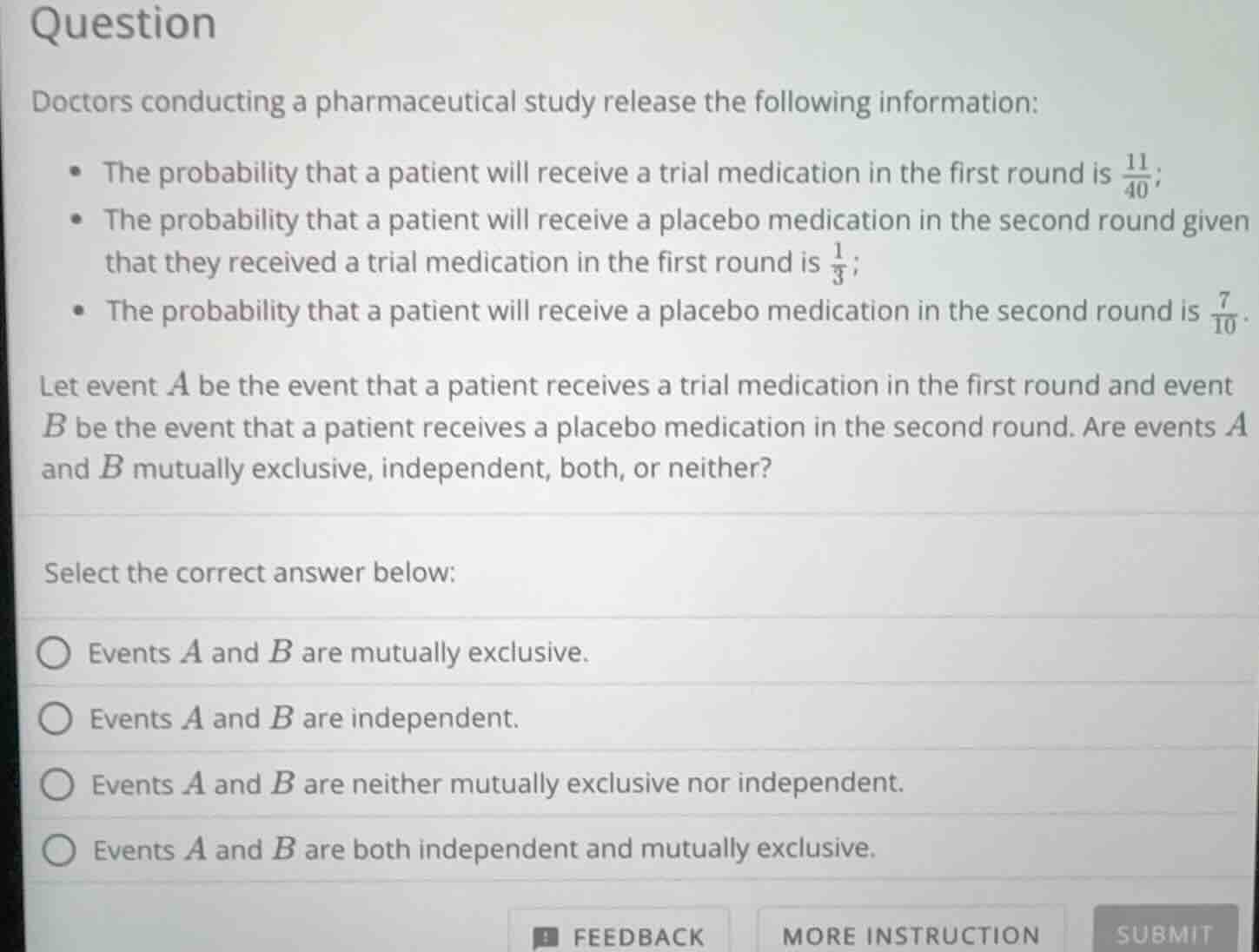
doctors conducting a pharmaceutical study release the following information:
- the probability that a patient will receive a trial medication in the first round is \\(\frac{11}{40}\\);
- the probability that a patient will receive a placebo medication in the second round given that they received a trial medication in the first round is \\(\frac{1}{3}\\);
- the probability that a patient will receive a placebo medication in the second round is \\(\frac{7}{10}\\).
let event \\(a\\) be the event that a patient receives a trial medication in the first round and event \\(b\\) be the event that a patient receives a placebo medication in the second round. are events \\(a\\) and \\(b\\) mutually exclusive, independent, both, or neither?
select the correct answer below:
\\(\bigcirc\\) events \\(a\\) and \\(b\\) are mutually exclusive.
\\(\bigcirc\\) events \\(a\\) and \\(b\\) are independent.
\\(\bigcirc\\) events \\(a\\) and \\(b\\) are neither mutually exclusive nor independent.
\\(\bigcirc\\) events \\(a\\) and \\(b\\) are both independent and mutually exclusive.
Step1: Recall definitions of mutually exclusive and independent events
- Mutually exclusive: \( P(A \cap B) = 0 \) (events cannot occur at the same time).
- Independent: \( P(A \cap B) = P(A) \times P(B) \) (occurrence of one does not affect the other).
Step2: Calculate \( P(A \cap B) \) using conditional probability
The formula for conditional probability is \( P(B|A) = \frac{P(A \cap B)}{P(A)} \), so \( P(A \cap B) = P(B|A) \times P(A) \).
Given \( P(A) = \frac{11}{40} \) and \( P(B|A) = \frac{1}{3} \), we have:
\( P(A \cap B) = \frac{1}{3} \times \frac{11}{40} = \frac{11}{120} \)
Step3: Check if mutually exclusive
Since \( P(A \cap B) = \frac{11}{120}
eq 0 \), events \( A \) and \( B \) are not mutually exclusive.
Step4: Check if independent
Calculate \( P(A) \times P(B) \). Given \( P(B) = \frac{7}{10} \), we have:
\( P(A) \times P(B) = \frac{11}{40} \times \frac{7}{10} = \frac{77}{400} \)
Now, compare with \( P(A \cap B) = \frac{11}{120} \approx 0.0917 \) and \( \frac{77}{400} = 0.1925 \). Since \( \frac{11}{120}
eq \frac{77}{400} \), events \( A \) and \( B \) are not independent.

Snap & solve any problem in the app
Get step-by-step solutions on Sovi AI
Photo-based solutions with guided steps
Explore more problems and detailed explanations
Events \( A \) and \( B \) are neither mutually exclusive nor independent.