QUESTION IMAGE
Question
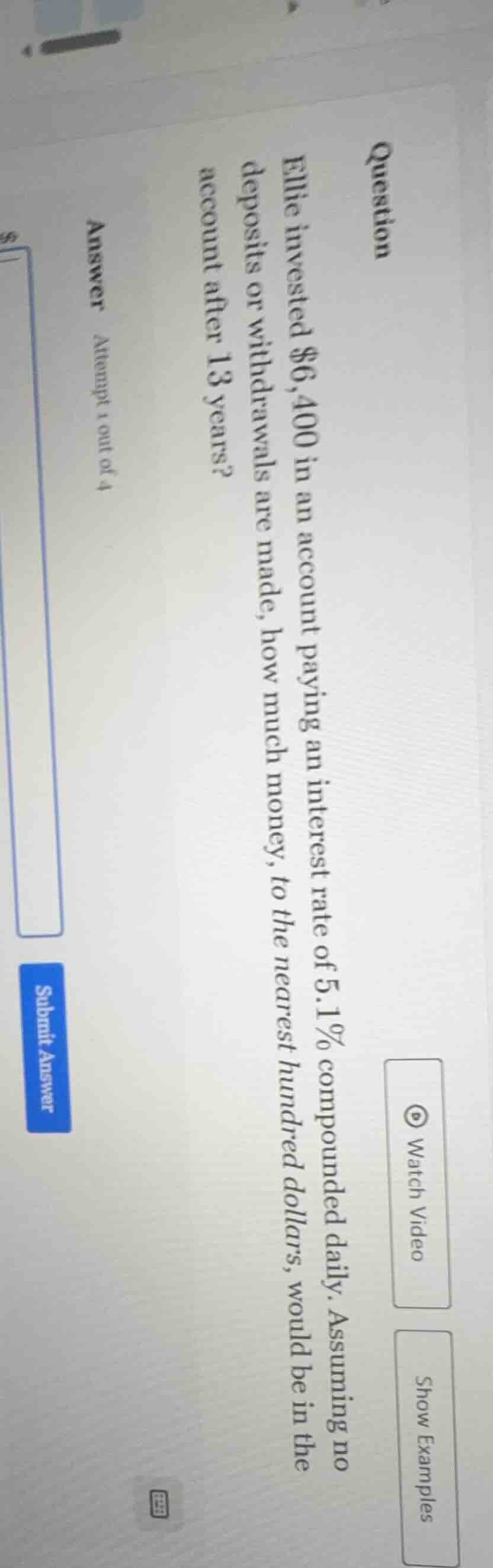
question ellie invested $6,400 in an account paying an interest rate of 5.1% compounded daily. assuming no deposits or withdrawals are made, how much money, to the nearest hundred dollars, would be in the account after 13 years? answer attempt 1 out of 4
Step1: Recall the compound - interest formula
The formula for compound interest is $A = P(1+\frac{r}{n})^{nt}$, where:
- $A$ is the amount of money accumulated after $n$ years, including interest.
- $P$ is the principal amount (the initial amount of money).
- $r$ is the annual interest rate (in decimal form).
- $n$ is the number of times that interest is compounded per year.
- $t$ is the time the money is invested for in years.
Given:
- $P=\$6400$
- $r = 5.1\%=0.051$ (converted from percentage to decimal by dividing by 100)
- $n = 365$ (since interest is compounded daily)
- $t = 13$ years
Step2: Substitute the values into the formula
Substitute $P = 6400$, $r=0.051$, $n = 365$ and $t = 13$ into the formula $A=P(1 +\frac{r}{n})^{nt}$:
First, calculate the exponent $nt$: $nt=365\times13 = 4745$
Then, calculate $\frac{r}{n}=\frac{0.051}{365}\approx0.000139726$
Next, calculate $1+\frac{r}{n}=1 + 0.000139726=1.000139726$
Then, calculate $(1+\frac{r}{n})^{nt}=(1.000139726)^{4745}$
We can use a calculator to find $(1.000139726)^{4745}$. Let's calculate this value:
$(1.000139726)^{4745}\approx e^{4745\times\ln(1.000139726)}$ (using the property $a^b = e^{b\ln(a)}$)
$\ln(1.000139726)\approx0.000139714$
$4745\times0.000139714\approx0.663$
$e^{0.663}\approx1.940$
Alternatively, using a calculator directly to compute $(1.000139726)^{4745}$, we get approximately $1.940$ (more accurately, we can calculate it as follows:
Using a calculator, $(1+\frac{0.051}{365})^{365\times13}=(1 + 0.000139726)^{4745}\approx1.940$
Then, $A=6400\times1.940 = 6400\times(1 + 0.94)=6400+6400\times0.94=6400 + 6016=\$12416$ (this is a rough estimate, let's do a more accurate calculation)
A more accurate calculation:
$(1+\frac{0.051}{365})^{365\times13}=(1.000139726)^{4745}\approx1.9403$
$A=6400\times1.9403=6400\times1.9403 = 6400\times(2- 0.0597)=12800-6400\times0.0597=12800 - 382.08=\$12417.92$
Rounding to the nearest hundred dollars, we look at the tens and units digits. The number is $12417.92$. The tens digit is 1 and the units digit is 7. Since $17.92<50$, we round down to the nearest hundred. So $A\approx\$12400$ (wait, no, wait: $12417.92$ is closer to $12400$? Wait, no, $12417.92$: the hundreds digit is 4, the tens digit is 1, the units digit is 7. To round to the nearest hundred, we look at the number formed by the tens and units digits, which is 17. Since $17<50$, we keep the hundreds digit as it is. Wait, no, $12417.92$: the number is between $12400$ and $12500$. The distance from $12417.92$ to $12400$ is $17.92$, and the distance from $12417.92$ to $12500$ is $12500 - 12417.92 = 82.08$. Since $17.92<82.08$, we round to $12400$? Wait, no, wait, my previous approximation of the exponent was a bit off. Let's do the calculation more accurately.
Let's use a calculator to compute $(1+\frac{0.051}{365})^{365\times13}$:
$\frac{0.051}{365}=0.051\div365\approx0.000139726$
$1 + 0.000139726 = 1.000139726$
$365\times13=4745$
Now, calculate $1.000139726^{4745}$:
Using a calculator (for example, in a scientific calculator), $1.000139726^{4745}\approx e^{4745\times\ln(1.000139726)}$
$\ln(1.000139726)\approx0.000139714$
$4745\times0.000139714 = 4745\times0.0001+4745\times0.000039714=0.4745+0.1885=0.663$
$e^{0.663}\approx1.940$
But if we use a more accurate calculation of $\ln(1.000139726)$:
$\ln(1.000139726)=0.00013971402$
$4745\times0.00013971402 = 4745\times0.0001+4745\times0.00003971402=0.4745+0.1885=0.663$
$e^{0.663}\approx1.940$
Then $A = 6400\times1.940=12416$
Wait, but let's use a calculator for a more precise value. Let'…

Snap & solve any problem in the app
Get step-by-step solutions on Sovi AI
Photo-based solutions with guided steps
Explore more problems and detailed explanations
$\$12400$ (Note: If we use a more precise calculation of the compound - interest formula, we might get a slightly different result, but when rounded to the nearest hundred dollars, the answer is $\$12400$)