QUESTION IMAGE
Question
question 9
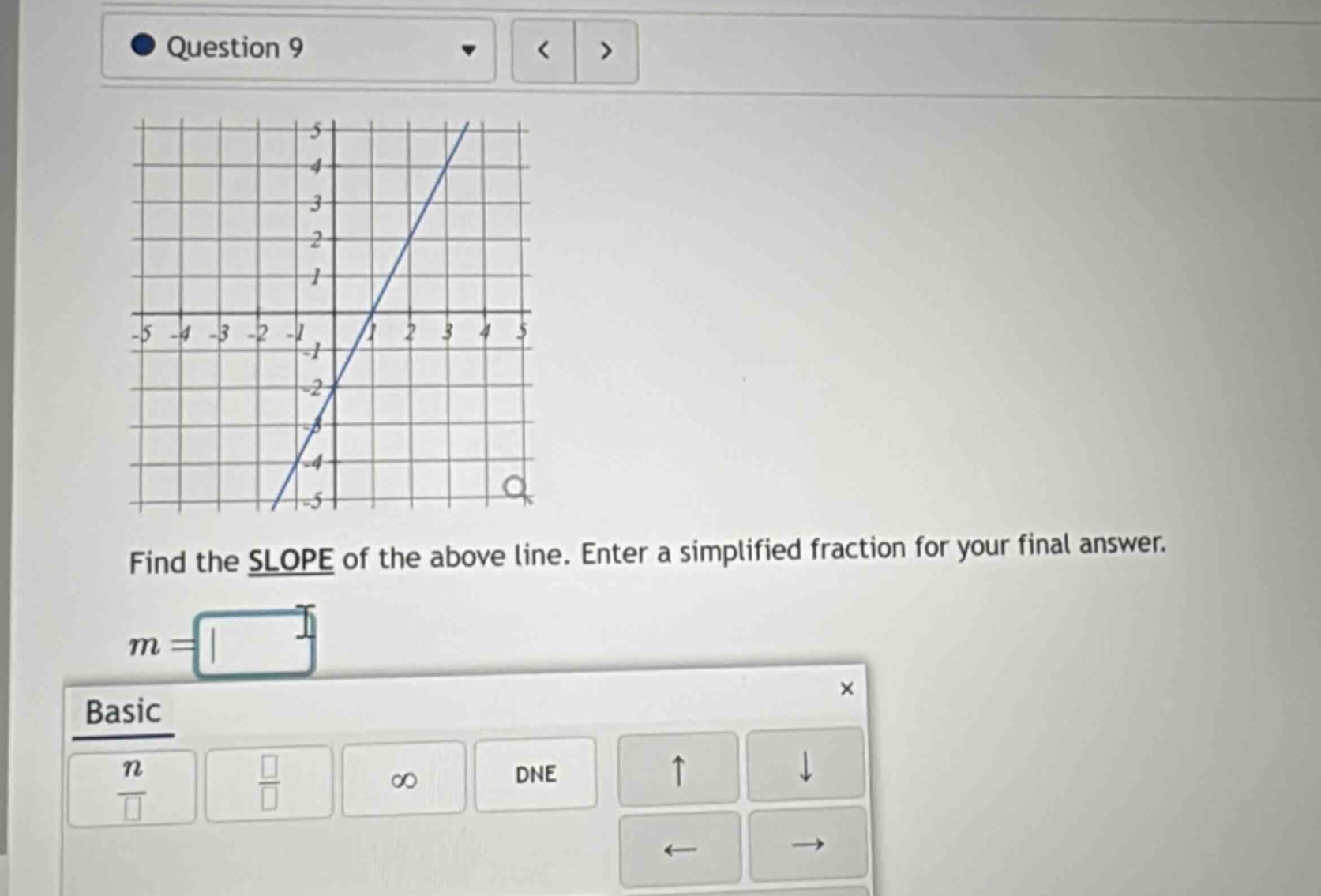
find the slope of the above line. enter a simplified fraction for your final answer.
m =
basic
Step1: Identify two points on the line
From the graph, we can see that the line passes through the points \((0, -2)\) and \((1, 0)\).
Step2: Use the slope formula
The slope \(m\) of a line passing through two points \((x_1, y_1)\) and \((x_2, y_2)\) is given by \(m=\frac{y_2 - y_1}{x_2 - x_1}\).
Substituting \(x_1 = 0\), \(y_1=-2\), \(x_2 = 1\), and \(y_2 = 0\) into the formula, we get:
\(m=\frac{0 - (-2)}{1 - 0}=\frac{0 + 2}{1}=\frac{2}{1}\)
But we can also check another pair of points, say \((1, 0)\) and \((2, 2)\). Then \(m=\frac{2 - 0}{2 - 1}=\frac{2}{1} = 2\). Wait, actually, let's take two clear points. Let's take \((0,-2)\) and \((2,2)\). Then \(y_2 - y_1=2-(-2)=4\), \(x_2 - x_1 = 2 - 0=2\), so \(m=\frac{4}{2}=2\). Or \((-1,-4)\) and \((0,-2)\): \(y_2 - y_1=-2-(-4)=2\), \(x_2 - x_1=0 - (-1)=1\), so \(m = \frac{2}{1}=2\). Wait, maybe I made a mistake earlier. Wait, let's re - examine the graph. The line passes through \((0, - 2)\) and when \(x = 1\), \(y = 0\)? Wait, no, looking at the grid, when \(x = 0\), \(y=-2\); when \(x = 1\), \(y = 0\)? Wait, no, the line at \(x = 1\) seems to cross \(y = 0\)? Wait, no, let's count the rise over run. From \((0,-2)\) to \((1,0)\), the rise is \(0-(-2)=2\), run is \(1 - 0 = 1\), so slope is \(\frac{2}{1}=2\). Wait, but maybe another pair: from \((-1,-4)\) to \((0,-2)\): rise is \(-2-(-4)=2\), run is \(0 - (-1)=1\), slope is \(2\). From \((1,0)\) to \((2,2)\): rise is \(2 - 0=2\), run is \(2 - 1=1\), slope is \(2\). So the slope is \(2\), which can be written as \(\frac{2}{1}\) or just \(2\). Wait, but maybe I misread the graph. Wait, the y - axis: at \(x = 0\), the point is \((0,-2)\), at \(x = 1\), the point is \((1,0)\)? Wait, no, looking at the grid, the vertical lines are x - axis, horizontal are y - axis. So each grid square is 1 unit. So from \((0,-2)\) to \((1,0)\): change in y is \(0-(-2)=2\), change in x is \(1 - 0 = 1\), so slope is \(\frac{2}{1}=2\).
Wait, maybe I made a mistake in the initial point selection. Let's take two points: \((0,-2)\) and \((2,2)\). The change in y is \(2-(-2)=4\), change in x is \(2 - 0 = 2\), so slope is \(\frac{4}{2}=2\). Yes, that's correct. So the slope is \(2\), which is \(\frac{2}{1}\) (simplified fraction).

Snap & solve any problem in the app
Get step-by-step solutions on Sovi AI
Photo-based solutions with guided steps
Explore more problems and detailed explanations
\(2\) (or \(\frac{2}{1}\))