QUESTION IMAGE
Question
question 3
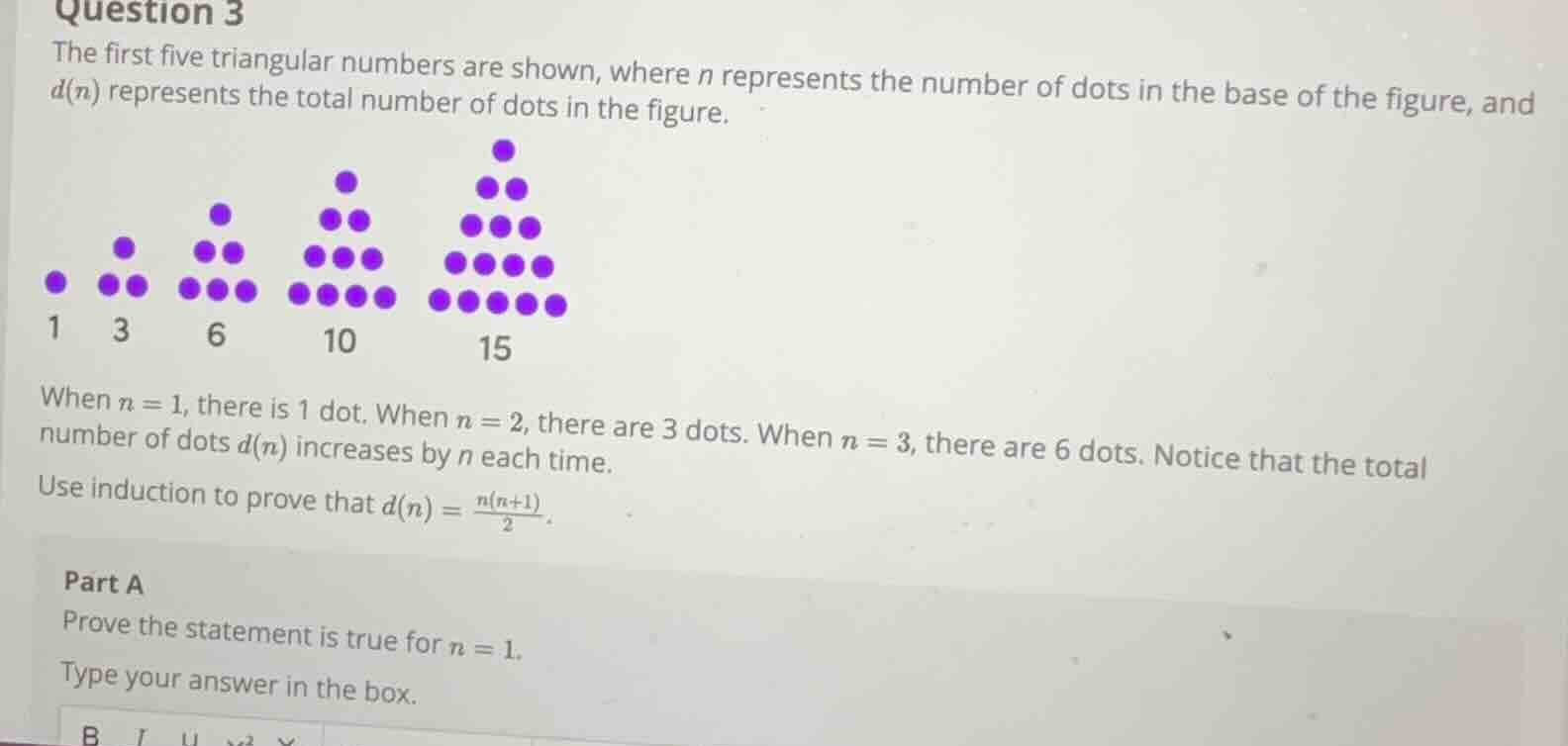
the first five triangular numbers are shown, where n represents the number of dots in the base of the figure, and d(n) represents the total number of dots in the figure.
images of triangular dot figures with labels 1, 3, 6, 10, 15
when n = 1, there is 1 dot. when n = 2, there are 3 dots. when n = 3, there are 6 dots. notice that the total number of dots d(n) increases by n each time.
use induction to prove that ( d(n) = \frac{n(n + 1)}{2} ).
part a
prove the statement is true for n = 1.
type your answer in the box.
Step1: Substitute n=1 into formula
Calculate $d(1)$ using $\frac{n(n+1)}{2}$:
$\frac{1(1+1)}{2} = \frac{1\times2}{2}$
Step2: Simplify the expression
$\frac{2}{2} = 1$
Step3: Match given value
When $n=1$, the given total dots is 1, which equals the formula result.

Snap & solve any problem in the app
Get step-by-step solutions on Sovi AI
Photo-based solutions with guided steps
Explore more problems and detailed explanations
When $n=1$, substitute into $d(n)=\frac{n(n+1)}{2}$:
$\frac{1(1+1)}{2}=\frac{2}{2}=1$, which matches the given total number of dots for $n=1$. Thus the statement is true for $n=1$.