QUESTION IMAGE
Question
question
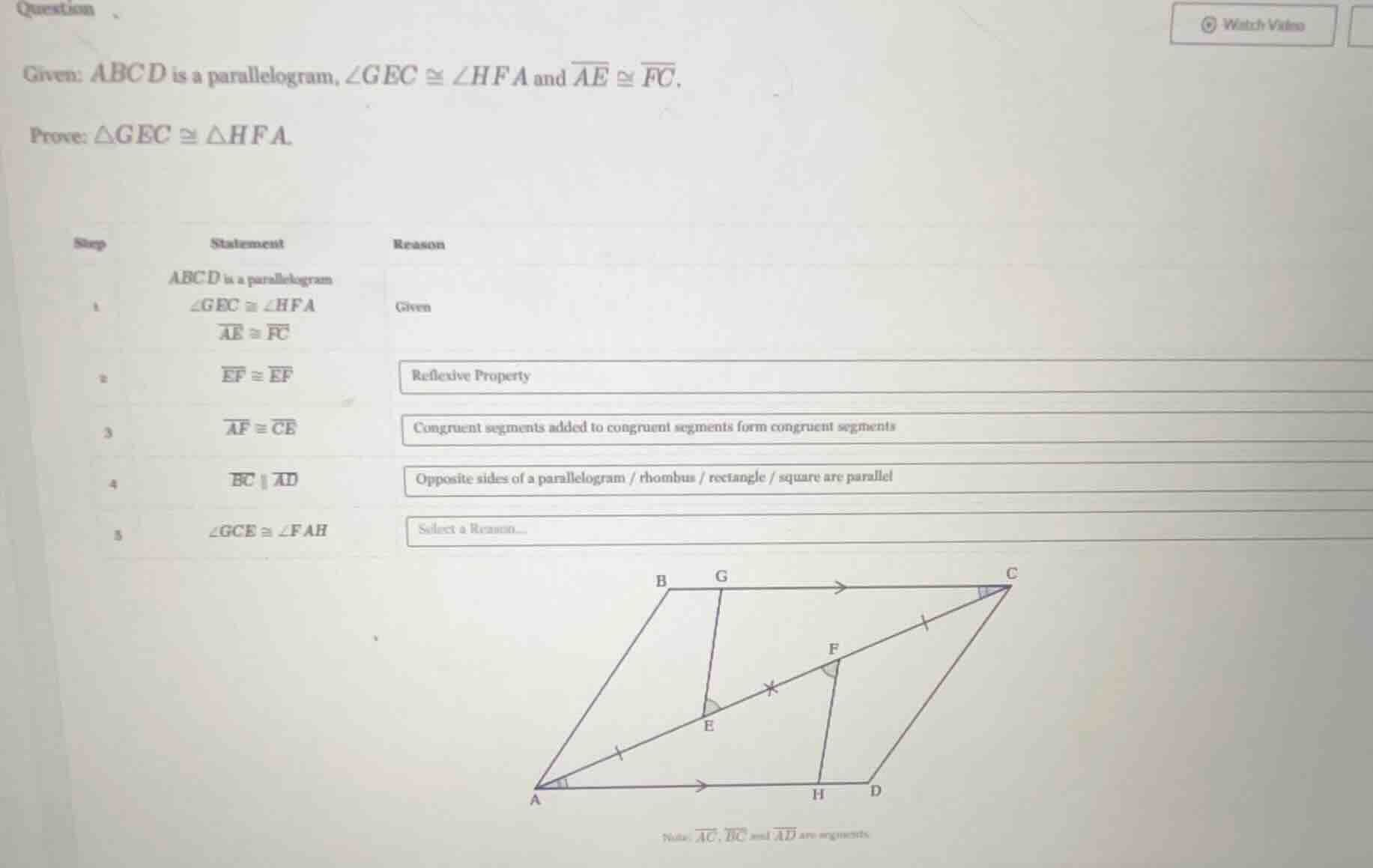
given: abcd is a parallelogram, ∠gec ≅ ∠hfa and \\(\overline{ae} \cong \overline{fc}\\).
prove: \\(\triangle gec \cong \triangle hfa\\).
step statement reason
1 abcd is a parallelogram
∠gec ≅ ∠hfa
\\(\overline{ae} \cong \overline{fc}\\) given
2 \\(\overline{ef} \cong \overline{ef}\\) reflexive property
3 \\(\overline{af} \cong \overline{ce}\\) congruent segments added to congruent segments form congruent segments
4 \\(\overline{bc} \parallel \overline{ad}\\) opposite sides of a parallelogram / rhombus / rectangle / square are parallel
5 ∠gce ≅ ∠fah select a reason...
(image of a parallelogram abcd with points e, f, g, h and triangles gec, hfa. note: \\(\overline{ac}\\), \\(\overline{bc}\\) and \\(\overline{ad}\\) are segments.)
Step1: Recall Parallel Line Angles
Since \( BC \parallel AD \) (from step 4, opposite sides of parallelogram), and \( AC \) is a transversal.
Step2: Apply Alternate Interior Angles
By the Alternate Interior Angles Theorem, when a transversal intersects two parallel lines, alternate interior angles are congruent. So \( \angle GCE \cong \angle FAH \) because \( BC \parallel AD \) and \( AC \) is the transversal, making \( \angle GCE \) and \( \angle FAH \) alternate interior angles.

Snap & solve any problem in the app
Get step-by-step solutions on Sovi AI
Photo-based solutions with guided steps
Explore more problems and detailed explanations
The reason for \( \angle GCE \cong \angle FAH \) is "Alternate Interior Angles Theorem (If two parallel lines are cut by a transversal, then alternate interior angles are congruent)".