QUESTION IMAGE
Question
question
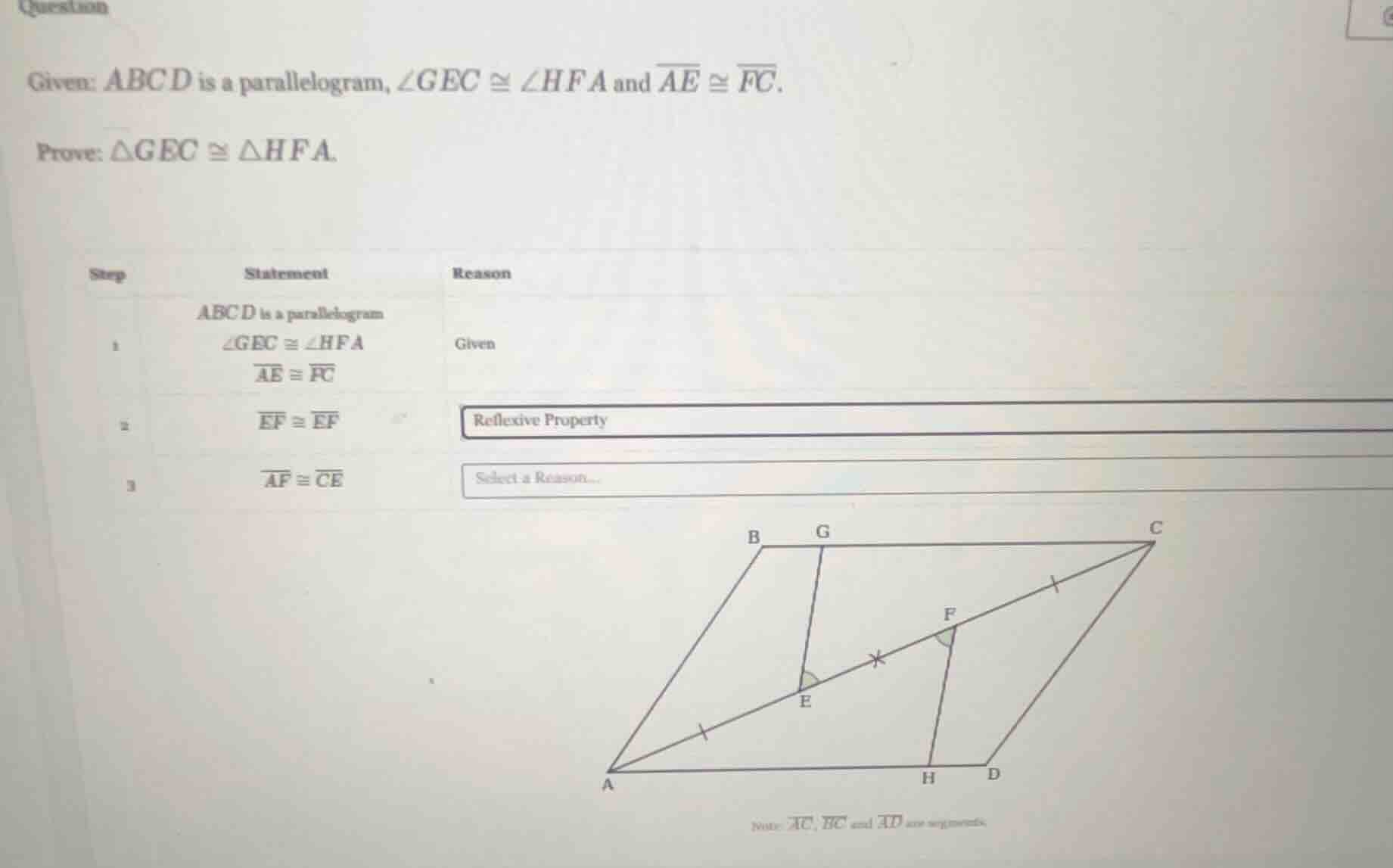
given: abcd is a parallelogram, ∠gec ≅ ∠hfa and \\(\overline{ae} \cong \overline{fc}\\).
prove: \\(\triangle gec \cong \triangle hfa\\).
step\tstatement\treason
1\tabcd is a parallelogram
∠gec ≅ ∠hfa
\\(\overline{ae} \cong \overline{fc}\\)\tgiven
2\t\\(\overline{ef} \cong \overline{ef}\\)\treflexive property
3\t\\(\overline{af} \cong \overline{ce}\\)\tselect a reason...
(note: there is a diagram of parallelogram abcd with points e, f, g, h as shown, and ac, bc, ad are segments.)
Step1: Analyze the segments
We know that \( \overline{AE} \cong \overline{FC} \) (given) and \( \overline{EF} \cong \overline{EF} \) (reflexive property). To find the relationship between \( \overline{AF} \) and \( \overline{CE} \), we can express \( \overline{AF} \) and \( \overline{CE} \) in terms of other segments.
\( \overline{AF}=\overline{AE}+\overline{EF} \) and \( \overline{CE}=\overline{FC}+\overline{EF} \).
Step2: Apply the Segment Addition Postulate and Congruence
Since \( \overline{AE} \cong \overline{FC} \) (given) and \( \overline{EF} \cong \overline{EF} \) (reflexive), by the Addition Property of Congruence (if two congruent segments are added to two other congruent segments, the resulting segments are congruent), we have:
If \( \overline{AE} \cong \overline{FC} \) and \( \overline{EF} \cong \overline{EF} \), then \( \overline{AE}+\overline{EF} \cong \overline{FC}+\overline{EF} \).
Substituting \( \overline{AF}=\overline{AE}+\overline{EF} \) and \( \overline{CE}=\overline{FC}+\overline{EF} \), we get \( \overline{AF} \cong \overline{CE} \). The reason is the Addition Property of Congruence (or more specifically, the Segment Addition Postulate combined with congruence of segments: if \( a \cong b \) and \( c \cong c \), then \( a + c \cong b + c \)).

Snap & solve any problem in the app
Get step-by-step solutions on Sovi AI
Photo-based solutions with guided steps
Explore more problems and detailed explanations
The reason for \( \overline{AF} \cong \overline{CE} \) is the Addition Property of Congruence (or "If two congruent segments are added to two other congruent segments, the resulting segments are congruent" or using the Segment Addition Postulate: \( \overline{AF}=\overline{AE}+\overline{EF} \), \( \overline{CE}=\overline{FC}+\overline{EF} \), and since \( \overline{AE} \cong \overline{FC} \) and \( \overline{EF} \cong \overline{EF} \), then \( \overline{AF} \cong \overline{CE} \) by the addition of congruent segments).