QUESTION IMAGE
Question
question
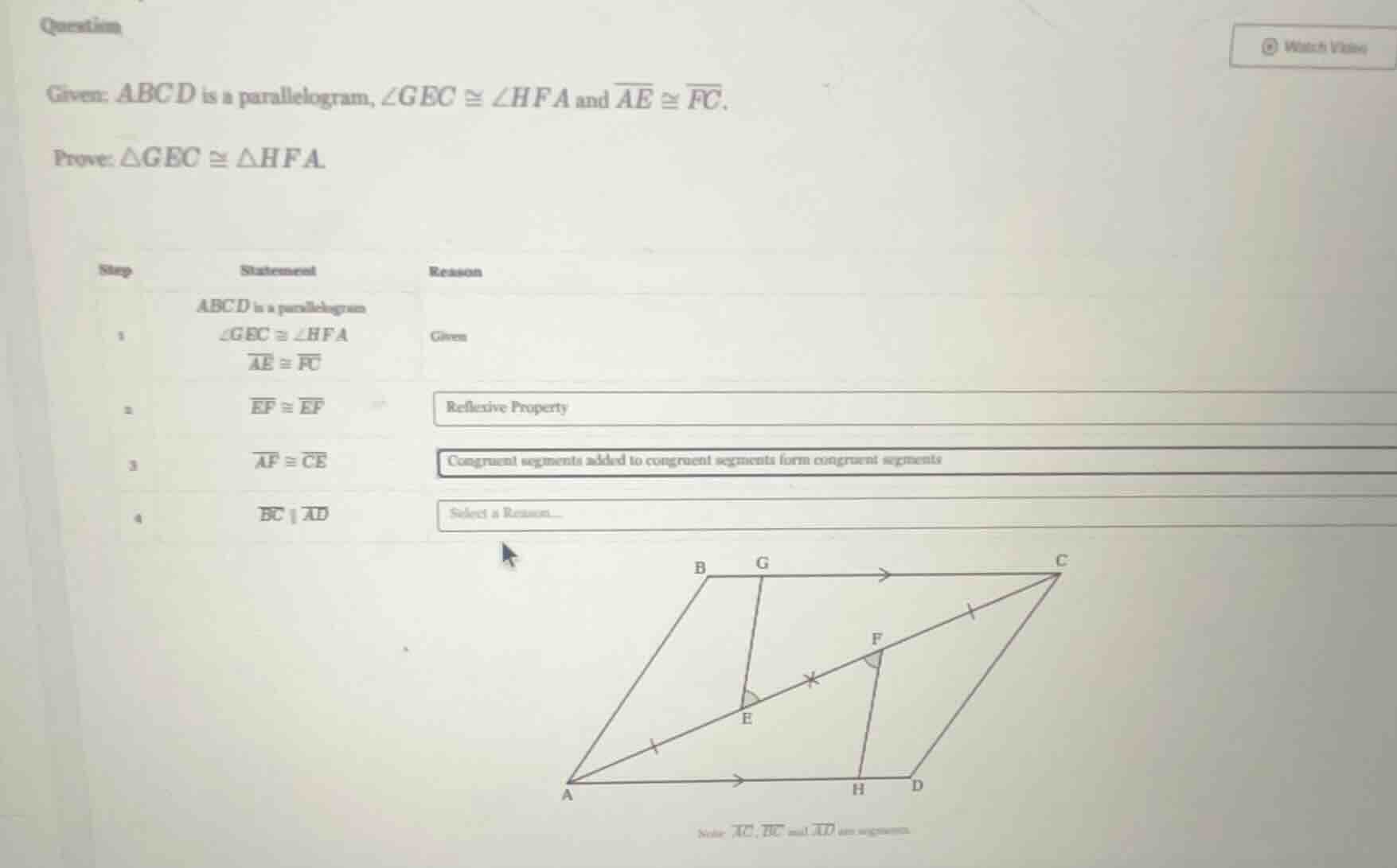
given: abcd is a parallelogram, $\angle gec \cong \angle hfa$ and $\overline{ae} \cong \overline{fc}$.
prove: $\triangle gec \cong \triangle hfa$
step\tstatement\treason
1\tabcd is a parallelogram
$\angle gec \cong \angle hfa$
$\overline{ae} \cong \overline{fc}$\tgiven
2\t$\overline{ef} \cong \overline{ef}$\treflexive property
3\t$\overline{af} \cong \overline{ce}$\tcongruent segments added to congruent segments form congruent segments
4\t$\overline{bc} \parallel \overline{ad}$\tselect a reason...
(note: there is a diagram of parallelogram abcd with points e, f, g, h and triangles gec, hfa as described.)
Step1: Recall Parallelogram Property
In a parallelogram, opposite sides are parallel. For parallelogram \(ABCD\), \(BC\) and \(AD\) are opposite sides. So by the definition of a parallelogram, opposite sides are parallel.
Step2: Determine the Reason
The reason for \(BC \parallel AD\) is that in a parallelogram, opposite sides are parallel. So the property of a parallelogram (opposite sides are parallel) justifies this statement.

Snap & solve any problem in the app
Get step-by-step solutions on Sovi AI
Photo-based solutions with guided steps
Explore more problems and detailed explanations
The reason for \(BC \parallel AD\) is "Opposite sides of a parallelogram are parallel".