QUESTION IMAGE
Question
question 5
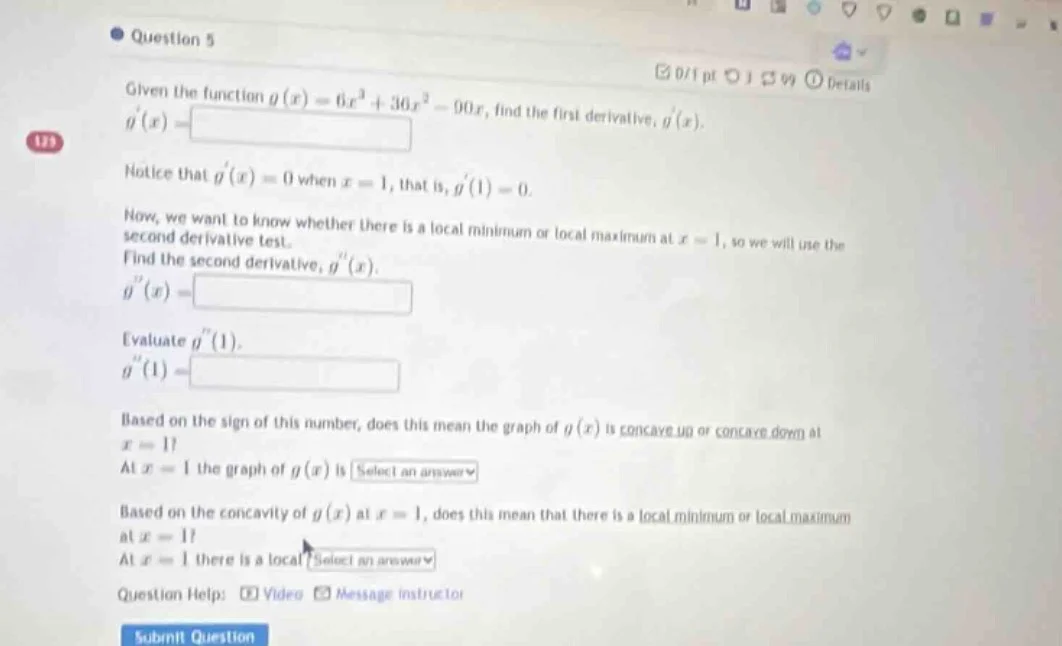
given the function ( g(x) = 6x^3 + 30x^2 - 90x ), find the first derivative, ( g(x) ).
( g(x) = )
notice that ( g(x) = 0 ) when ( x = 1 ), that is, ( g(1) = 0 ).
now, we want to know whether there is a local minimum or local maximum at ( x = 1 ), so we will use the second derivative test.
find the second derivative, ( g(x) ).
( g(x) = )
evaluate ( g(1) ).
( g(1) = )
based on the sign of this number, does this mean the graph of ( g(x) ) is concave up or concave down at ( x = 1 )?
at ( x = 1 ) the graph of ( g(x) ) is
based on the concavity of ( g(x) ) at ( x = 1 ), does this mean that there is a local minimum or local maximum at ( x = 1 )?
at ( x = 1 ) there is a local
question help: video message instructor
submit question
Step1: Compute first derivative
Apply power rule: $\frac{d}{dx}x^n=nx^{n-1}$
$g'(x) = 6\cdot3x^{2} + 36\cdot2x^{1} - 90\cdot1x^{0}$
$g'(x) = 18x^2 + 72x - 90$
Step2: Compute second derivative
Differentiate $g'(x)$
$g''(x) = 18\cdot2x^{1} + 72\cdot1x^{0} - 0$
$g''(x) = 36x + 72$
Step3: Evaluate $g''(1)$
Substitute $x=1$ into $g''(x)$
$g''(1) = 36(1) + 72 = 108$
Step4: Determine concavity
Positive $g''(x)$ means concave up
$g''(1)=108>0$, so concave up
Step5: Classify extrema
Concave up implies local minimum
---

Snap & solve any problem in the app
Get step-by-step solutions on Sovi AI
Photo-based solutions with guided steps
Explore more problems and detailed explanations
$g'(x) = 18x^2 + 72x - 90$
$g''(x) = 36x + 72$
$g''(1) = 108$
At $x=1$ the graph of $g(x)$ is concave up
At $x=1$ there is a local minimum