QUESTION IMAGE
Question
question 9
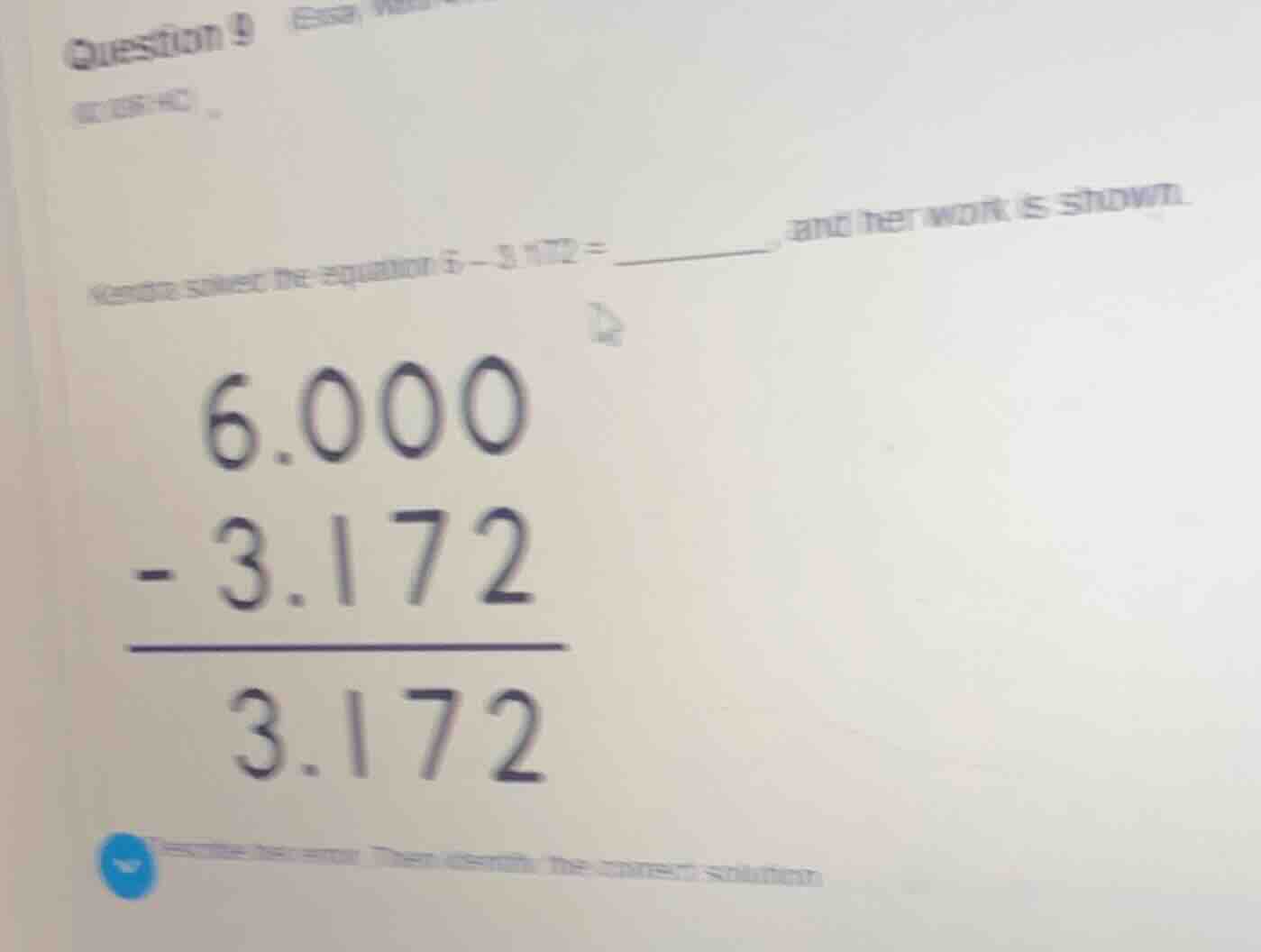
kendra solved the equation $6 - 3.172 =$ ______, and her work is shown.
\
describe her error. then identify the correct solution.
Step1: Analyze the subtraction error
When subtracting decimals, we need to borrow correctly. Let's rewrite \(6\) as \(6.000\) (since \(3.172\) has three decimal places). Now, subtracting the thousandths place: \(0 - 2\) is not possible, so we borrow from the hundredths place. But the hundredths place is also \(0\), so we borrow from the tenths place, which is also \(0\), so we borrow from the ones place. So \(6\) becomes \(5\), the tenths place becomes \(10\) (but we need to borrow again for the hundredths place), so tenths place becomes \(9\), hundredths place becomes \(10\) (borrow for thousandths place), hundredths place becomes \(9\), and thousandths place becomes \(10\). Now, thousandths place: \(10 - 2 = 8\), hundredths place: \(9 - 7 = 2\), tenths place: \(9 - 1 = 8\), ones place: \(5 - 3 = 2\). Wait, no, let's do it step by step.
Wait, the correct subtraction: \(6.000 - 3.172\). Let's subtract each place:
- Ones place: \(6 - 3 = 3\)? No, wait, when we borrow for the decimal places, the ones place becomes \(5\) (because we borrowed \(1\) for the tenths place). Wait, no, let's do decimal subtraction properly.
\(6.000\) can be thought of as \(5 + 1.000\). Then \(1.000 - 0.172 = 0.828\). Then \(5 - 3 = 2\). Then \(2 + 0.828 = 2.828\).
Wait, Kendra's mistake: She didn't borrow correctly. She just subtracted \(6 - 3 = 3\) in the ones place, \(0 - 1\) (but didn't borrow), \(0 - 7\) (didn't borrow), \(0 - 2\) (didn't borrow), which is wrong.
Step2: Correct the subtraction
Let's perform the subtraction correctly:
\[
\]
Borrowing:
- Ones place: \(6\) becomes \(5\) (borrow \(1\) for tenths place), tenths place becomes \(10\) tenths. But tenths place is \(0\), so we borrow from the ones place to the tenths place: \(6\) (ones) becomes \(5\), tenths place becomes \(10\) tenths. Now, tenths place is \(10\) tenths, but we need to borrow for the hundredths place. So tenths place becomes \(9\) tenths, hundredths place becomes \(10\) hundredths. Now, hundredths place is \(10\) hundredths, but we need to borrow for the thousandths place. So hundredths place becomes \(9\) hundredths, thousandths place becomes \(10\) thousandths.
Now:
- Thousandths place: \(10 - 2 = 8\)
- Hundredths place: \(9 - 7 = 2\)
- Tenths place: \(9 - 1 = 8\)
- Ones place: \(5 - 3 = 2\)
Wait, no, that's not right. Wait, no, when we borrow \(1\) from the ones place (which is \(6\)) to the tenths place, the ones place becomes \(5\), tenths place becomes \(10\) tenths. Then, since we need to subtract \(0.172\), we need to borrow from the tenths place to the hundredths place: tenths place becomes \(9\) tenths, hundredths place becomes \(10\) hundredths. Then borrow from hundredths place to thousandths place: hundredths place becomes \(9\) hundredths, thousandths place becomes \(10\) thousandths.
Now, subtract each place:
- Thousandths: \(10 - 2 = 8\)
- Hundredths: \(9 - 7 = 2\)
- Tenths: \(9 - 1 = 8\)
- Ones: \(5 - 3 = 2\)
Wait, no, that gives \(2.828\)? Wait, no, let's use a calculator approach. \(6 - 3.172 = 2.828\). Kendra's answer was \(3.172\), which is wrong because she didn't borrow when subtracting the decimal parts. She just subtracted \(6 - 3 = 3\) for the ones place, and then kept the decimal part as \(0.172\), which is incorrect.
Step3: Find the correct solution
To find the correct value, we do \(6.000 - 3.172\). Let's align the decimals:
\[
\begin{array}{r@{}l}
& 6.…

Snap & solve any problem in the app
Get step-by-step solutions on Sovi AI
Photo-based solutions with guided steps
Explore more problems and detailed explanations
The error is that Kendra did not borrow correctly when subtracting the decimal places. The correct solution is \(2.828\).