QUESTION IMAGE
Question
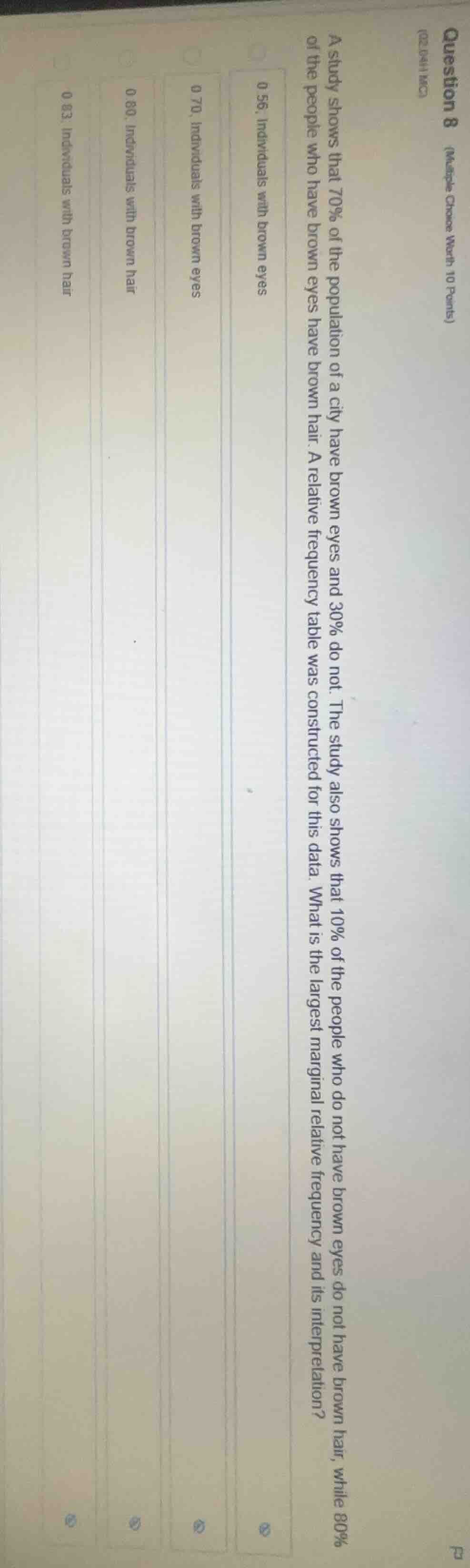
question 8 (multiple choice worth 10 points) (02.04h mc) a study shows that 70% of the population of a city have brown eyes and 30% do not. the study also shows that 10% of the people who do not have brown eyes do not have brown hair, while 80% of the people who have brown eyes have brown hair. a relative frequency table was constructed for this data. what is the largest marginal relative frequency and its interpretation? 0.56, individuals with brown eyes 0.70, individuals with brown eyes 0.80, individuals with brown hair 0.83, individuals with brown hair
Step1: Define population segments
Let total population = 1 (or 100%).
- Brown eyes (BE): $P(BE) = 0.7$
- No brown eyes (NBE): $P(NBE) = 0.3$
Step2: Calculate brown hair subgroups
- Brown hair, BE: $0.8 \times P(BE) = 0.8 \times 0.7 = 0.56$
- Brown hair, NBE: $(1-0.1) \times P(NBE) = 0.9 \times 0.3 = 0.27$
Step3: Total brown hair frequency
Total brown hair: $0.56 + 0.27 = 0.83$
Step4: Compare all marginal frequencies
- Brown eyes: 0.7; No brown eyes: 0.3; Brown hair: 0.83; No brown hair: $1-0.83=0.17$
Largest frequency is 0.83.

Snap & solve any problem in the app
Get step-by-step solutions on Sovi AI
Photo-based solutions with guided steps
Explore more problems and detailed explanations
0.83, Individuals with brown hair