QUESTION IMAGE
Question
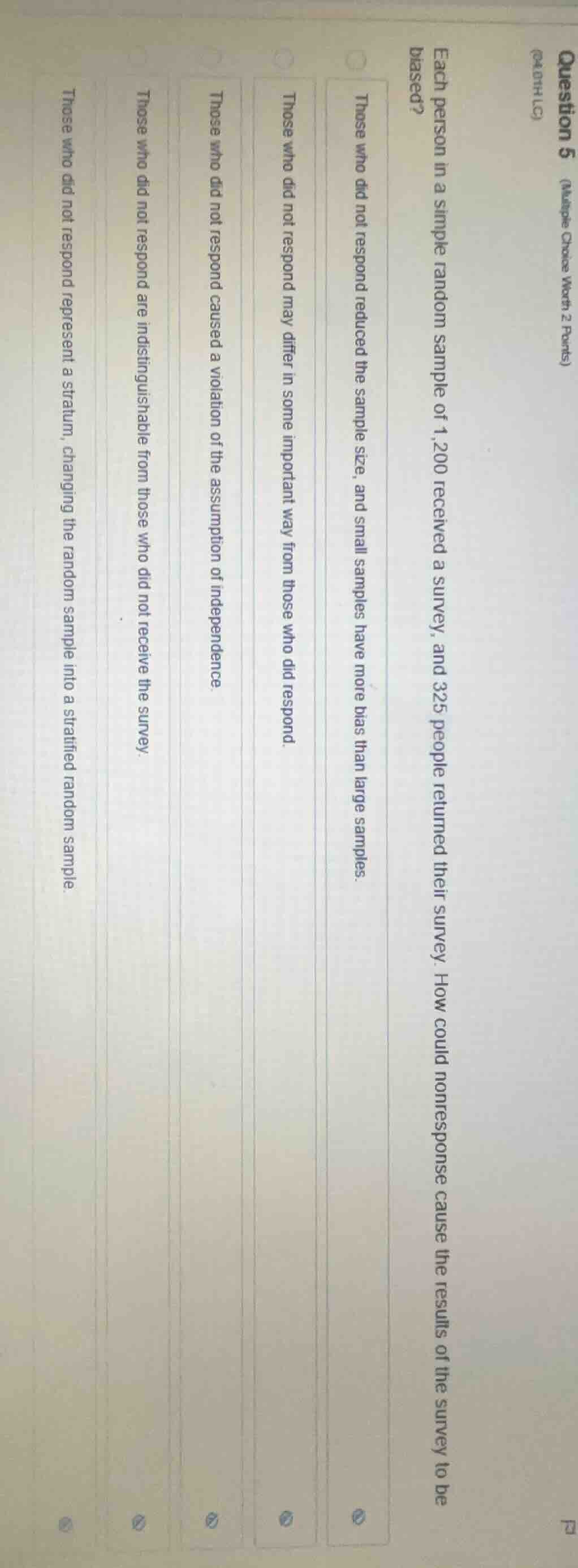
question 5 (multiple choice worth 2 points) (940111lc) each person in a simple random sample of 1,200 received a survey, and 325 people returned their survey. how could nonresponse cause the results of the survey to be biased? those who did not respond reduced the sample size, and small samples have more bias than large samples. those who did not respond may differ in some important way from those who did respond. those who did not respond caused a violation of the assumption of independence. those who did not respond are indistinguishable from those who did not receive the survey. those who did not respond represent a stratum, changing the random sample into a stratified random sample.
Nonresponse bias occurs when the group of people who do not respond to a survey has different characteristics, opinions, or attributes related to the survey topic compared to those who do respond. This difference means the remaining respondents no longer represent the full original sample, leading to biased results.

Snap & solve any problem in the app
Get step-by-step solutions on Sovi AI
Photo-based solutions with guided steps
Explore more problems and detailed explanations
B. Those who did not respond may differ in some important way from those who did respond.