QUESTION IMAGE
Question
question number 8. (4.00 points)
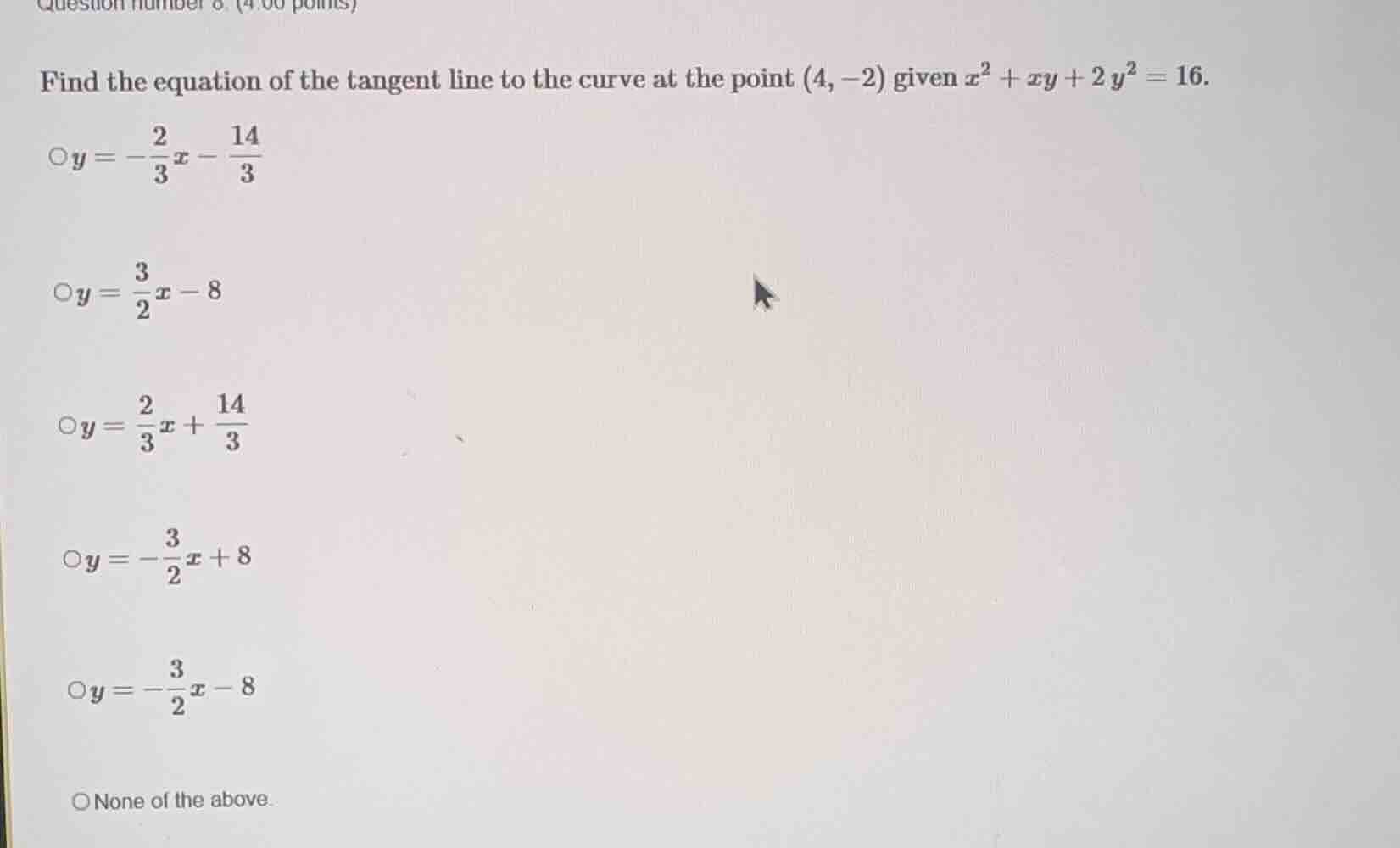
find the equation of the tangent line to the curve at the point (4, -2) given ( x^2 + xy + 2y^2 = 16 ).
( circ y = -\frac{2}{3}x - \frac{14}{3} )
( circ y = \frac{3}{2}x - 8 )
( circ y = \frac{2}{3}x + \frac{14}{3} )
( circ y = -\frac{3}{2}x + 8 )
( circ y = -\frac{3}{2}x - 8 )
( circ )none of the above.
Step1: Implicit Differentiation
Differentiate \(x^{2}+xy + 2y^{2}=16\) with respect to \(x\).
Using power rule and product rule:
\(\frac{d}{dx}(x^{2})=2x\)
\(\frac{d}{dx}(xy)=y + x\frac{dy}{dx}\) (product rule: \(u = x\), \(v = y\), \(u'v+uv'\))
\(\frac{d}{dx}(2y^{2}) = 4y\frac{dy}{dx}\)
\(\frac{d}{dx}(16)=0\)
So, \(2x + y+x\frac{dy}{dx}+4y\frac{dy}{dx}=0\)
Step2: Solve for \(\frac{dy}{dx}\)
Rearrange terms to solve for \(\frac{dy}{dx}\):
\(x\frac{dy}{dx}+4y\frac{dy}{dx}=-2x - y\)
\(\frac{dy}{dx}(x + 4y)=-2x - y\)
\(\frac{dy}{dx}=\frac{-2x - y}{x + 4y}\)
Step3: Find the slope at \((4,-2)\)
Substitute \(x = 4\) and \(y=-2\) into \(\frac{dy}{dx}\):
\(\frac{dy}{dx}=\frac{-2(4)-(-2)}{4+4(-2)}=\frac{-8 + 2}{4-8}=\frac{-6}{-4}=\frac{3}{2}\)? Wait, no, wait: Wait, \(-2x - y\) when \(x = 4\), \(y=-2\) is \(-2(4)-(-2)=-8 + 2=-6\). Denominator \(x + 4y=4+4(-2)=4 - 8=-4\). So \(\frac{-6}{-4}=\frac{3}{2}\)? Wait, but let's check again. Wait, maybe I made a mistake. Wait, the original equation: \(x^{2}+xy + 2y^{2}=16\). At \(x = 4\), \(y=-2\): \(16+(4)(-2)+2(4)=16-8 + 8=16\), which is correct. Now, differentiation: \(\frac{d}{dx}(x^{2})=2x\), \(\frac{d}{dx}(xy)=y + x y'\), \(\frac{d}{dx}(2y^{2})=4y y'\), so \(2x + y+ x y'+4y y'=0\). Then, \(y'(x + 4y)=-2x - y\), so \(y'=\frac{-2x - y}{x + 4y}\). Now, plug \(x = 4\), \(y=-2\): numerator: \(-24-(-2)=-8 + 2=-6\), denominator: \(4+4(-2)=4 - 8=-4\), so \(y'=\frac{-6}{-4}=\frac{3}{2}\). Wait, but let's check the tangent line equation. The point - slope form is \(y - y_{1}=m(x - x_{1})\), where \((x_{1},y_{1})=(4,-2)\) and \(m=\frac{3}{2}\). So \(y-(-2)=\frac{3}{2}(x - 4)\), \(y + 2=\frac{3}{2}x-6\), \(y=\frac{3}{2}x-8\). Wait, that's one of the options: \(y=\frac{3}{2}x - 8\). Wait, but let's check again. Wait, maybe I messed up the sign. Wait, let's re - do the differentiation. Wait, original equation: \(x^{2}+xy + 2y^{2}=16\). Differentiate both sides: \(2x + y+ x y'+4y y'=0\). Then, \(x y'+4y y'=-2x - y\), \(y'(x + 4y)=-2x - y\), so \(y'=\frac{-2x - y}{x + 4y}\). Now, \(x = 4\), \(y=-2\): numerator: \(-24-(-2)=-8 + 2=-6\), denominator: \(4+4(-2)=4 - 8=-4\), so \(y'=\frac{-6}{-4}=\frac{3}{2}\). Then, the tangent line is \(y - (-2)=\frac{3}{2}(x - 4)\), so \(y + 2=\frac{3}{2}x-6\), so \(y=\frac{3}{2}x-8\), which is option B.

Snap & solve any problem in the app
Get step-by-step solutions on Sovi AI
Photo-based solutions with guided steps
Explore more problems and detailed explanations
B. \(y=\frac{3}{2}x - 8\)