QUESTION IMAGE
Question
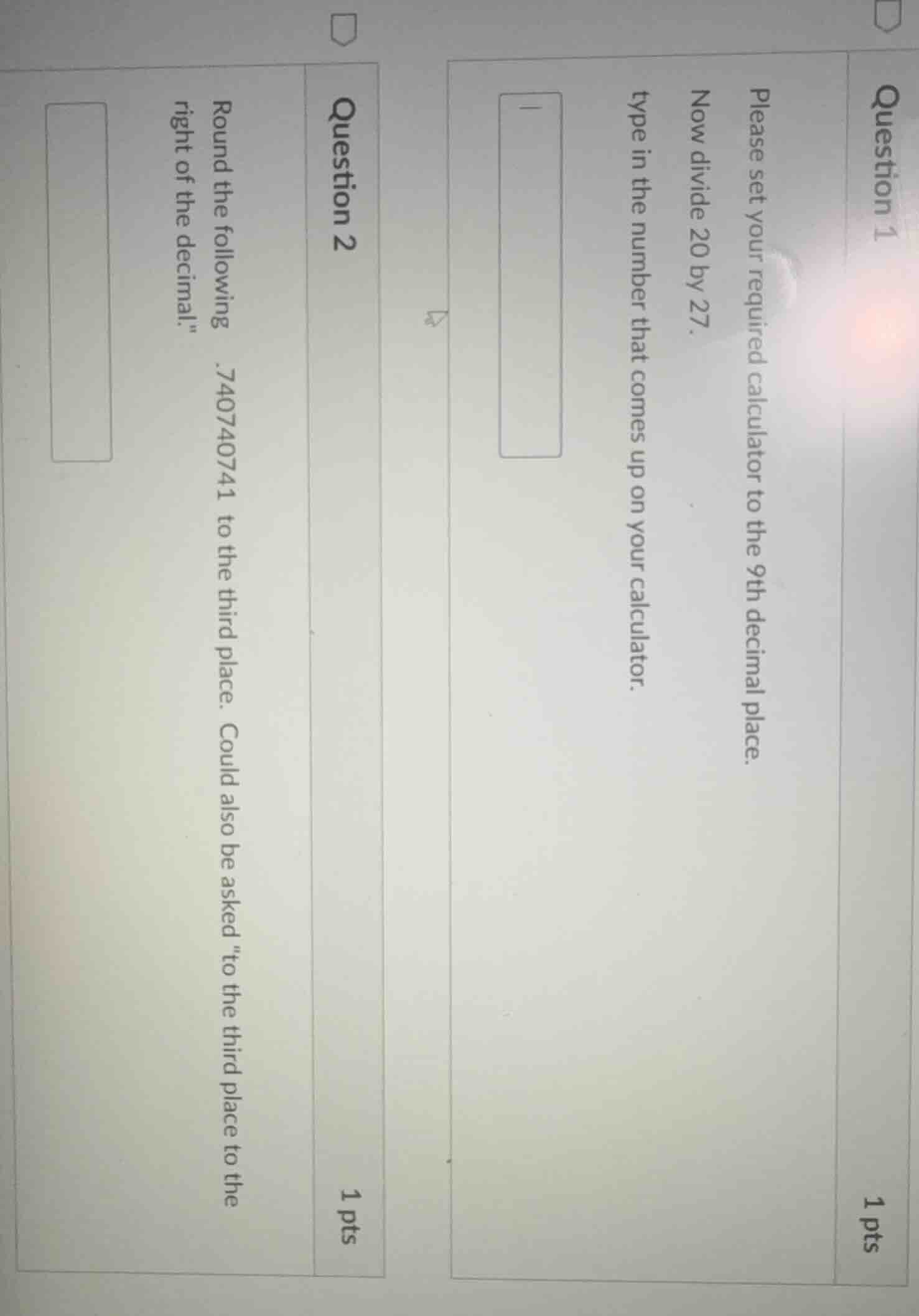
question 1
please set your required calculator to the 9th decimal place.
now divide 20 by 27.
type in the number that comes up on your calculator.
question 2
1 pts
round the following .740740741 to the third place. could also be asked \to the third place to the right of the decimal.\
Question 1
Step1: Divide 20 by 27
$20\div27\approx0.7407407407$
Step2: Round to 9th decimal place
The 9th decimal place is the digit in the position corresponding to $10^{-9}$. Looking at $0.7407407407$, the 9th decimal is 0 (and the 10th is 7, but since we just need the value up to 9th decimal, we can present it as is or check rounding rules. But the problem says "type in the number that comes up on your calculator" when set to 9th decimal place, so we calculate $20\div27$ with sufficient precision. $20\div27 = 0.\overline{740}$, but to 9 decimal places, it's $0.740740741$ (wait, no, let's do the division properly: 20 ÷ 27. 27*0.7 = 18.9, 20 - 18.9 = 1.1. 1.1/27 = 0.0407407407... So 20/27 = 0.7407407407... So to 9 decimal places, it's 0.740740741? Wait, no, the 9th decimal: let's count the digits after decimal: 7 (1st), 4 (2nd), 0 (3rd), 7 (4th), 4 (5th), 0 (6th), 7 (7th), 4 (8th), 0 (9th), 7 (10th)... Wait, no, 0.7 (1), 4 (2), 0 (3), 7 (4), 4 (5), 0 (6), 7 (7), 4 (8), 0 (9), 7 (10)... So 20 ÷ 27 = 0.7407407407... So to 9 decimal places, it's 0.740740741? Wait, no, the 9th digit is 0 (the 9th position after decimal: index 8 if we start at 0? Wait, maybe I'm miscalculating. Let's do the division step by step:
20 ÷ 27:
27 goes into 200 seven times (7*27=189), remainder 11.
110 ÷ 27: 4 times (4*27=108), remainder 2.
20 ÷ 27: 0 times, remainder 20.
200 ÷ 27: 7 times (189), remainder 11.
So the decimal repeats: 0.7 4 0 7 4 0 7 4 0 7 4 0...
So the digits are:
1:7, 2:4, 3:0, 4:7, 5:4, 6:0, 7:7, 8:4, 9:0, 10:7...
So to 9 decimal places, it's 0.740740740 (wait, no, the 9th digit is the 9th after the decimal, so position 8 in 0-based index? Wait, no, the first digit after decimal is position 1 (tenths), second (hundredths), third (thousandths),..., ninth (9th decimal place, which is 10^-9 place). So the digits are:
1: 7 (0.7)
2: 4 (0.74)
3: 0 (0.740)
4: 7 (0.7407)
5: 4 (0.74074)
6: 0 (0.740740)
7: 7 (0.7407407)
8: 4 (0.74074074)
9: 0 (0.740740740)
10:7 (0.7407407407)
Ah, so I made a mistake earlier. So 20 ÷ 27 to 9 decimal places is 0.740740740. Wait, but when we do 20 ÷ 27 on a calculator, let's check: 20 ÷ 27 ≈ 0.7407407407407407... So the 9th decimal is 0 (the 9th digit after decimal: 7 (1),4(2),0(3),7(4),4(5),0(6),7(7),4(8),0(9),7(10)...). So the number is 0.740740740 (or 0.740740741? Wait, no, the 9th digit is 0, and the 10th is 7, but if we are just taking the first 9 digits after decimal, it's 740740740. Wait, maybe the calculator will show 0.740740741 if it rounds the 9th decimal? Wait, no, the problem says "set your required calculator to the 9th decimal place" and "type in the number that comes up on your calculator". So when you set a calculator to 9 decimal places, it will display the number rounded to 9 decimal places? Wait, no, some calculators show the number with 9 decimal digits, either truncating or rounding. Let's do the division: 20 ÷ 27 = 0.7407407407407407... So the first 9 decimal digits are 7,4,0,7,4,0,7,4,0. So 0.740740740. But maybe the calculator rounds the 9th decimal? Wait, the 9th decimal is 0, and the next digit is 7, so if we round to 9 decimal places, we look at the 10th digit (7) which is ≥5, so we round up the 9th digit. Wait, no: the 9th decimal place is the digit in the 10^-9 position. The number is 0.7407407407407407... So the digits are:
Position: 1 (10^-1): 7
Position: 2 (10^-2): 4
Position: 3 (10^-3): 0
Position: 4 (10^-4): 7
Position: 5 (10^-5): 4
Position: 6 (10^-6): 0
Position: 7 (10^-7): 7
Position: 8 (10^-8): 4
Position: 9 (10^-9): 0
Position: 10 (10^-10): 7
So to round t…
Step1: Identify the third decimal place
The number is 0.740740741 (wait, no, the original number is 0.740740741? Wait, the problem says ".740740741" (wait, the original number is.740740741, which is 0.740740741). Wait, no, the problem says "Round the following.740740741 to the third place. Could also be asked 'to the third place to the right of the decimal'." So the third decimal place is the thousandths place (10^-3). The number is 0.740740741. Let's write the digits:
1st decimal: 7 (0.7)
2nd: 4 (0.74)
3rd: 0 (0.740)
4th: 7 (0.7407)
So we need to round to the third decimal place. To do that, we look at the fourth decimal place (7) to decide rounding. Since 7 ≥ 5, we round up the third decimal place.
Step2: Round the third decimal place
The third decimal place is 0, and the next digit (fourth) is 7, so we round up 0 to 1? Wait, no: wait, the number is 0.740740741. Wait, let's write the number as 0.7 4 0 7 4 0 7 4 1 (wait, no, the original number is.740740741, which is 0.740740741. Let's count the decimal places:
- 1st: 7 (tenths)
- 2nd: 4 (hundredths)
- 3rd: 0 (thousandths)
- 4th: 7 (ten - thousandths)
- 5th: 4 (hundred - thousandths)
- 6th: 0 (millionths)
- 7th: 7 (ten - millionths)
- 8th: 4 (hundred - millionths)
- 9th: 1 (billionths)
Wait, maybe I misread the number. The problem says ".740740741" – maybe it's a typo, and it's 0.740740741? Or maybe 0.740740741 is the number. Wait, the third decimal place is the third digit after the decimal, which is 0 (from 0.740...). The next digit (fourth) is 7, so we round up the third decimal place. So 0.740 + 0.001 = 0.741? Wait, no: wait, 0.740740741. Let's write it as 0.740 740741. So the third decimal is 0, the fourth is 7. So when rounding to the third decimal, we look at the fourth decimal. Since 7 ≥ 5, we increase the third decimal by 1. So 0 (third decimal) becomes 1? Wait, no, 0 + 1 = 1? Wait, no, 0.740740741. Let's do the rounding:
Number: 0.740740741
Third decimal place: 0 (digit at 10^-3)
Digit to the right (fourth decimal place): 7
Since 7 ≥ 5, we round up the third decimal place. So 0.740 becomes 0.741? Wait, no, 0.740 + 0.001 = 0.741? Wait, no, 0.740740741 rounded to three decimal places:
The rule is: look at the digit in the next decimal place (fourth) to determine if we round up.
So 0.740740741:
- First decimal: 7
- Second: 4
- Third: 0
- Fourth: 7
So we take the first three decimals: 7,4,0, and then check the fourth. Since 7 ≥ 5, we add 1 to the third decimal. So 0 + 1 = 1. So the rounded number is 0.741.
Wait, but let's check with the number. If the number is 0.740740741, then to three decimal places:
0.740740741 ≈ 0.741 (because the fourth decimal is 7, which is more than 5, so we round up the third decimal from 0 to 1).

Snap & solve any problem in the app
Get step-by-step solutions on Sovi AI
Photo-based solutions with guided steps
Explore more problems and detailed explanations
0.740740741