QUESTION IMAGE
Question
question 8 (1 point)
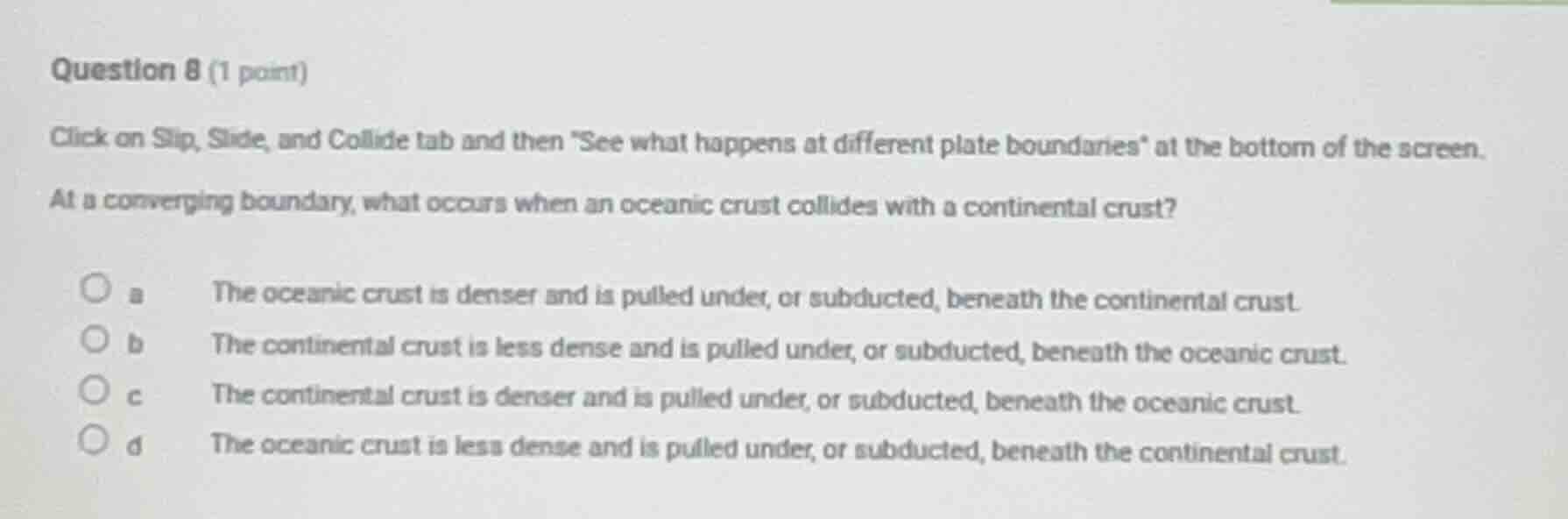
click on slip, slide, and collide tab and then \see what happens at different plate boundaries\ at the bottom of the screen.
at a converging boundary, what occurs when an oceanic crust collides with a continental crust?
a the oceanic crust is denser and is pulled under, or subducted, beneath the continental crust.
b the continental crust is less dense and is pulled under, or subducted, beneath the oceanic crust.
c the continental crust is denser and is pulled under, or subducted, beneath the oceanic crust.
d the oceanic crust is less dense and is pulled under, or subducted, beneath the continental crust.
To solve this, we recall the properties of oceanic and continental crusts. Oceanic crust is denser than continental crust. At a converging boundary, the denser crust (oceanic) subducts (is pulled under) the less - dense continental crust.
- Option a: States that oceanic crust is denser and subducts under continental crust. This matches the known geological facts.
- Option b: Continental crust is less dense, so it should not subduct under oceanic crust. This is incorrect.
- Option c: Continental crust is less dense than oceanic crust, so this statement about continental crust being denser is wrong.
- Option d: Oceanic crust is denser (not less dense) than continental crust, so this is incorrect.

Snap & solve any problem in the app
Get step-by-step solutions on Sovi AI
Photo-based solutions with guided steps
Explore more problems and detailed explanations
a. The oceanic crust is denser and is pulled under, or subducted, beneath the continental crust.