QUESTION IMAGE
Question
question 9 (1 point)
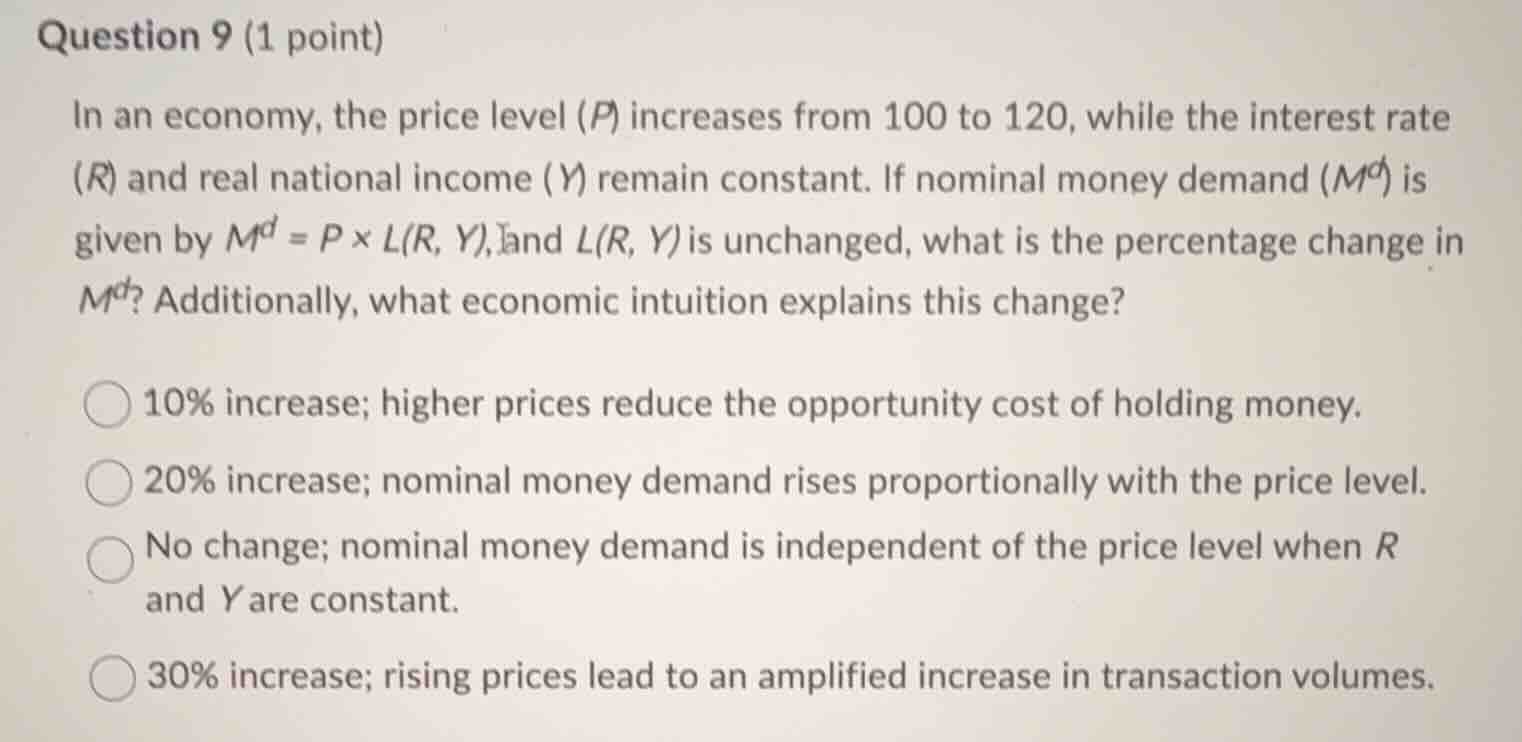
in an economy, the price level (p) increases from 100 to 120, while the interest rate (r) and real national income (y) remain constant. if nominal money demand (m^d) is given by m^d = p × l(r, y), and l(r, y) is unchanged, what is the percentage change in m^d? additionally, what economic intuition explains this change?
10% increase; higher prices reduce the opportunity cost of holding money.
20% increase; nominal money demand rises proportionally with the price level.
no change; nominal money demand is independent of the price level when r and y are constant.
30% increase; rising prices lead to an amplified increase in transaction volumes.
- First, recall the formula for nominal money demand: \( M^d = P \times L(R, Y) \). Here, \( L(R, Y) \) is unchanged (since \( R \) and \( Y \) are constant), and \( P \) increases from 100 to 120.
- Calculate the percentage change in \( P \): The initial \( P_1 = 100 \), final \( P_2 = 120 \). The percentage change in \( P \) is \( \frac{P_2 - P_1}{P_1} \times 100=\frac{120 - 100}{100}\times 100 = 20\% \).
- Since \( M^d = P \times L(R, Y) \) and \( L(R, Y) \) is constant, the change in \( M^d \) is proportional to the change in \( P \). So the percentage change in \( M^d \) is the same as the percentage change in \( P \), which is 20%.
- The economic intuition: Nominal money demand reflects the amount of money needed to conduct transactions at current prices. If prices rise (and real income/interest rate don't change), people need more nominal money to buy the same real quantity of goods/services, so nominal money demand rises proportionally with the price level.
Now, analyze the options:
- The first option's intuition is wrong (higher prices don't reduce the opportunity cost of holding money in this context, and the percentage change is incorrect).
- The second option has a 20% increase and the correct intuition about proportionality with price level.
- The third option is wrong as \( M^d \) depends on \( P \) here.
- The fourth option's percentage and intuition are incorrect (no amplified increase in transaction volumes as real income is constant).

Snap & solve any problem in the app
Get step-by-step solutions on Sovi AI
Photo-based solutions with guided steps
Explore more problems and detailed explanations
B. 20% increase; nominal money demand rises proportionally with the price level.