QUESTION IMAGE
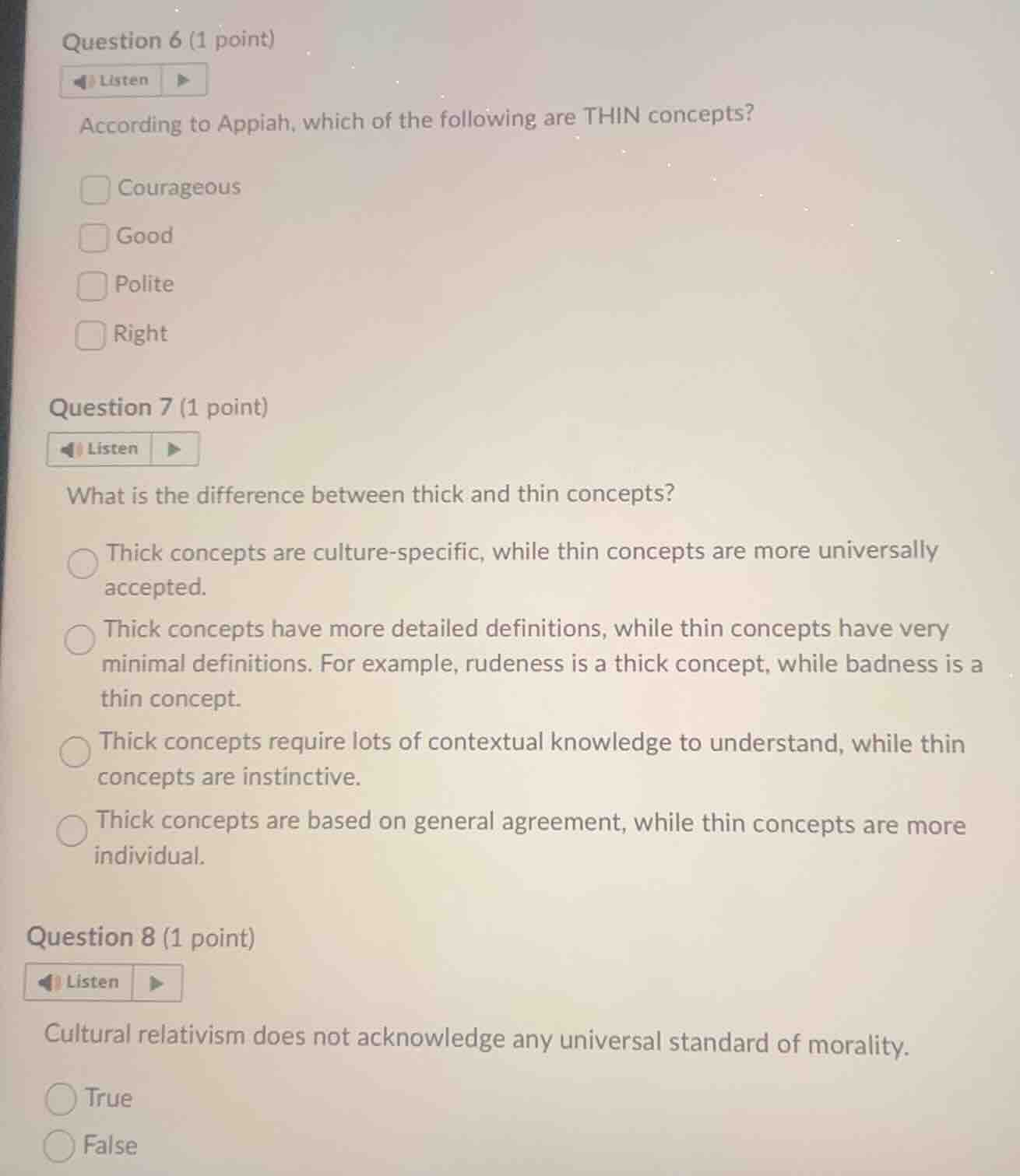
Question
question 6 (1 point)
listen
according to appiah, which of the following are thin concepts?
courageous
good
polite
right
question 7 (1 point)
listen
what is the difference between thick and thin concepts?
thick concepts are culture - specific, while thin concepts are more universally accepted.
thick concepts have more detailed definitions, while thin concepts have very minimal definitions. for example, rudeness is a thick concept, while badness is a thin concept.
thick concepts require lots of contextual knowledge to understand, while thin concepts are instinctive.
thick concepts are based on general agreement, while thin concepts are more individual.
question 8 (1 point)
listen
cultural relativism does not acknowledge any universal standard of morality.
true
false
Question 6
In philosophical theory (per Appiah), thin ethical concepts are abstract, general evaluative terms without specific descriptive content. "Good" and "Right" are core thin concepts, while "Courageous" and "Polite" are thick concepts (combining evaluation and specific description).
Question 7
Thick concepts blend evaluative and specific descriptive content (requiring context/nuance), while thin concepts are purely abstract evaluative terms with minimal, general definitions. The correct option clearly distinguishes them with a standard example.
Question 8
Cultural relativism is the view that moral standards are determined solely by individual cultures, so it rejects the existence of universal, cross-cultural moral standards.

Snap & solve any problem in the app
Get step-by-step solutions on Sovi AI
Photo-based solutions with guided steps
Explore more problems and detailed explanations
Question 6:
- Good
- Right
Question 7: Thick concepts have more detailed definitions, while thin concepts have very minimal definitions. For example, rudeness is a thick concept, while badness is a thin concept.
Question 8: True