QUESTION IMAGE
Question
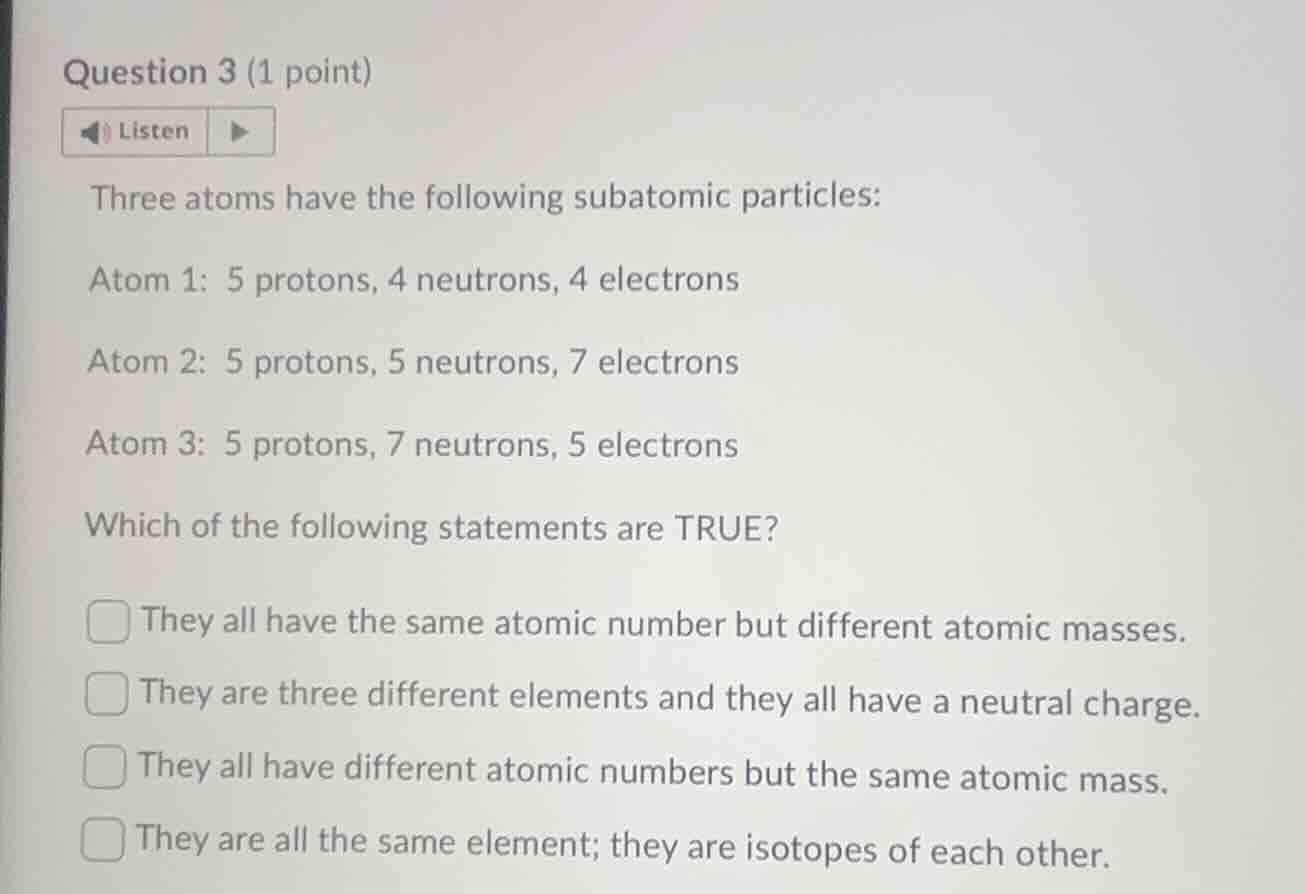
question 3 (1 point) listen three atoms have the following subatomic particles: atom 1: 5 protons, 4 neutrons, 4 electrons atom 2: 5 protons, 5 neutrons, 7 electrons atom 3: 5 protons, 7 neutrons, 5 electrons which of the following statements are true? they all have the same atomic number but different atomic masses. they are three different elements and they all have a neutral charge. they all have different atomic numbers but the same atomic mass. they are all the same element; they are isotopes of each other.
Step1: Identify atomic number
Atomic number = number of protons. All atoms have 5 protons, so atomic number = 5 for all.
Step2: Calculate atomic mass
Atomic mass ≈ protons + neutrons.
- Atom1: $5 + 4 = 9$
- Atom2: $5 + 5 = 10$
- Atom3: $5 + 7 = 12$
All have different atomic masses.
Step3: Check element identity
Same atomic number = same element. Isotopes are same element with different neutron counts (different masses).
Step4: Analyze charge
Charge = protons - electrons.
- Atom1: $5 - 4 = +1$ (positive)
- Atom2: $5 - 7 = -2$ (negative)
- Atom3: $5 - 5 = 0$ (neutral)
Not all neutral.

Snap & solve any problem in the app
Get step-by-step solutions on Sovi AI
Photo-based solutions with guided steps
Explore more problems and detailed explanations
- They all have the same atomic number but different atomic masses.
- They are all the same element; they are isotopes of each other.