QUESTION IMAGE
Question
question 2 · 1 point
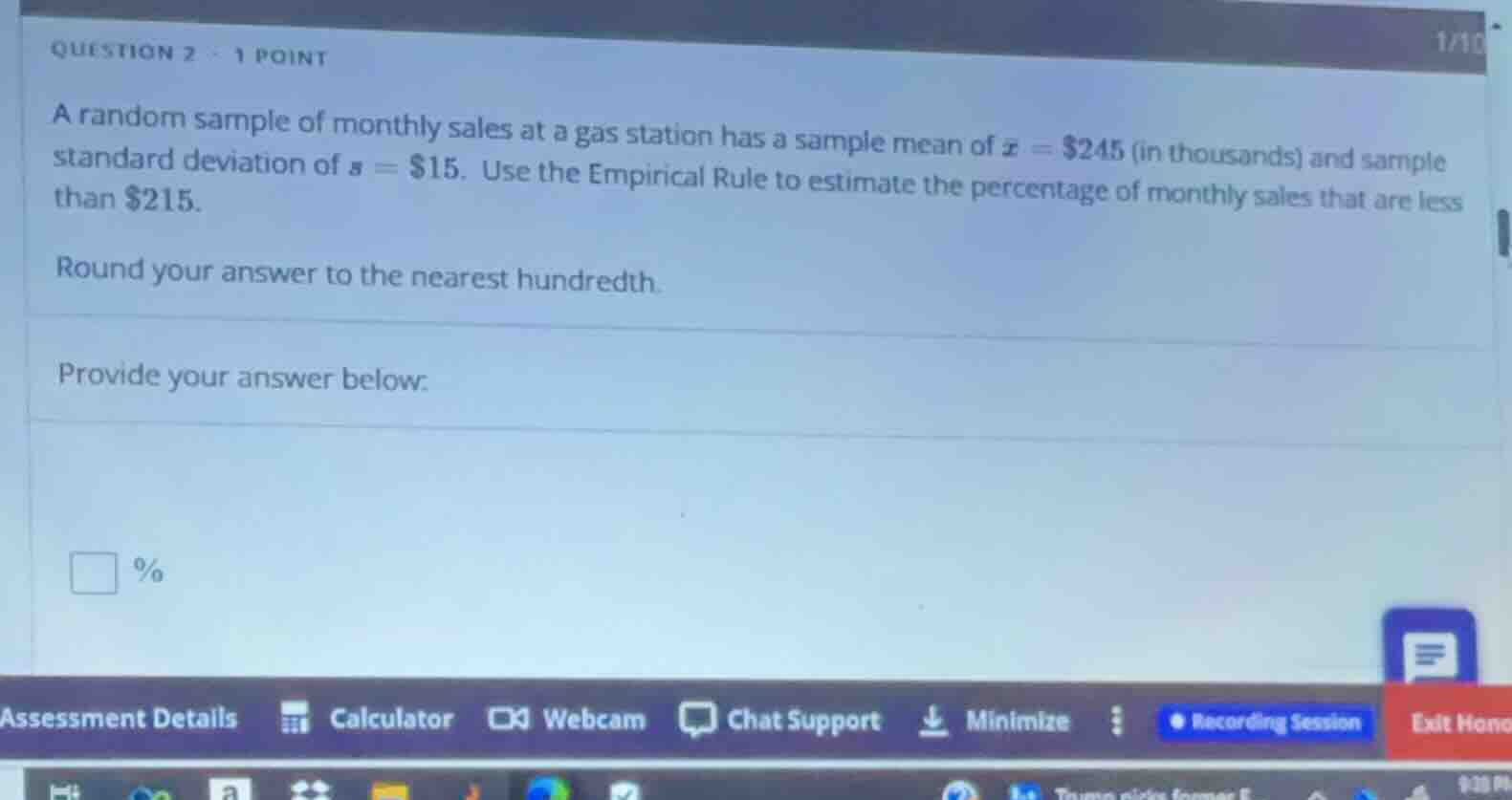
a random sample of monthly sales at a gas station has a sample mean of ( \bar{x} = $245 ) (in thousands) and sample standard deviation of ( s = $15 ). use the empirical rule to estimate the percentage of monthly sales that are less than $215.
round your answer to the nearest hundredth.
provide your answer below:
( square %)
Step1: Identify the number of standard deviations
First, we calculate how many standard deviations away $215$ is from the mean $\bar{x} = 245$. The formula for the number of standard deviations $z$ is $z=\frac{x - \bar{x}}{s}$. Here, $x = 215$, $\bar{x}=245$, and $s = 15$. So, $z=\frac{215 - 245}{15}=\frac{- 30}{15}=- 2$. This means $215$ is $2$ standard deviations below the mean.
Step2: Apply the Empirical Rule
The Empirical Rule states that for a normal distribution:
- Approximately $68\%$ of the data lies within $1$ standard deviation of the mean.
- Approximately $95\%$ of the data lies within $2$ standard deviations of the mean.
- Approximately $99.7\%$ of the data lies within $3$ standard deviations of the mean.
The total percentage of data below the mean is $50\%$ (since the normal distribution is symmetric about the mean). The percentage of data between $\bar{x}-2s$ and $\bar{x}+2s$ is $95\%$, so the percentage of data below $\bar{x}-2s$ (which is $215$ here) is $\frac{100\% - 95\%}{2}=2.5\%$.

Snap & solve any problem in the app
Get step-by-step solutions on Sovi AI
Photo-based solutions with guided steps
Explore more problems and detailed explanations
$2.50\%$