QUESTION IMAGE
Question
question 8 (1 point)
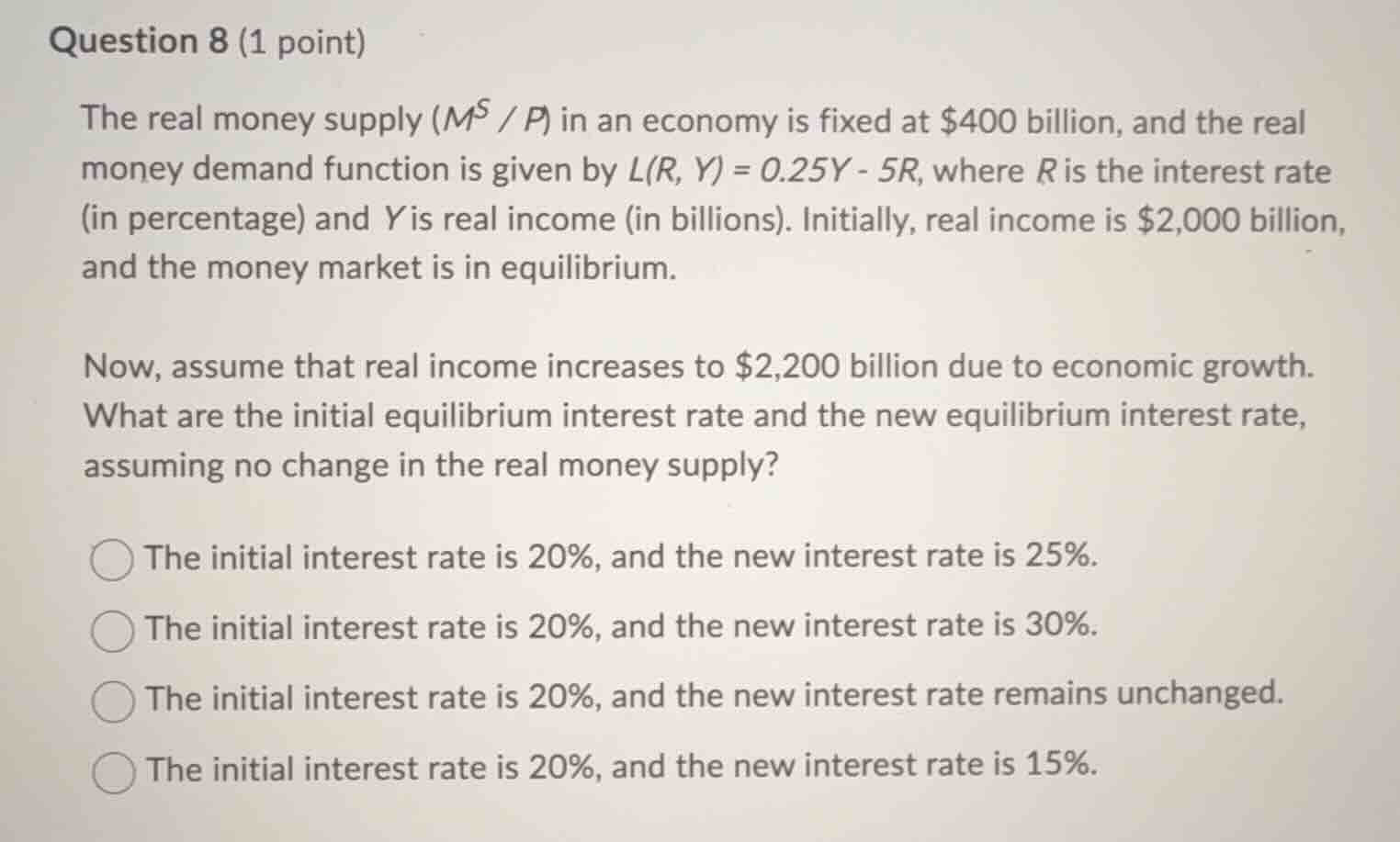
the real money supply ($m^s / p$) in an economy is fixed at $400 billion, and the real money demand function is given by $l(r, y) = 0.25y - 5r$, where $r$ is the interest rate (in percentage) and $y$ is real income (in billions). initially, real income is $2,000 billion, and the money market is in equilibrium.
now, assume that real income increases to $2,200 billion due to economic growth. what are the initial equilibrium interest rate and the new equilibrium interest rate, assuming no change in the real money supply?
the initial interest rate is 20%, and the new interest rate is 25%.
the initial interest rate is 20%, and the new interest rate is 30%.
the initial interest rate is 20%, and the new interest rate remains unchanged.
the initial interest rate is 20%, and the new interest rate is 15%.
Step1: Find Initial Equilibrium Interest Rate
In money market equilibrium, real money supply equals real money demand, so \( \frac{M^S}{P}=L(R,Y) \). Given \( \frac{M^S}{P} = 400 \), \( Y = 2000 \), and \( L(R,Y)=0.25Y - 5R \). Substitute values:
\( 400 = 0.25\times2000 - 5R \)
\( 400 = 500 - 5R \)
Solve for \( R \):
\( 5R = 500 - 400 \)
\( 5R = 100 \)
\( R=\frac{100}{5}=20 \) (percent).
Step2: Find New Equilibrium Interest Rate
Now \( Y = 2200 \), \( \frac{M^S}{P} = 400 \). Substitute into \( \frac{M^S}{P}=L(R,Y) \):
\( 400 = 0.25\times2200 - 5R \)
\( 400 = 550 - 5R \)
Solve for \( R \):
\( 5R = 550 - 400 \)
\( 5R = 150 \)
\( R=\frac{150}{5}=30 \) (percent).

Snap & solve any problem in the app
Get step-by-step solutions on Sovi AI
Photo-based solutions with guided steps
Explore more problems and detailed explanations
The initial interest rate is 20%, and the new interest rate is 30%. (Corresponding to the option: The initial interest rate is 20%, and the new interest rate is 30%.)