QUESTION IMAGE
Question
question 4 (1 point)
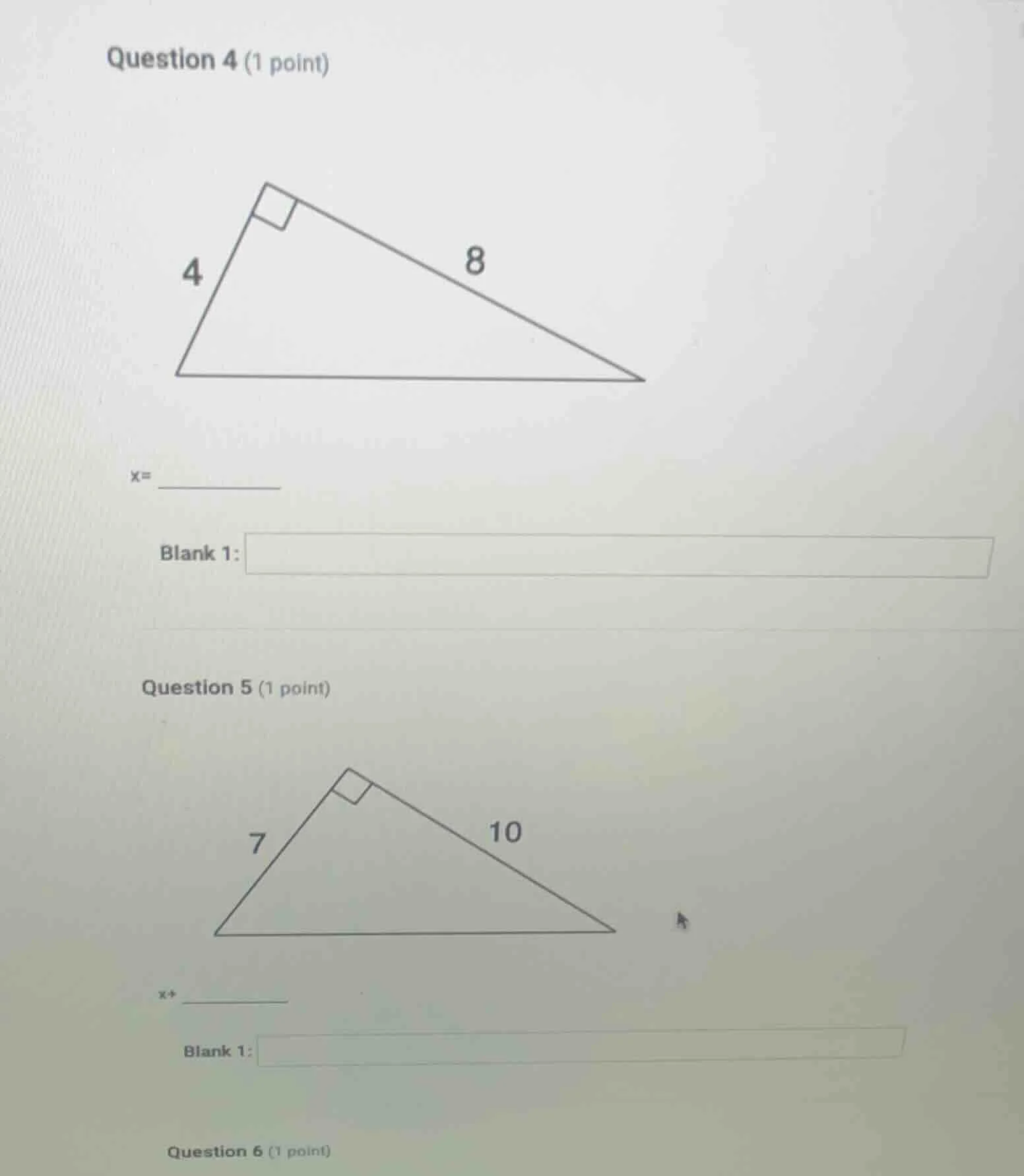
right triangle with legs 4 and 8, hypotenuse x
x=
blank 1:
question 5 (1 point)
right triangle with legs 7 and 10, hypotenuse x
x=
blank 1:
question 6 (1 point)
Question 4
Step1: Identify triangle type (right triangle)
This is a right triangle, so we use the Pythagorean theorem: \(a^2 + b^2 = c^2\), where \(a = 4\), \(b = 8\), and \(c = x\) (hypotenuse).
Step2: Apply Pythagorean theorem
Substitute values: \(4^2 + 8^2 = x^2\)
Calculate: \(16 + 64 = x^2\)
Simplify: \(80 = x^2\)
Take square root: \(x = \sqrt{80} = 4\sqrt{5} \approx 8.94\) (or exact form \(4\sqrt{5}\))
Step1: Identify triangle type (right triangle)
Right triangle, use Pythagorean theorem: \(a^2 + b^2 = c^2\), with \(a = 7\), \(b = 10\), \(c = x\) (hypotenuse).
Step2: Apply Pythagorean theorem
Substitute: \(7^2 + 10^2 = x^2\)
Calculate: \(49 + 100 = x^2\)
Simplify: \(149 = x^2\)
Take square root: \(x = \sqrt{149} \approx 12.21\) (or exact form \(\sqrt{149}\))

Snap & solve any problem in the app
Get step-by-step solutions on Sovi AI
Photo-based solutions with guided steps
Explore more problems and detailed explanations
\(4\sqrt{5}\) (or approximately \(8.94\))