QUESTION IMAGE
Question
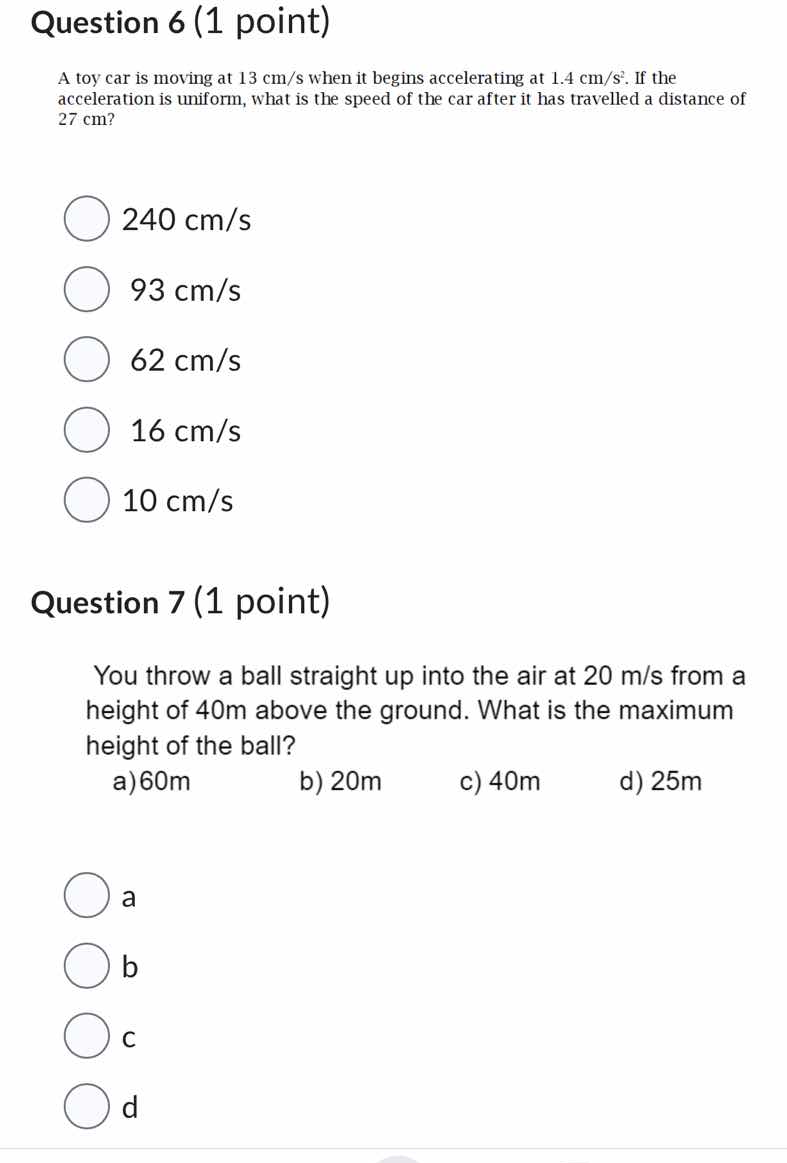
question 6 (1 point)
a toy car is moving at 13 cm/s when it begins accelerating at 1.4 cm/s². if the acceleration is uniform, what is the speed of the car after it has travelled a distance of 27 cm?
240 cm/s
93 cm/s
62 cm/s
16 cm/s
10 cm/s
question 7 (1 point)
you throw a ball straight up into the air at 20 m/s from a height of 40m above the ground. what is the maximum height of the ball?
a)60m b) 20m c) 40m d) 25m
a
b
c
d
(Question 6):
Step1: Select kinematic equation
We use the equation $v^2 = u^2 + 2as$, where $u$ is initial speed, $a$ is acceleration, $s$ is distance, $v$ is final speed.
Step2: Plug in given values
$u=13\ \text{cm/s}$, $a=1.4\ \text{cm/s}^2$, $s=27\ \text{cm}$
$v^2 = 13^2 + 2\times1.4\times27$
Step3: Calculate each term
$13^2=169$, $2\times1.4\times27=75.6$
$v^2 = 169 + 75.6 = 244.6$
Step4: Solve for final speed
$v = \sqrt{244.6} \approx 16\ \text{cm/s}$
(Question 7):
Step1: Select kinematic equation
Use $v^2 = u^2 - 2gh$ for upward motion, where $v=0$ at max height, $u=20\ \text{m/s}$, $g=10\ \text{m/s}^2$, $h$ is height gained.
Step2: Solve for height gained
$0 = 20^2 - 2\times10\times h$
$20h = 400$
$h = 20\ \text{m}$
Step3: Add initial height
Total max height = $40 + 20 = 60\ \text{m}$

Snap & solve any problem in the app
Get step-by-step solutions on Sovi AI
Photo-based solutions with guided steps
Explore more problems and detailed explanations
Question 6: 16 cm/s
Question 7: a)60m