QUESTION IMAGE
Question
question 3 (1 point)
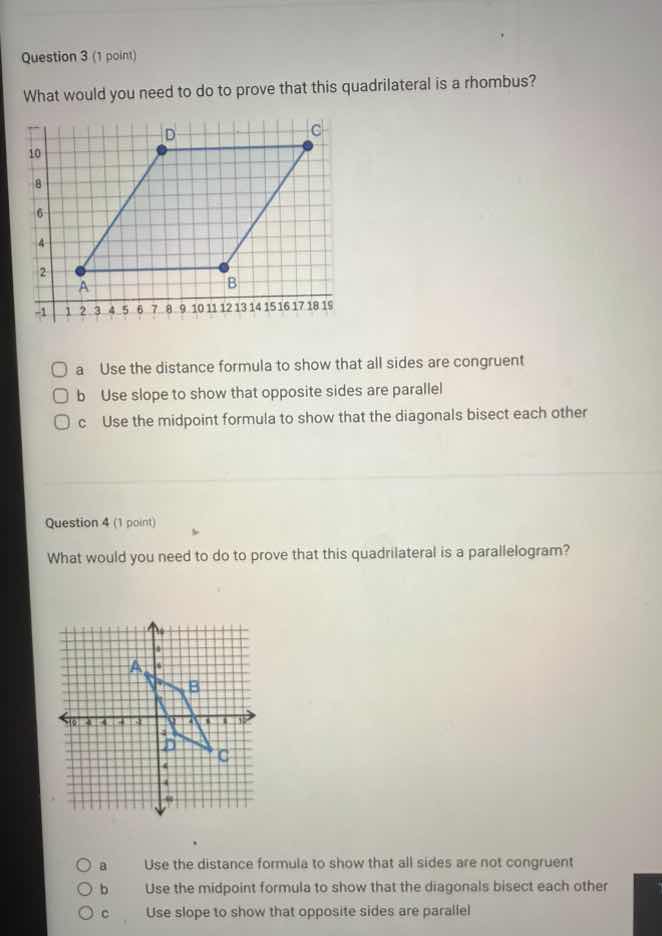
what would you need to do to prove that this quadrilateral is a rhombus?
image of a quadrilateral on a coordinate grid with points a, b, c, d
options:
○ a use the distance formula to show that all sides are congruent
○ b use slope to show that opposite sides are parallel
○ c use the midpoint formula to show that the diagonals bisect each other
question 4 (1 point)
what would you need to do to prove that this quadrilateral is a parallelogram?
image of a quadrilateral on a coordinate grid with points a, b, c, d
options:
○ a use the distance formula to show that all sides are not congruent
○ b use the midpoint formula to show that the diagonals bisect each other
○ c use slope to show that opposite sides are parallel
Question 3
A rhombus is defined as a quadrilateral with all four sides congruent. To prove a quadrilateral is a rhombus, we can use the distance formula to calculate the lengths of all sides and show they are equal. Option b would prove it's a parallelogram (opposite sides parallel), and option c would also prove it's a parallelogram (diagonals bisect each other), but to specifically prove it's a rhombus, we need to show all sides are congruent.
A parallelogram is defined as a quadrilateral with opposite sides parallel. Using the slope formula, we can find the slopes of opposite sides. If the slopes are equal, the sides are parallel. Option a is incorrect (we don't need to show sides are not congruent), and option b proves it's a parallelogram but is more about diagonals; the most direct way to prove opposite sides are parallel (a key property of parallelograms) is using slope to check parallelism.

Snap & solve any problem in the app
Get step-by-step solutions on Sovi AI
Photo-based solutions with guided steps
Explore more problems and detailed explanations
a. Use the distance formula to show that all sides are congruent