QUESTION IMAGE
Question
question 9 (8 points)
progress build two: how do rocks change?
fill in the blanks below with answers from the word bank.
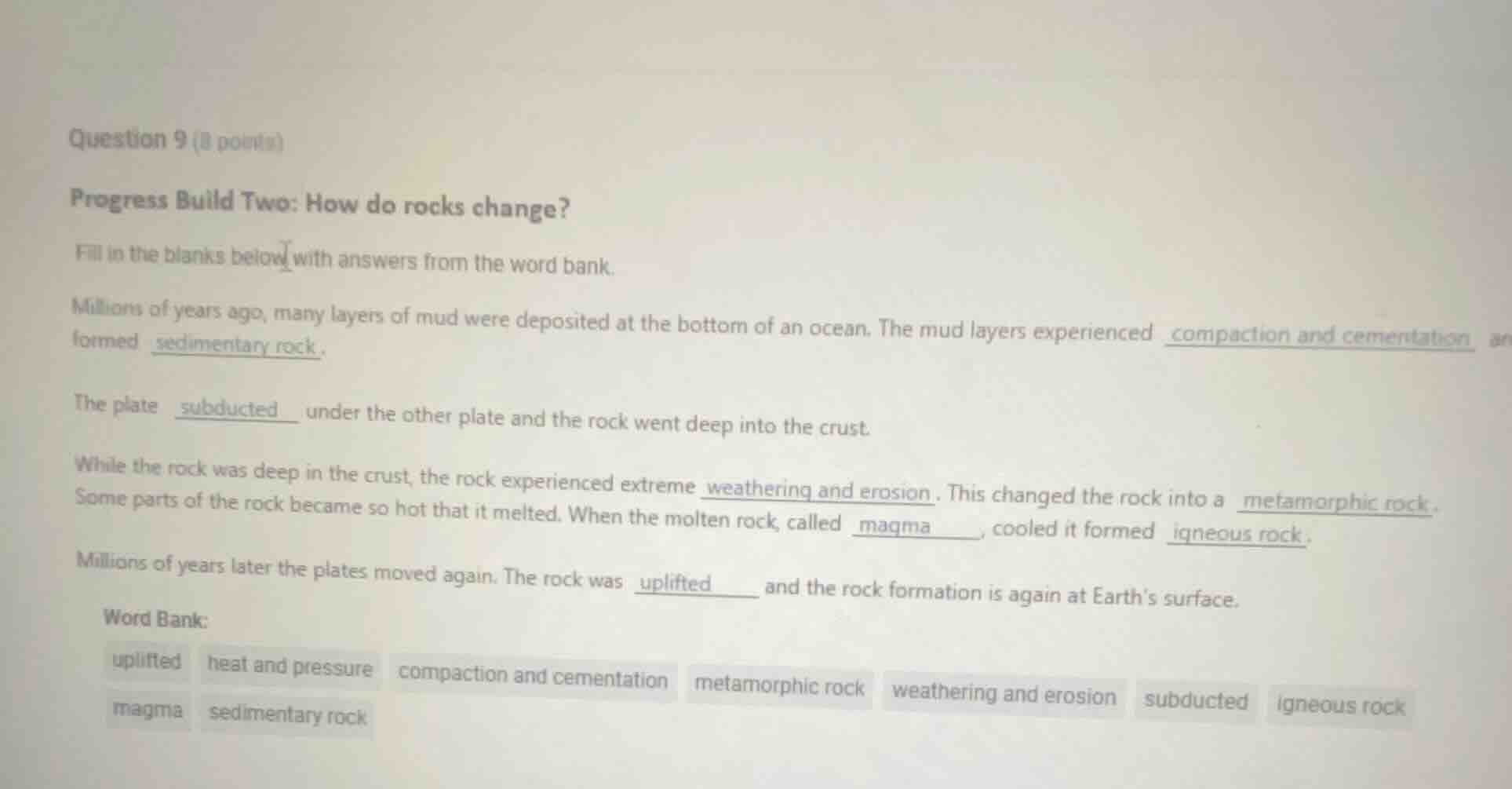
millions of years ago, many layers of mud were deposited at the bottom of an ocean. the mud layers experienced compaction and cementation an formed sedimentary rock.
the plate subducted under the other plate and the rock went deep into the crust.
while the rock was deep in the crust, the rock experienced extreme weathering and erosion. this changed the rock into a metamorphic rock.
some parts of the rock became so hot that it melted. when the molten rock, called magma, cooled it formed igneous rock.
millions of years later the plates moved again. the rock was uplifted and the rock formation is again at earth’s surface.
word bank:
uplifted heat and pressure compaction and cementation metamorphic rock weathering and erosion subducted igneous rock
magma sedimentary rock
To solve this fill - in - the - blank problem about rock change, we analyze each blank according to the knowledge of the rock cycle:
1. First blank (after "The mud layers experienced")
The process of forming sedimentary rock from mud layers (sediments) is compaction and cementation. So we fill in "compaction and cementation".
2. Second blank (after "formed")
After compaction and cementation of mud layers, sedimentary rock is formed. So we fill in "sedimentary rock".
3. Third blank (after "The plate")
When one tectonic plate moves under another, the process is called subduction. So we fill in "subducted".
4. Fourth blank (after "the rock experienced extreme")
When a rock is deep in the crust, the main factors that change it into metamorphic rock are heat and pressure. So we fill in "heat and pressure".
5. Fifth blank (after "changed the rock into a")
Under heat and pressure, a rock will be transformed into metamorphic rock. So we fill in "metamorphic rock".
6. Sixth blank (after "called")
Molten rock within the Earth's crust is called magma. So we fill in "magma".
7. Seventh blank (after "cooled it formed")
When magma cools, it forms igneous rock. So we fill in "igneous rock".
8. Eighth blank (after "The rock was")
When the plates move and the rock is brought back to the Earth's surface from deep within the crust, the process is called uplift. So we fill in "uplifted".
The filled - in blanks are as follows:
- compaction and cementation
- sedimentary rock
- subducted
- heat and pressure
- metamorphic rock
- magma
- igneous rock
- uplifted

Snap & solve any problem in the app
Get step-by-step solutions on Sovi AI
Photo-based solutions with guided steps
Explore more problems and detailed explanations
To solve this fill - in - the - blank problem about rock change, we analyze each blank according to the knowledge of the rock cycle:
1. First blank (after "The mud layers experienced")
The process of forming sedimentary rock from mud layers (sediments) is compaction and cementation. So we fill in "compaction and cementation".
2. Second blank (after "formed")
After compaction and cementation of mud layers, sedimentary rock is formed. So we fill in "sedimentary rock".
3. Third blank (after "The plate")
When one tectonic plate moves under another, the process is called subduction. So we fill in "subducted".
4. Fourth blank (after "the rock experienced extreme")
When a rock is deep in the crust, the main factors that change it into metamorphic rock are heat and pressure. So we fill in "heat and pressure".
5. Fifth blank (after "changed the rock into a")
Under heat and pressure, a rock will be transformed into metamorphic rock. So we fill in "metamorphic rock".
6. Sixth blank (after "called")
Molten rock within the Earth's crust is called magma. So we fill in "magma".
7. Seventh blank (after "cooled it formed")
When magma cools, it forms igneous rock. So we fill in "igneous rock".
8. Eighth blank (after "The rock was")
When the plates move and the rock is brought back to the Earth's surface from deep within the crust, the process is called uplift. So we fill in "uplifted".
The filled - in blanks are as follows:
- compaction and cementation
- sedimentary rock
- subducted
- heat and pressure
- metamorphic rock
- magma
- igneous rock
- uplifted