QUESTION IMAGE
Question
question
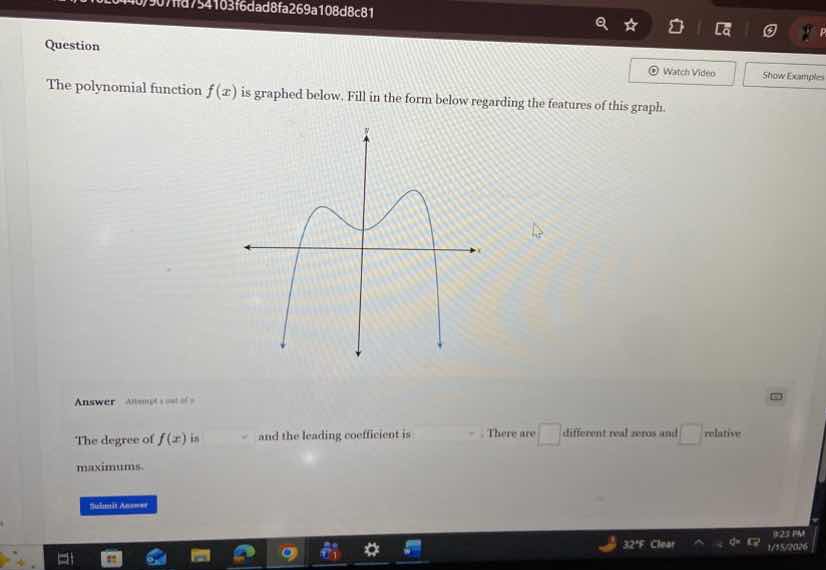
the polynomial function f(x) is graphed below. fill in the form below regarding the features of this graph.
graph of a polynomial function
answer
the degree of f(x) is and the leading coefficient is . there are different real zeros and relative maximums.
Step1: Determine the degree of the polynomial
The end - behavior of a polynomial is determined by the degree (even or odd) and the leading coefficient (positive or negative). For a polynomial, if the ends of the graph go in the same direction (both up or both down), the degree is even. Here, as \(x\to+\infty\) and \(x\to-\infty\), the graph goes down (since the ends point downwards). So the degree is even. Also, the number of turning points (relative maxima and minima) is related to the degree. The number of turning points of a polynomial of degree \(n\) is at most \(n - 1\). Looking at the graph, we can see that there are 3 turning points (2 minima and 1 maximum? Wait, no, let's count again. The graph has two "hills" and one "valley"? Wait, the graph as shown: let's see the shape. From the left, it comes up, has a peak, then a valley, then a peak, then goes down. Wait, no, the end - behavior: as \(x\to-\infty\), the graph goes down, then it rises to a local maximum, then falls to a local minimum, then rises to a local maximum, then falls as \(x\to+\infty\). So the number of turning points (local maxima and minima) is 3. So if the number of turning points is \(n - 1\), then \(n-1 = 3\), so \(n=4\)? Wait, no, wait. Wait, the degree of a polynomial is the highest power of \(x\) in the polynomial. The end - behavior: for even degree, if the leading coefficient is negative, the ends go down (since for \(y = ax^{n}\), when \(n\) is even, if \(a<0\), as \(x\to\pm\infty\), \(y\to-\infty\)). So the degree is even. Let's count the number of real zeros. The graph intersects the \(x\) - axis at 2 points? Wait, the graph crosses the \(x\) - axis at two points? Wait, no, looking at the graph, the left part comes from below, crosses the \(x\) - axis, then has a peak, then a valley (which is on the \(y\) - axis? Wait, the graph is symmetric about the \(y\) - axis? Wait, the vertex (the valley) is on the \(y\) - axis. So the graph intersects the \(x\) - axis at two points (left and right of the \(y\) - axis). Wait, no, maybe it's tangent? No, the graph crosses the \(x\) - axis at two distinct points? Wait, no, let's re - examine. The graph: as \(x\to-\infty\), \(y\to-\infty\), then it rises, crosses the \(x\) - axis, reaches a local maximum, then falls, touches the \(y\) - axis (the minimum point is on the \(y\) - axis), then rises again, crosses the \(x\) - axis, then falls as \(x\to+\infty\). Wait, so it crosses the \(x\) - axis at two points? No, that would be two real zeros? Wait, no, maybe the minimum on the \(y\) - axis is above the \(x\) - axis? No, the graph as shown: the middle minimum (the valley) is on the \(y\) - axis, and the graph is below the \(x\) - axis on the ends. Wait, no, the ends are going down, so as \(x\to\pm\infty\), \(y\to-\infty\). The graph has a local maximum on the left, a local minimum on the \(y\) - axis, and a local maximum on the right. So the number of turning points (local maxima and minima) is 3 (2 maxima and 1 minimum). For a polynomial, the number of turning points is at most \(n - 1\), so if there are 3 turning points, \(n-1\geq3\), so \(n\geq4\). Since the end - behavior is even (both ends down), the degree is even. Let's assume the degree is 4 (quartic). The leading coefficient: since the ends go down (as \(x\to\pm\infty\), \(y\to-\infty\)) and the degree is even, the leading coefficient is negative. Now, the number of real zeros: the graph intersects the \(x\) - axis at 2 points? Wait, no, maybe it's 2? Wait, no, let's see: the graph comes from below (\(x\to-\infty\), \(y\to-\infty\)), rises, crosses the…

Snap & solve any problem in the app
Get step-by-step solutions on Sovi AI
Photo-based solutions with guided steps
Explore more problems and detailed explanations
The degree of \(f(x)\) is \(\boldsymbol{4}\) and the leading coefficient is \(\boldsymbol{\text{negative}}\). There are \(\boldsymbol{2}\) different real zeros and \(\boldsymbol{2}\) relative maximums.