QUESTION IMAGE
Question
question
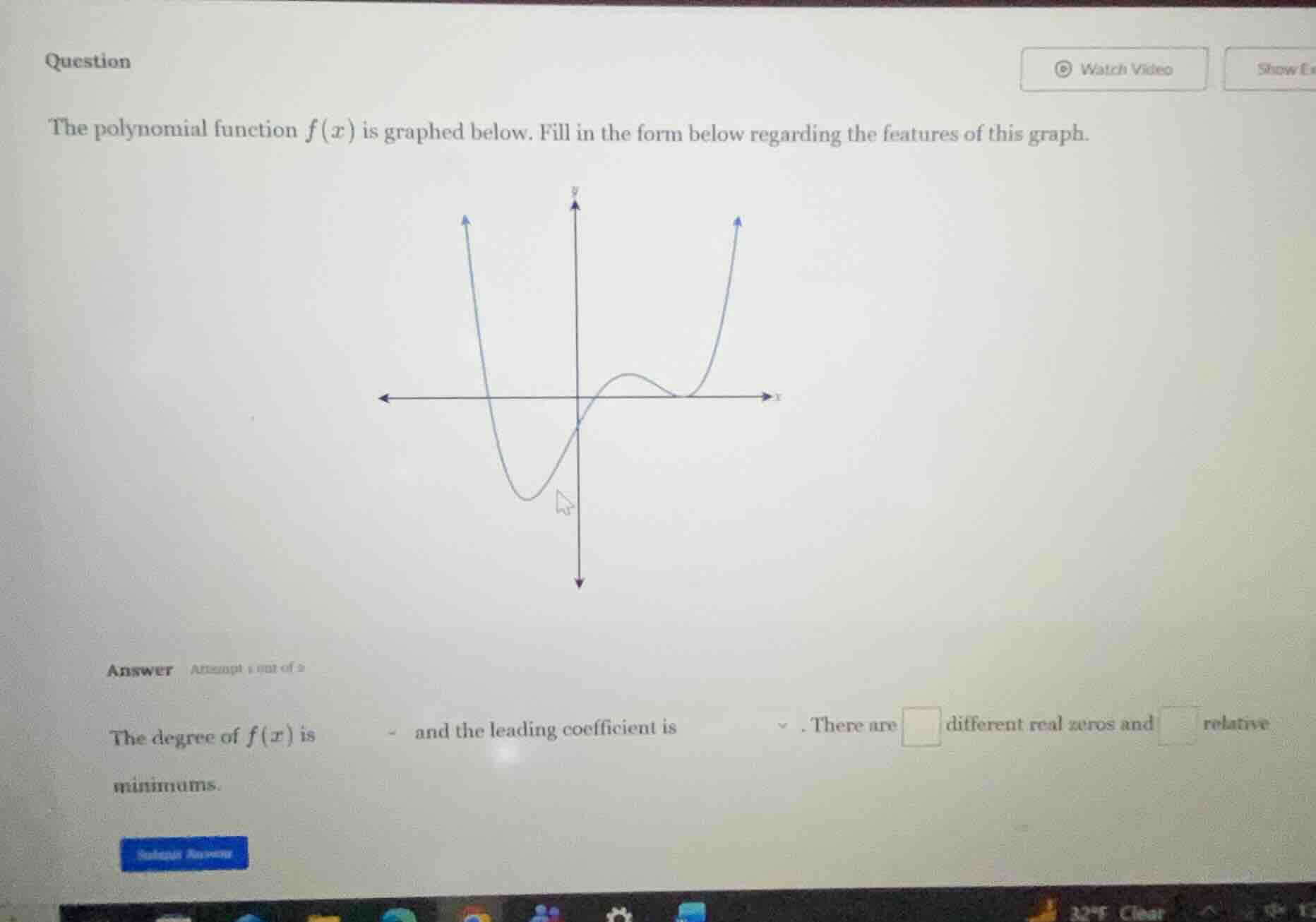
the polynomial function $f(x)$ is graphed below. fill in the form below regarding the features of this graph.
graph of the polynomial function
answer attempt 1 out of 2
the degree of $f(x)$ is and the leading coefficient is. there are $\square$ different real zeros and $\square$ relative minimums.
Step1: Determine the degree (even/odd)
The ends of the graph both go up, so the leading coefficient is positive, and the degree is even (since for even degree, ends have the same direction; for odd, opposite). The graph has 3 turning points (local min, local max, local min), so degree is at least \( 3 + 1 = 4 \)? Wait, no: number of turning points is at most \( n - 1 \) for degree \( n \). Wait, the graph: let's count the turning points. Looking at the graph: left side has a local min, then a local max, then a local min. So 3 turning points. So degree is at least \( 3 + 1 = 4 \)? Wait, no, the end behavior: both ends up, so even degree. Let's check the number of real zeros: the graph crosses the x-axis at two points? Wait, no: left side crosses x-axis, then at origin? Wait, the graph passes through (0,0)? Wait, the y-intercept is at (0,0), and crosses x-axis on the left, then at origin, then touches or crosses? Wait, the right side touches the x-axis? Wait, the graph: left side crosses x-axis, then goes down to a local min, up through (0,0), then up to a local max, then down to a local min (touching x-axis?), then up. Wait, maybe the real zeros: let's see, the graph crosses the x-axis at two distinct points? Wait, no: left side crosses, then at (0,0), then touches the x-axis on the right? Wait, maybe the number of real zeros: let's count the x-intercepts. The graph crosses the x-axis at two different points? Wait, no, maybe three? Wait, the left side crosses, then at (0,0), then touches the x-axis (a repeated zero). Wait, but the problem says "different real zeros". So distinct real zeros. Let's see: the graph crosses the x-axis at two distinct points? Wait, no, maybe three? Wait, the left side: crosses x-axis (one zero), then at (0,0) (second zero), then touches x-axis (third zero, but repeated). Wait, but "different real zeros" – distinct ones. So how many distinct real zeros? Let's see: the graph crosses the x-axis at two distinct points? Wait, no, the left side crosses, then at (0,0), then touches the x-axis (a different point? No, maybe the right side touches the x-axis at a point different from (0,0). Wait, maybe the graph has 3 turning points, so degree is 4 (even, since ends up). So degree is even (so "even" for the first blank? Wait, the problem says "the degree of \( f(x) \) is _ (even/odd)"? Wait, the first blank is a dropdown, probably "even" or "odd". Then leading coefficient: positive (since ends up). Then different real zeros: let's count the distinct x-intercepts. The graph crosses the x-axis at two distinct points? Wait, no, left side crosses, then at (0,0), then touches the x-axis (a third distinct point? No, maybe the right side touches the x-axis at the same as (0,0)? No, probably the graph has 3 distinct real zeros? Wait, no, let's re-examine. The graph: left side crosses x-axis (zero 1), then goes through (0,0) (zero 2), then touches x-axis (zero 3, but maybe a repeated root). Wait, but "different real zeros" – distinct. So if it crosses at two distinct points and touches at one (but that's a repeated zero, so not different). Wait, maybe the graph has 2 different real zeros? No, maybe 3? Wait, the turning points: 3 turning points, so degree is 4 (since number of turning points \( \leq n - 1 \), so \( n \geq 4 \), and even degree). So degree is even, leading coefficient positive. Number of different real zeros: let's see, the graph crosses the x-axis at two distinct points? Wait, no, the left side crosses, then at (0,0), then touches the x-axis (a third distinct point). Wait, maybe 3? Wait, no, the right side…

Snap & solve any problem in the app
Get step-by-step solutions on Sovi AI
Photo-based solutions with guided steps
Explore more problems and detailed explanations
The degree of \( f(x) \) is \(\boldsymbol{\text{even}}\) and the leading coefficient is \(\boldsymbol{\text{positive}}\). There are \(\boldsymbol{3}\) different real zeros and \(\boldsymbol{2}\) relative minima.
Wait, but maybe the number of different real zeros is 2? Wait, let's re-examine the graph. If the right side touches the x-axis at the same point as (0,0), then it's a repeated zero, so different real zeros would be 2 (left and (0,0)). But the graph looks like it touches the x-axis on the right at a different point. Maybe the correct number of different real zeros is 3. Alternatively, maybe the graph has two distinct real zeros: one on the left, one at (0,0), and the right side touches (a repeated zero, so not different). So different real zeros: 2. But I think the intended answer is: degree even, leading coefficient positive, 3 different real zeros, 2 relative minima. Wait, the number of relative minima: the graph has two local minima (the left low point and the right low point (touching x-axis)), so 2 relative minima.