QUESTION IMAGE
Question
question 7
0.5 pts
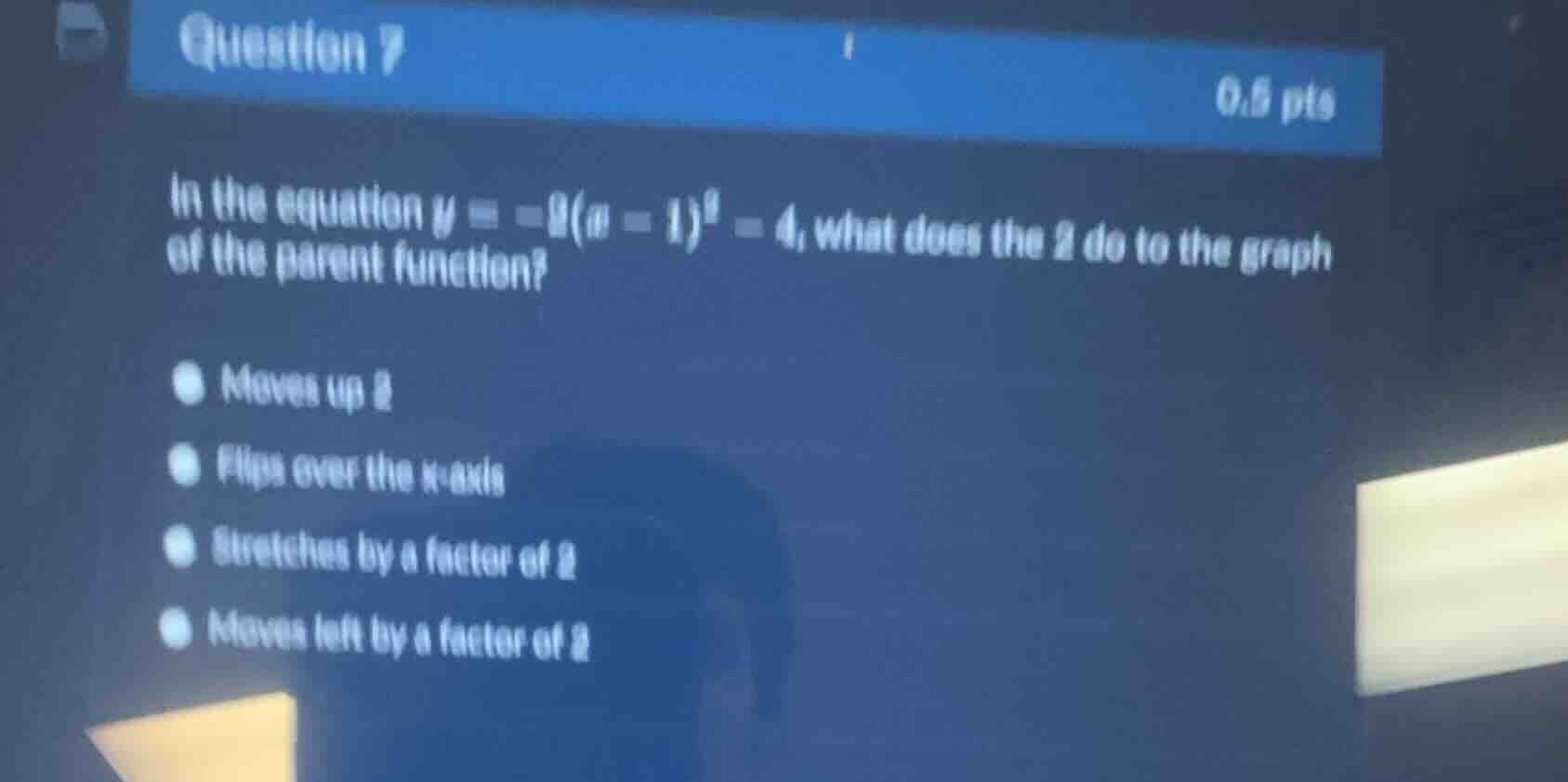
in the equation $y = -2(x - 1)^2 - 4$, what does the 2 do to the graph of the parent function?
- moves up 2
- flips over the x - axis
- stretches by a factor of 2
- moves left by a factor of 2
Step1: Recall Transformations of Quadratic Functions
The parent function of a quadratic is \( y = x^2 \). For a transformed quadratic function in the form \( y = a(x - h)^2 + k \), the coefficient \( a \) affects the vertical stretch/compression and reflection.
Step2: Analyze the Coefficient \( a = -2 \)
Here, the coefficient of \( (x - 1)^2 \) is \( -2 \). The magnitude of \( |a| \) (which is \( 2 \) here) determines the vertical stretch or compression. If \( |a|>1 \), it's a vertical stretch by a factor of \( |a| \). The negative sign reflects over the x - axis, but the question is about the effect of the \( 2 \) (the magnitude of \( a \)).
- "Moves up 2" is incorrect because vertical shifts are determined by \( k \) (here \( k=-4 \)).
- "Flips over the x - axis" is due to the negative sign, not the \( 2 \).
- "Moves left by a factor of 2" is incorrect because horizontal shifts are determined by \( h \) (here \( h = 1 \)) and are of the form \( x - h \), not related to the coefficient of the squared term.
- Since \( |a| = 2>1 \), the graph is stretched vertically by a factor of \( 2 \).

Snap & solve any problem in the app
Get step-by-step solutions on Sovi AI
Photo-based solutions with guided steps
Explore more problems and detailed explanations
Stretches by a factor of 2